
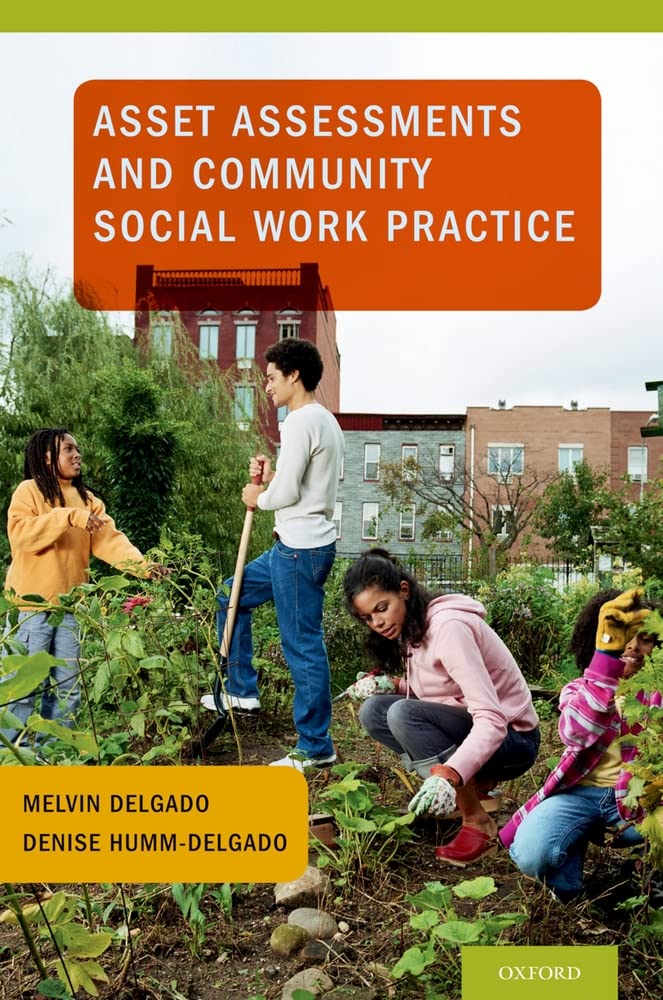
Title
Asset Assessments and Community Social Work Practice,Used
Sold by Ergodebooks, an authorized reseller.
Returns accepted within 30 days | support@ergodebooks.com
Shipping Information
- Free Standard Shipping — United States only
- Processing Time: 3–5 business days
- Estimated Delivery: 6–10 business days after dispatch
- Double-boxed, fully insured & discreetly packaged
- Tracking number sent via email once dispatched
Returns & Refund
Returns accepted within 30 days of delivery.
Damaged or Defective Item
Free return shipping + replacement or full refund
Wrong Item Received
Free return shipping + replacement or full refund
Change of Mind
Return shipping at customer's expense · 25% restocking fee applies
Payment Option

The role and importance of assessment in development of health and social services are well accepted in the field, and represent the fundamental building blocks for the creation of any form of social intervention. Need assessments are, without question, the most common form of assessment in these fields. They typically, however, result in a rather narrow view of a community that stresses disease risk profiles and lists of various social problem categories. Nevertheless, unlike needs assessments, asset assessments bring a range of factors and considerations to the creation of an intervention that are guided by participatory democratic principles and processes. Although need assessments can also be guided by participatory principles, they generally are professionallydriven and do not stress capacity enhancement in the process. Asset assessments' emphasis on participatory democracy sufficiently distance themselves from their needs counterpart through the use of values, language used to communicate, and how research methods get conceptualized and carried out. Community asset assessments can be viewed as a goal; a strategy; a set of guiding principles; a method; and a process. These different perspectives make a consensus definition of a capital difficult to arrive at in both scholarly and practice realms. Consequently, it is best to view asset assessments from an evolutionary point of view in order to appreciate the variety of perspectives, tensions, and potential for achieving positive social change. In essence asset assessments are both an instrument of discovery as well as an intervention to achieve community change.
⚠️ WARNING (California Proposition 65):
This product may contain chemicals known to the State of California to cause cancer, birth defects, or other reproductive harm.
For more information, please visit www.P65Warnings.ca.gov.