
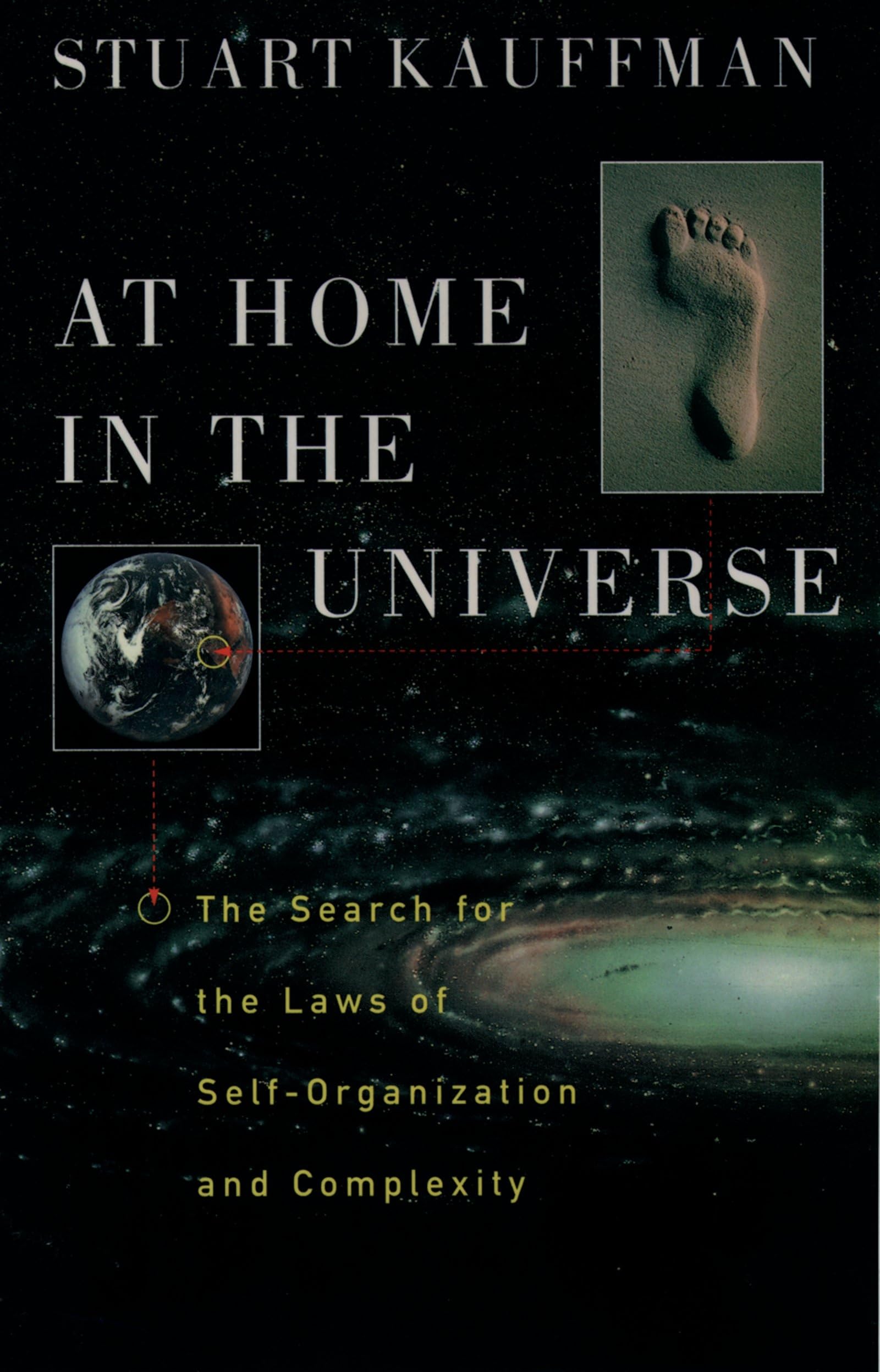
Title
At Home In The Universe: The Search For The Laws Of Selforganization And Complexity,New
Sold by Ergodebooks, an authorized reseller.
Returns accepted within 30 days | support@ergodebooks.com
Shipping Information
- Free Standard Shipping — United States only
- Processing Time: 3–5 business days
- Estimated Delivery: 6–10 business days after dispatch
- Double-boxed, fully insured & discreetly packaged
- Tracking number sent via email once dispatched
Returns & Refund
Returns accepted within 30 days of delivery.
Damaged or Defective Item
Free return shipping + replacement or full refund
Wrong Item Received
Free return shipping + replacement or full refund
Change of Mind
Return shipping at customer's expense · 25% restocking fee applies
Payment Option

A Major Scientific Revolution Has Begun, A New Paradigm That Rivals Darwin'S Theory In Importance. At Its Heart Is The Discovery Of The Order That Lies Deep Within The Most Complex Of Systems, From The Origin Of Life, To The Workings Of Giant Corporations, To The Rise And Fall Of Great Civilizations. And More Than Anyone Else, This Revolution Is The Work Of One Man, Stuart Kauffman, A Macarthur Fellow And Visionary Pioneer Of The New Science Of Complexity. Now, In At Home In The Universe, Kauffman Brilliantly Weaves Together The Excitement Of Intellectual Discovery And A Fertile Mix Of Insights To Give The General Reader A Fascinating Look At This New Scienceand At The Forces For Order That Lie At The Edge Of Chaos.We All Know Of Instances Of Spontaneous Order In Naturean Oil Droplet In Water Forms A Sphere, Snowflakes Have A Sixfold Symmetry. What We Are Only Now Discovering, Kauffman Says, Is That The Range Of Spontaneous Order Is Enormously Greater Than We Had Supposed. Indeed, Selforganization Is A Great Undiscovered Principle Of Nature. But How Does This Spontaneous Order Arise? Kauffman Contends That Complexity Itself Triggers Selforganization, Or What He Calls 'Order For Free,' That If Enough Different Molecules Pass A Certain Threshold Of Complexity, They Begin To Selforganize Into A New Entitya Living Cell. Kauffman Uses The Analogy Of A Thousand Buttons On A Rugjoin Two Buttons Randomly With Thread, Then Another Two, And So On. At First, You Have Isolated Pairs; Later, Small Clusters; But Suddenly At Around The 500Th Repetition, A Remarkable Transformation Occursmuch Like The Phase Transition When Water Abruptly Turns To Iceand The Buttons Link Up In One Giant Network. Likewise, Life May Have Originated When The Mix Of Different Molecules In The Primordial Soup Passed A Certain Level Of Complexity And Selforganized Into Living Entities (If So, Then Life Is Not A Highly Improbable Chance Event, But Almost Inevitable). Kauffman Uses The Basic Insight Of 'Order For Free' To Illuminate A Staggering Range Of Phenomena. We See How A Singlecelled Embryo Can Grow To A Highly Complex Organism With Over Two Hundred Different Cell Types. We Learn How The Science Of Complexity Extends Darwin'S Theory Of Evolution By Natural Selection: That Selforganization, Selection, And Chance Are The Engines Of The Biosphere. And We Gain Insights Into Biotechnology, The Stunning Magic Of The New Frontier Of Genetic Engineeringgenerating Trillions Of Novel Molecules To Find New Drugs, Vaccines, Enzymes, Biosensors, And More. Indeed, Kauffman Shows That Ecosystems, Economic Systems, And Even Cultural Systems May All Evolve According To Similar General Laws, That Tissues And Terra Cotta Evolve In Similar Ways. And Finally, There Is A Profoundly Spiritual Element To Kauffman'S Thought. If, As He Argues, Life Were Bound To Arise, Not As An Incalculably Improbable Accident, But As An Expected Fulfillment Of The Natural Order, Then We Truly Are At Home In The Universe.Kauffman'S Earlier Volume, The Origins Of Order, Written For Specialists, Received Lavish Praise. Stephen Jay Gould Called It 'A Landmark And A Classic.' And Nobel Laureate Philip Anderson Wrote That 'There Are Few People In This World Who Ever Ask The Right Questions Of Science, And They Are The Ones Who Affect Its Future Most Profoundly. Stuart Kauffman Is One Of These.' In At Home In The Universe, This Visionary Thinker Takes You Along As He Explores New Insights Into The Nature Of Life.
⚠️ WARNING (California Proposition 65):
This product may contain chemicals known to the State of California to cause cancer, birth defects, or other reproductive harm.
For more information, please visit www.P65Warnings.ca.gov.
- Q: How many pages are in 'At Home in the Universe'? A: This book contains three hundred thirty-six pages. It's a comprehensive exploration of self-organization and complexity in various systems.
- Q: What is the binding type of this book? A: The book is published in paperback format. This makes it flexible and easy to handle for readers.
- Q: What are the dimensions of 'At Home in the Universe'? A: The dimensions are six point six nine inches in length, six point one four inches in width, and nine point two five inches in height. This size is standard for paperback books.
- Q: Who is the author of this book? A: The author is Stuart Kauffman. He is a renowned scientist known for his work in complexity and self-organization.
- Q: What category does this book belong to? A: This book is categorized as a classic. It delves into significant scientific theories and insights.
- Q: How do I read 'At Home in the Universe'? A: You can read this book like any other paperback. It is recommended for general audiences interested in science and complexity.
- Q: Is this book suitable for beginners in science? A: Yes, this book is suitable for beginners. It provides insights into complex scientific ideas in an accessible manner.
- Q: What age group is this book appropriate for? A: This book is appropriate for adults and older teens. Its themes are complex and require a certain level of comprehension.
- Q: How should I store 'At Home in the Universe'? A: Store this book in a cool, dry place. Keep it upright on a shelf to maintain its condition.
- Q: Can this book be damaged by moisture? A: Yes, moisture can damage this book. It is important to keep it away from damp areas to preserve its quality.
- Q: What if I receive a damaged copy of the book? A: If you receive a damaged copy, you should contact the seller for a return or exchange. Most sellers have policies to accommodate such issues.
- Q: Is there a warranty for 'At Home in the Universe'? A: No, books typically do not come with a warranty. However, check with the retailer for their return policy.
- Q: How can I keep my book in good condition? A: To keep your book in good condition, avoid direct sunlight and handle it gently. Regularly check for signs of wear.
- Q: Is this book better than other science classics? A: It depends on your interest in complexity science. 'At Home in the Universe' offers unique insights compared to other classics.
- Q: What are common issues with this book? A: Common issues may include wear and tear over time. Ensure to handle it carefully to avoid dog-eared pages or spine damage.