
Title
Atmospheric Thermodynamics,Used
Sold by Ergodebooks, an authorized reseller.
Returns accepted within 30 days | support@ergodebooks.com
Shipping Information
- Free Standard Shipping — United States only
- Processing Time: 3–5 business days
- Estimated Delivery: 6–10 business days after dispatch
- Double-boxed, fully insured & discreetly packaged
- Tracking number sent via email once dispatched
Returns & Refund
Returns accepted within 30 days of delivery.
Damaged or Defective Item
Free return shipping + replacement or full refund
Wrong Item Received
Free return shipping + replacement or full refund
Change of Mind
Return shipping at customer's expense · 25% restocking fee applies
Payment Option

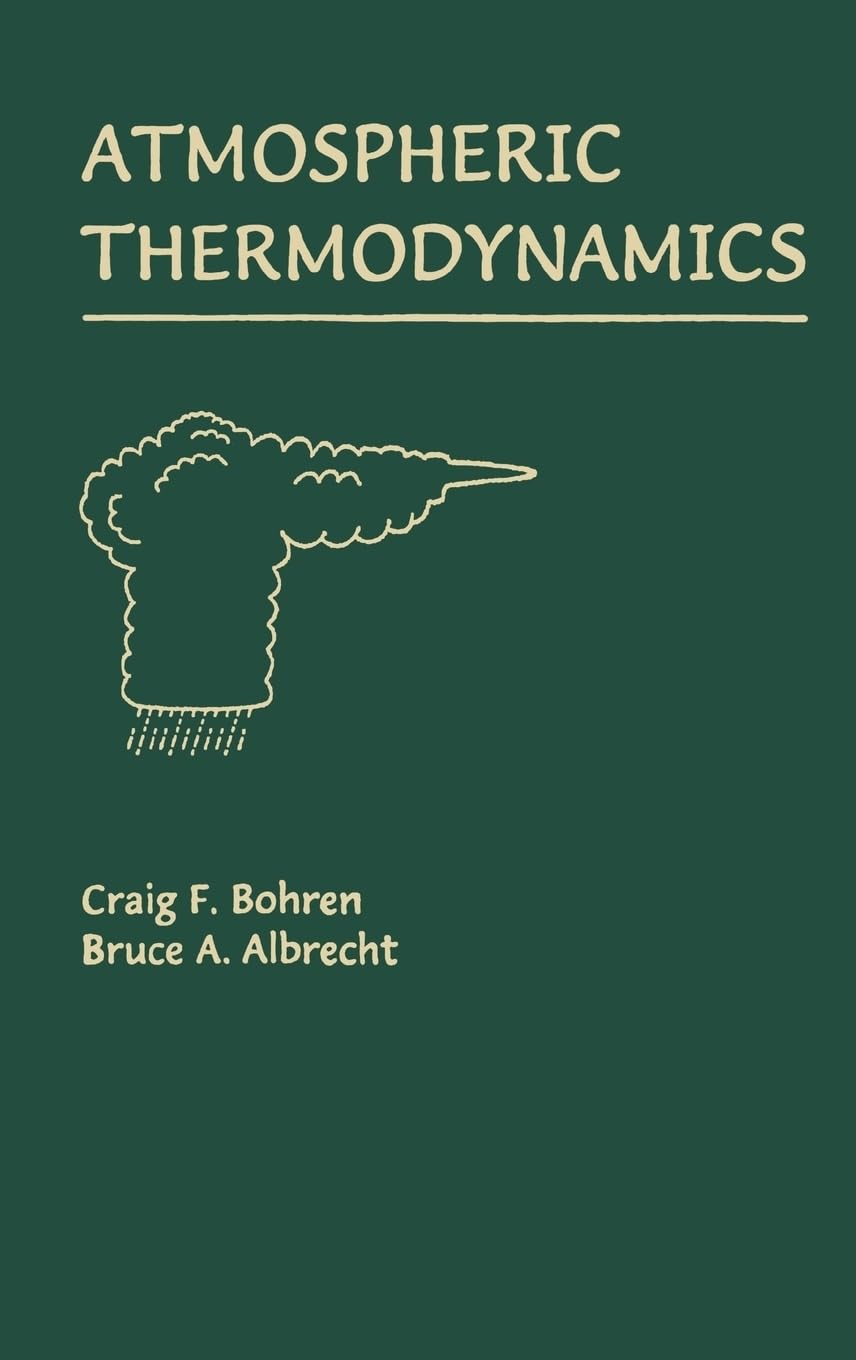
This comprehensive text is based on the authors' course notes, refined and updated over 15 years of teaching. The core of the text focuses on water and its transformations. Four chapters lay the foundation, from energy conservation to the ideal gas law, specific heat capacities, adiabatic processes, and entropy. An extensive chapter treats phase transitions of water, and a lengthy discussion of the van der Waals equation sets the stage for phase diagrams. Free energy is applied to determining the effect of dissolved substances, total pressure, and size on vapor pressure. The chapter on moist air and clouds discusses wetbulb and virtual temperatures, isentropic ascent of saturated air, thermodynamic diagrams, stability, and cloud formation. The final chapter covers energy, momentum, and mass transfer, topics not usually considered part of thermodynamics. Measurements are included and experiments and observations are suggested, all with the aim of breathing life into equations. The authors are careful to recognize and unafraid to criticize the treatments of thermodynamics that have been unchanged for more than a hundred years.Atmospheric Thermodynamics contains over 200 exercises, mostly applications of basic principles to concrete problems. Often inspired by inquisitive students and colleagues, the exercises cover everything from automobiles and airplanes to baseball, wind turbines, and ground hogs. The authors weave history into the text by drawing on original writings rather than using textbook anecdotes, and molecular interpretations are given wherever possible. Assumptions and approximations are carefully laid out, derivations are detailed, and equations are interpreted physically and applied. No previous knowledge of thermodynamics or kinetic theory is assumed, although students are expected to be wellgrounded in calculus, differential equations, vector analysis, and classical mechanics.
⚠️ WARNING (California Proposition 65):
This product may contain chemicals known to the State of California to cause cancer, birth defects, or other reproductive harm.
For more information, please visit www.P65Warnings.ca.gov.
- Q: What is the main focus of 'Atmospheric Thermodynamics'? A: 'Atmospheric Thermodynamics' primarily focuses on water and its transformations, covering essential topics such as energy conservation, the ideal gas law, and phase transitions.
- Q: How many pages does the book contain? A: The book contains 416 pages, providing a comprehensive overview of atmospheric thermodynamics.
- Q: Is prior knowledge of thermodynamics required to understand this book? A: No previous knowledge of thermodynamics or kinetic theory is assumed, although readers should be well-grounded in calculus and classical mechanics.
- Q: What type of binding does 'Atmospheric Thermodynamics' have? A: The book is available in hardcover binding, ensuring durability and longevity.
- Q: Who is the author of 'Atmospheric Thermodynamics'? A: The author of 'Atmospheric Thermodynamics' is Craig F. Bohren.
- Q: When was 'Atmospheric Thermodynamics' published? A: 'Atmospheric Thermodynamics' was published on February 19, 1998.
- Q: What types of exercises are included in the book? A: The book includes over 200 exercises that apply basic principles to real-world problems, ranging from automobiles to atmospheric phenomena.
- Q: Does the book include experiments or observations? A: Yes, the book suggests various measurements, experiments, and observations to help readers engage with the material.
- Q: What is the edition of 'Atmospheric Thermodynamics'? A: This book is the first edition of 'Atmospheric Thermodynamics'.
- Q: What topics are covered in the final chapter of the book? A: The final chapter covers energy, momentum, and mass transfer, which are often overlooked in traditional thermodynamics discussions.