
Title
Audacious Euphony: Chromatic Harmony and the Triad's Second Nature (Oxford Studies in Music Theory),Used
Sold by Ergodebooks, an authorized reseller.
Returns accepted within 30 days | support@ergodebooks.com
Shipping Information
- Free Standard Shipping — United States only
- Processing Time: 3–5 business days
- Estimated Delivery: 6–10 business days after dispatch
- Double-boxed, fully insured & discreetly packaged
- Tracking number sent via email once dispatched
Returns & Refund
Returns accepted within 30 days of delivery.
Damaged or Defective Item
Free return shipping + replacement or full refund
Wrong Item Received
Free return shipping + replacement or full refund
Change of Mind
Return shipping at customer's expense · 25% restocking fee applies
Payment Option

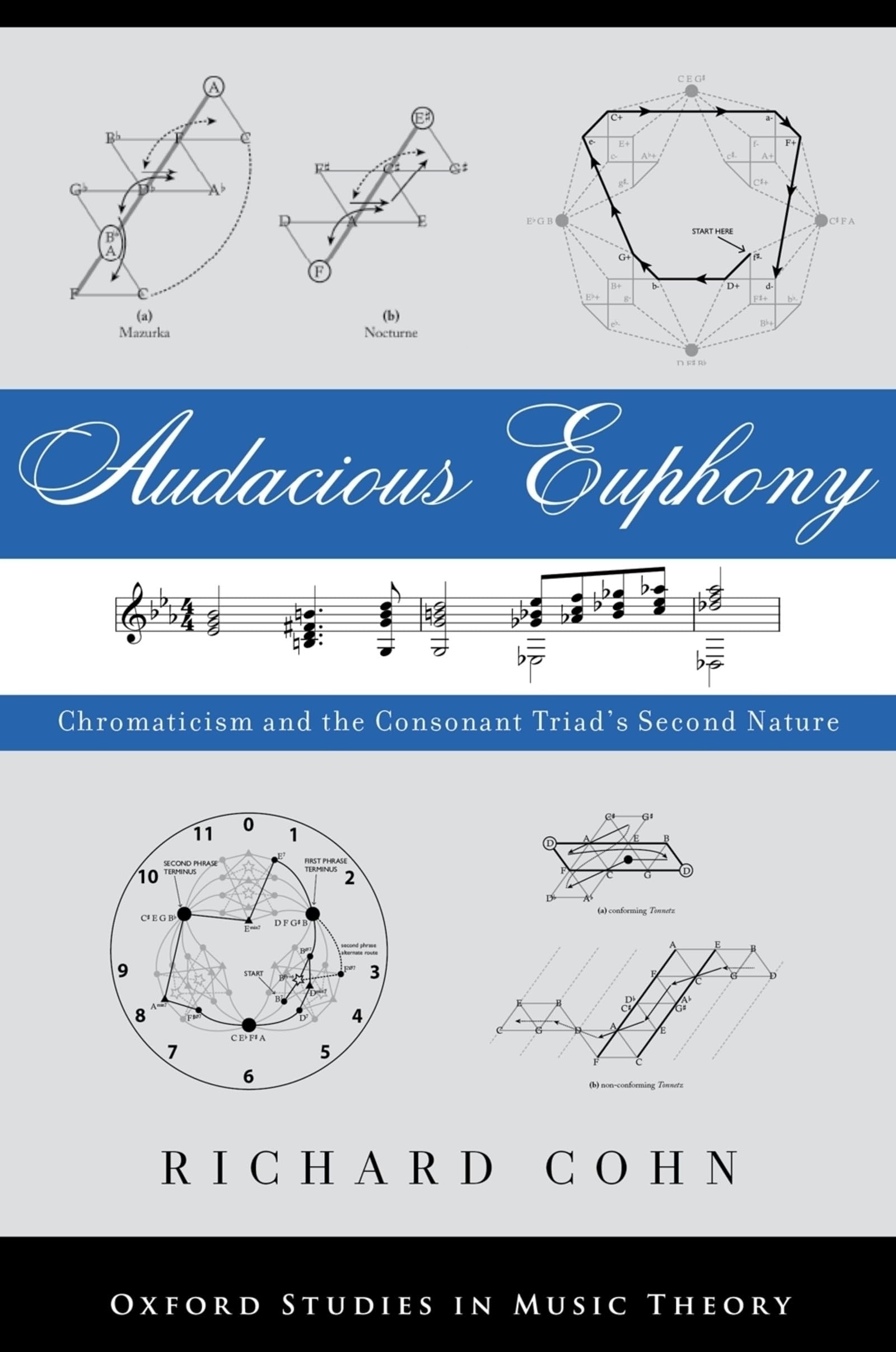
Music theorists have long believed that 19thcentury triadic progressions idiomatically extend the diatonic syntax of 18thcentury classical tonality, and have accordingly unified the two repertories under a single mode of representation. Poststructuralist musicologists have challenged this belief, advancing the view that many romantic triadic progressions exceed the reach of classical syntax and are mobilized as the result of a transgressive, antisyntactic impulse. In Audacious Euphony, author Richard Cohn takes both of these views to task, arguing that romantic harmony operates under syntactic principles distinct from those that underlie classical tonality, but no less susceptible to systematic definition. Charting this alternative triadic syntax, Cohn reconceives what consonant triads are, and how they relate to one another. In doing so, he shows that major and minor triads have two distinct natures: one based on their acoustic properties, and the other on their ability to voicelead smoothly to each other in the chromatic universe. Whereas their acoustic nature underlies the diatonic tonality of the classical tradition, their voiceleading properties are optimized by the pantriadic progressions characteristic of the 19th century. Audacious Euphony develops a set of interrelated maps that organize intuitions about triadic proximity as seen through the lens of voiceleading proximity, using various geometries related to the 19thcentury Tonnetz. This model leads to cogent analyses both of particular compositions and of historical trends across the long nineteenth century. Essential reading for music theorists, Audacious Euphony is also a valuable resource for music historians, performers and composers.
⚠️ WARNING (California Proposition 65):
This product may contain chemicals known to the State of California to cause cancer, birth defects, or other reproductive harm.
For more information, please visit www.P65Warnings.ca.gov.