
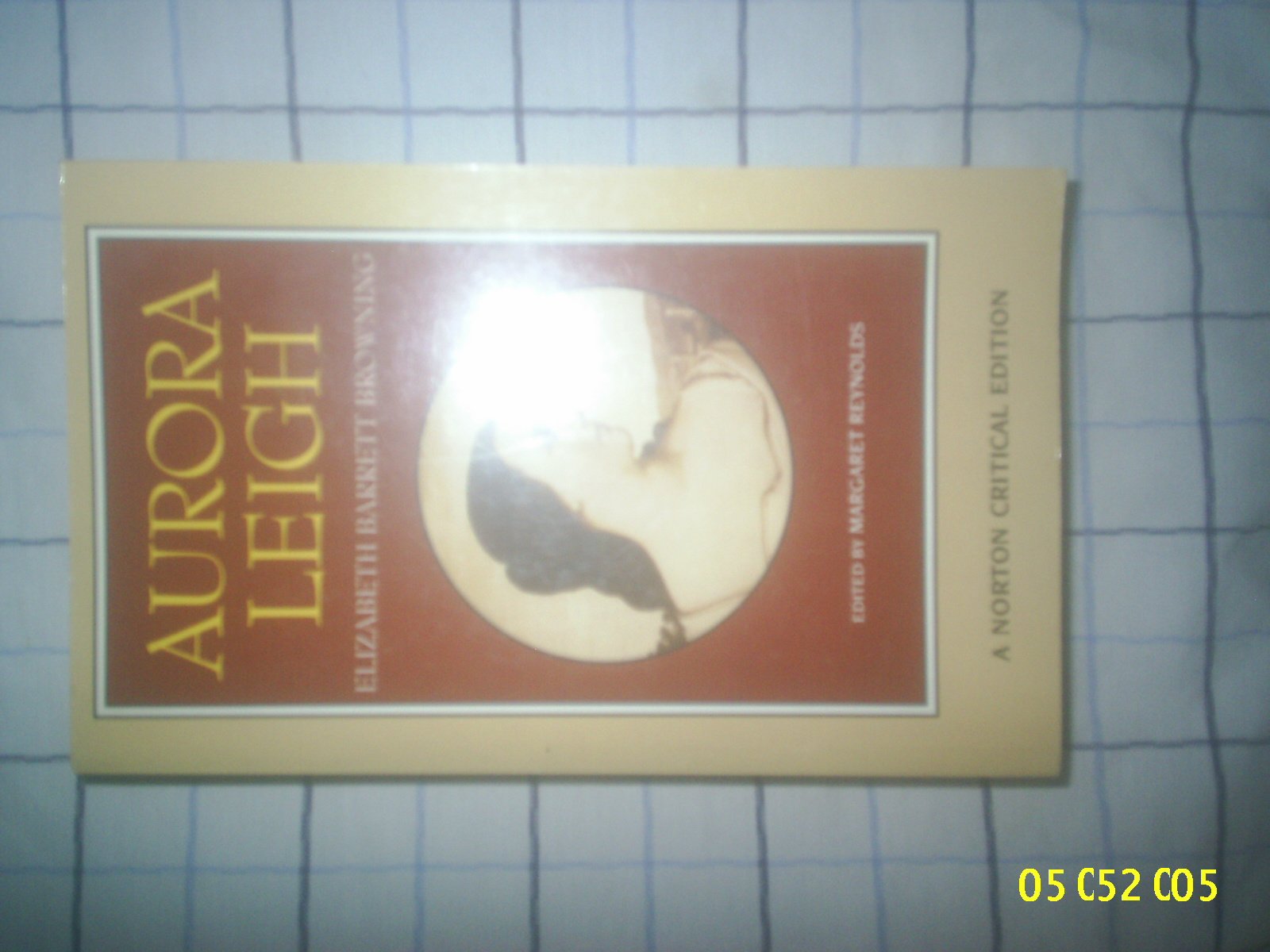
Title
Aurora Leigh: A Norton Critical Edition (Norton Critical Editions),New
Sold by Ergodebooks, an authorized reseller.
Returns accepted within 30 days | support@ergodebooks.com
Shipping Information
- Free Standard Shipping — United States only
- Processing Time: 3–5 business days
- Estimated Delivery: 6–10 business days after dispatch
- Double-boxed, fully insured & discreetly packaged
- Tracking number sent via email once dispatched
Returns & Refund
Returns accepted within 30 days of delivery.
Damaged or Defective Item
Free return shipping + replacement or full refund
Wrong Item Received
Free return shipping + replacement or full refund
Change of Mind
Return shipping at customer's expense · 25% restocking fee applies
Payment Option

This Norton Critical Edition of Elizabeth Barrett Brownings 1856 versenovel is based on Margaret Reynolds variorum edition, which the British Academy awarded the 1993 Rose Mary Crawshay Prize and which is reprinted here by special arrangement with the Ohio University Press. The text is accompanied by both explanatory annotations and textual notes.'Backgrounds and Contexts' includes thirty letters or letter excerpts by Elizabeth Barrett Browning and Robert Browning that trace Aurora Leighs inception, evolution, and publication.Seven contemporary documentson the 'woman question,' prostitution, socialism, and poetic theoryplace the text historically.'Criticism' collects twentyfive assessments of Aurora Leigh from the period 18991993.A wide range of opinion is provided by George Eliot, Virginia Woolf, Ellen Moers, Sandra Gilbert and Susan Gubar, Angela Leighton, Deirdre David, Dorothy Mermin, and Margaret Reynolds, among others.A Chronology and Selected Bibliography are also included.
⚠️ WARNING (California Proposition 65):
This product may contain chemicals known to the State of California to cause cancer, birth defects, or other reproductive harm.
For more information, please visit www.P65Warnings.ca.gov.
- Q: How many pages does 'Aurora Leigh' have? A: This book has five hundred eighty-four pages. It provides an extensive exploration of Elizabeth Barrett Browning's verse-novel.
- Q: What is the binding type of 'Aurora Leigh'? A: The binding type is paperback. This makes it lightweight and suitable for easy handling and reading.
- Q: What are the dimensions of 'Aurora Leigh'? A: The dimensions are five point two inches in length, one point three inches in width, and eight point four inches in height. This size makes it portable for readers.
- Q: Who is the author of 'Aurora Leigh'? A: The author is Elizabeth Barrett Browning. She is a renowned poet known for her significant contributions to Victorian literature.
- Q: Which publisher released 'Aurora Leigh'? A: The publisher is W. W. Norton & Company. They are known for producing critical editions of classic literature.
- Q: Is 'Aurora Leigh' suitable for all ages? A: Yes, it is suitable for a general audience. However, readers should be aware of mature themes present in the text.
- Q: How do I read 'Aurora Leigh'? A: You can read it as you would any book, starting from the beginning and following through to the end. It is recommended for those interested in poetry and critical analysis.
- Q: What themes does 'Aurora Leigh' explore? A: The book explores themes of gender, social issues, and artistic identity. It's a deep dive into the societal roles of women in the Victorian era.
- Q: Is 'Aurora Leigh' appropriate for academic study? A: Yes, it is appropriate for academic study. The Norton Critical Edition includes valuable annotations and context for deeper understanding.
- Q: How do I care for my copy of 'Aurora Leigh'? A: To care for your copy, store it upright in a dry place and avoid exposure to direct sunlight. This will help preserve the binding and pages.
- Q: Can I highlight or annotate in 'Aurora Leigh'? A: Yes, you can highlight or annotate in the book. Many readers find it helpful for tracking insights and important passages.
- Q: What if my copy of 'Aurora Leigh' arrives damaged? A: If your copy arrives damaged, you should contact the seller for a return or replacement. Most sellers have customer service policies for such issues.
- Q: How do I store 'Aurora Leigh' safely? A: Store 'Aurora Leigh' on a shelf away from moisture and in a stable temperature environment. This prevents damage to the pages and binding.
- Q: Is there a bibliography included in 'Aurora Leigh'? A: Yes, there is a selected bibliography included. This provides additional resources for readers interested in further study.
- Q: What type of criticism is included in 'Aurora Leigh'? A: The book includes twenty-five assessments from various critics. These span from the years 1899 to 1993, offering a historical perspective on the work.