If you have any questions, you are always welcome to contact us. We'll get back to you as soon as possible, withing 24 hours on weekdays.
Customer service
All questions about your order, return and delivery must be sent to our customer service team by e-mail at yourstore@yourdomain.com
Sale & Press
If you are interested in selling our products, need more information about our brand or wish to make a collaboration, please contact us at press@yourdomain.com
Help
If you have any questions, you are always welcome to contact us. We'll get back to you as soon as possible, withing 24 hours on weekdays.
Customer service
All questions about your order, return and delivery must be sent to our customer service team by e-mail at yourstore@yourdomain.com
Sale & Press
If you are interested in selling our products, need more information about our brand or wish to make a collaboration, please contact us at press@yourdomain.com
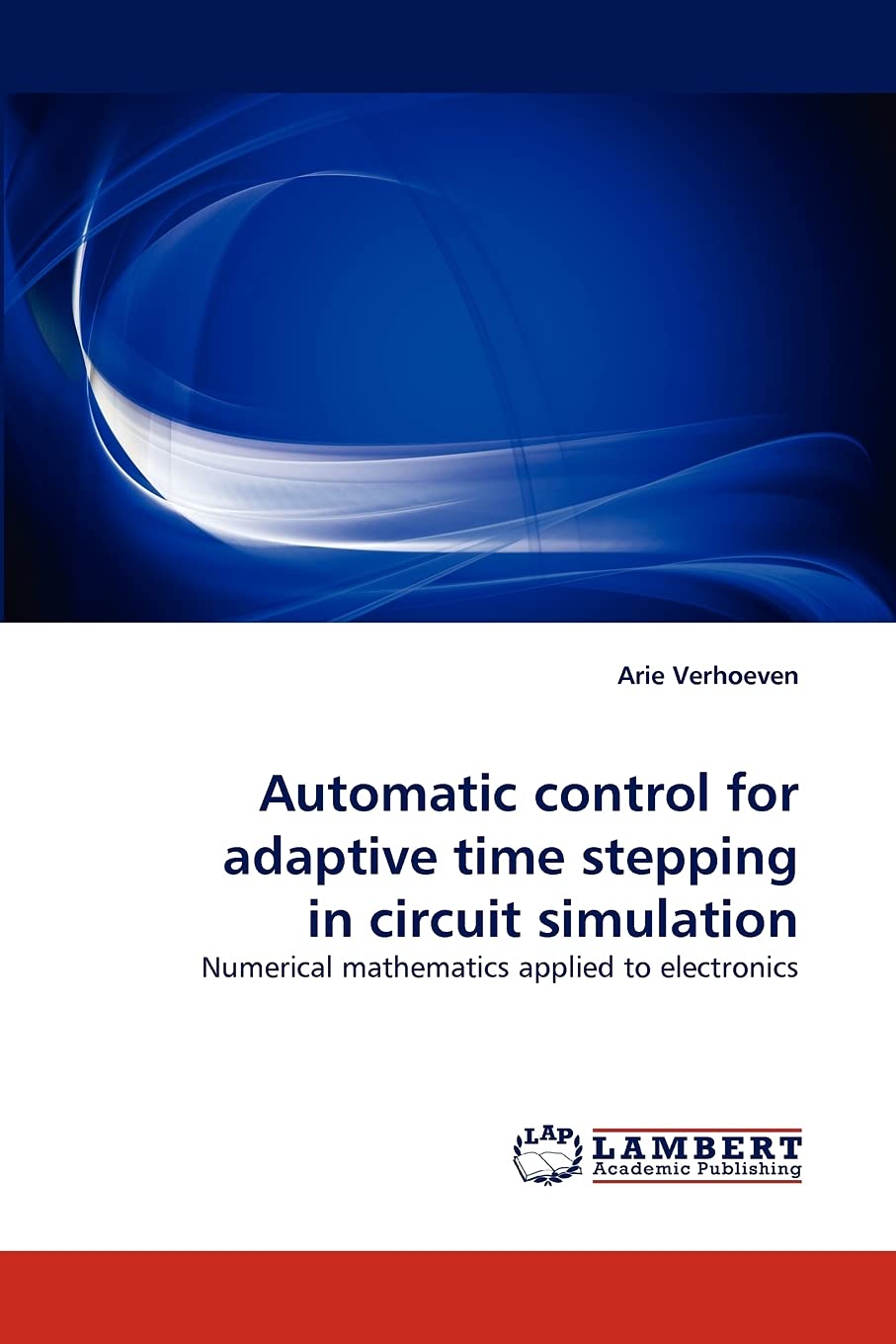
DAEsolvers are used to find the numerical solution of the transient analysis of electrical circuits. For onestep methods, the local truncation error only depends on the last stepsize, but for multistep methods, this error is also depends on previous stepsizes in a nonlinear way. Adaptive stepsize control and order control can be used to control these truncation errors. In connection with the articles of prof.Soderlind, the possibilities of a controltheoretic approach are investigated. For onestep methods, the stepsize control process can be viewed as a digital linear control system for the logarithms of the errors and steps. From a controltheoretic point of view, the goal is to keep the error close to a reference level with use of the stepsizes as input. If the stepsize control process is correctly modelled, a finite order digital linear controller can be designed. From the results, it appears that it is possible to design linear controllers that achieve better properties than the commonly used deadbeat controllers.
⚠️ WARNING (California Proposition 65):
This product may contain chemicals known to the State of California to cause cancer,
birth defects, or other reproductive harm.
For MAP (Minimum Advertised Price) violations and Intellectual Property (IP) or Trademark concerns, please contact:
support@ergodebooks.com
⚠️ California Proposition 65 Warning: Some products sold on this website may expose you to chemicals known to the State of California to cause cancer, birth defects, or other reproductive harm. For more information, visit www.P65Warnings.ca.gov.