If you have any questions, you are always welcome to contact us. We'll get back to you as soon as possible, withing 24 hours on weekdays.
Customer service
All questions about your order, return and delivery must be sent to our customer service team by e-mail at yourstore@yourdomain.com
Sale & Press
If you are interested in selling our products, need more information about our brand or wish to make a collaboration, please contact us at press@yourdomain.com
Help
If you have any questions, you are always welcome to contact us. We'll get back to you as soon as possible, withing 24 hours on weekdays.
Customer service
All questions about your order, return and delivery must be sent to our customer service team by e-mail at yourstore@yourdomain.com
Sale & Press
If you are interested in selling our products, need more information about our brand or wish to make a collaboration, please contact us at press@yourdomain.com
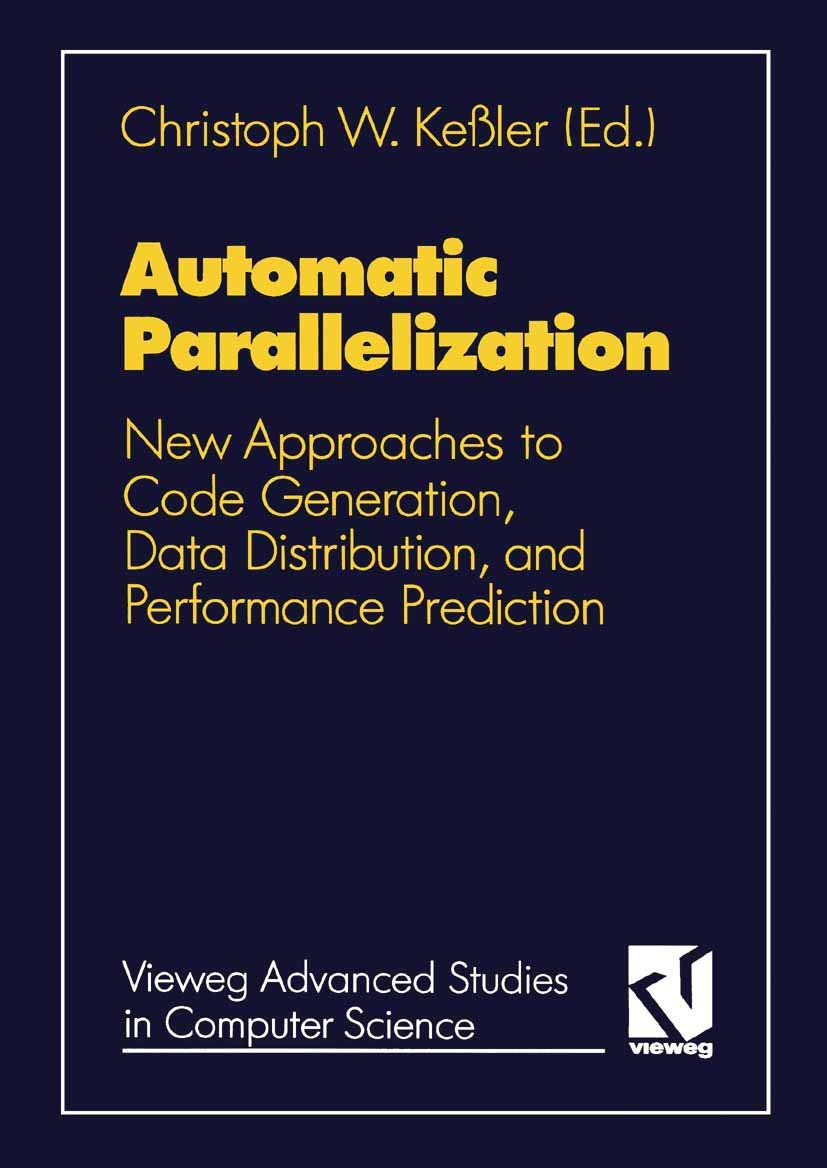
Distributedmemory multiprocessing systems (DMS), such as Intel's hypercubes, the Paragon, Thinking Machine's CM5, and the Meiko Computing Surface, have rapidly gained user acceptance and promise to deliver the computing power required to solve the grand challenge problems of Science and Engineering. These machines are relatively inexpensive to build, and are potentially scalable to large numbers of processors. However, they are difficult to program: the nonuniformity of the memory which makes local accesses much faster than the transfer of nonlocal data via messagepassing operations implies that the locality of algorithms must be exploited in order to achieve acceptable performance. The management of data, with the twin goals of both spreading the computational workload and minimizing the delays caused when a processor has to wait for nonlocal data, becomes of paramount importance. When a code is parallelized by hand, the programmer must distribute the program's work and data to the processors which will execute it. One of the common approaches to do so makes use of the regularity of most numerical computations. This is the socalled Single Program Multiple Data (SPMD) or data parallel model of computation. With this method, the data arrays in the original program are each distributed to the processors, establishing an ownership relation, and computations defining a data item are performed by the processors owning the data.
⚠️ WARNING (California Proposition 65):
This product may contain chemicals known to the State of California to cause cancer,
birth defects, or other reproductive harm.
For MAP (Minimum Advertised Price) violations and Intellectual Property (IP) or Trademark concerns, please contact:
support@ergodebooks.com
⚠️ California Proposition 65 Warning: Some products sold on this website may expose you to chemicals known to the State of California to cause cancer, birth defects, or other reproductive harm. For more information, visit www.P65Warnings.ca.gov.