
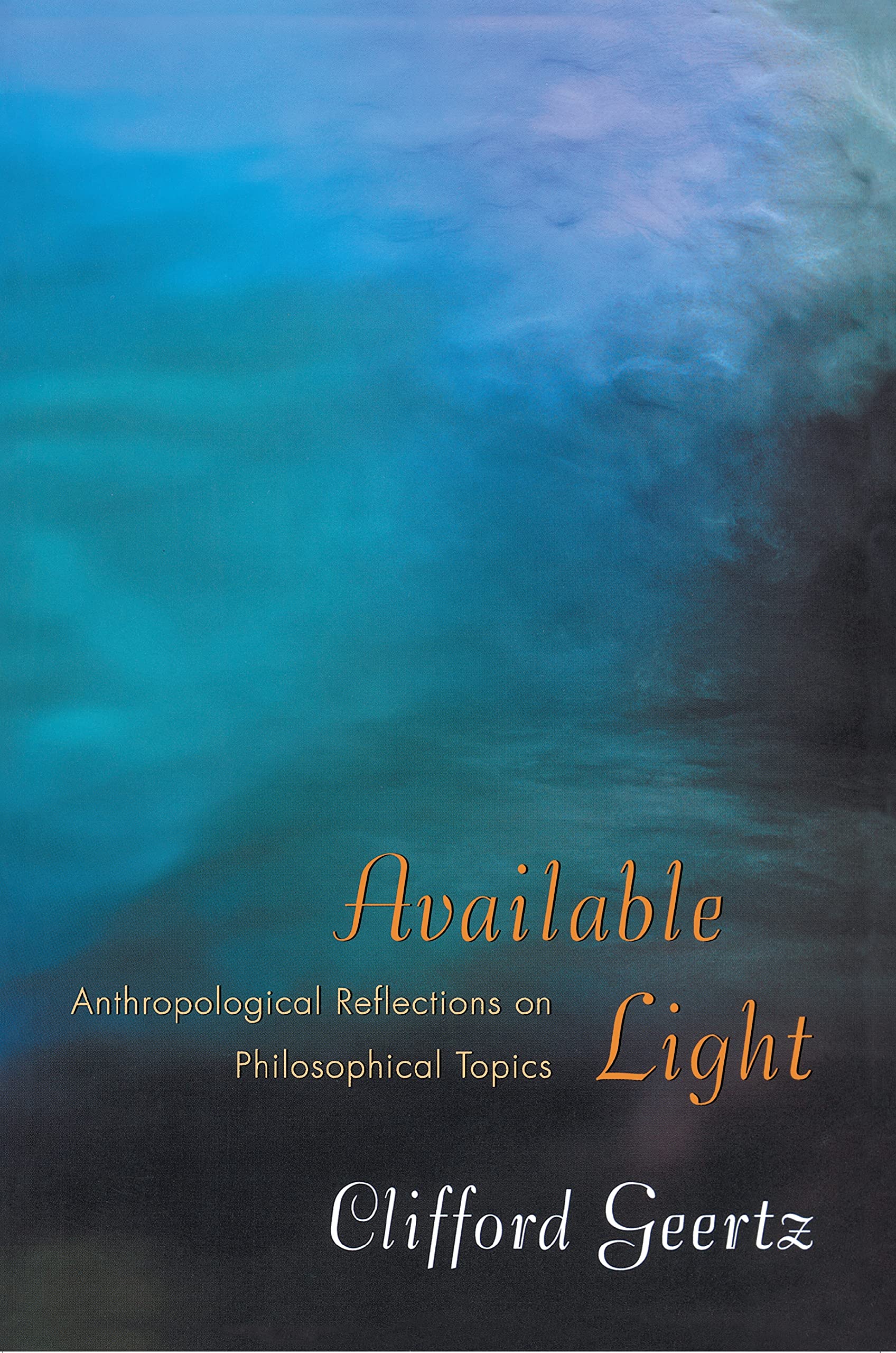
Title
Available Light: Anthropological Reflections On Philosophical Topics.
Sold by Ergodebooks, an authorized reseller.
Returns accepted within 30 days | support@ergodebooks.com
Shipping Information
- Free Standard Shipping — United States only
- Processing Time: 3–5 business days
- Estimated Delivery: 6–10 business days after dispatch
- Double-boxed, fully insured & discreetly packaged
- Tracking number sent via email once dispatched
Returns & Refund
Returns accepted within 30 days of delivery.
Damaged or Defective Item
Free return shipping + replacement or full refund
Wrong Item Received
Free return shipping + replacement or full refund
Change of Mind
Return shipping at customer's expense · 25% restocking fee applies
Payment Option

Clifford Geertz, One Of The Most Influential Thinkers Of Our Time, Here Discusses Some Of The Most Urgent Issues Facing Intellectuals Today. In This Collection Of Personal And Revealing Essays, He Explores The Nature Of His Anthropological Work In Relation To A Broader Public, Serving As The Foremost Spokesperson Of His Generation Of Scholars, Those Who Came Of Age After World War Ii. His Reflections Are Written In A Style That Both Entertains And Disconcerts, As They Engage Us In Topics Ranging From Moral Relativism To The Relationship Between Cultural And Psychological Differences, From The Diversity And Tension Among Activist Faiths To Ethnic Conflict In Today'S Politics.Geertz, Who Once Considered A Career In Philosophy, Begins By Explaining How He Got Swept Into The Revolutionary Movement Of Symbolic Anthropology. At That Point, His Work Began To Encompass Not Only The Ethnography Of Groups In Southeast Asia And North Africa, But Also The Study Of How Meaning Is Made In All Culturesor, To Use His Phrase, To Explore The Frames Of Meaning In Which People Everywhere Live Out Their Lives. His Philosophical Orientation Helped Him To Establish The Role Of Anthropology Within Broader Intellectual Circles And Led Him To Address The Work Of Such Leading Thinkers As Charles Taylor, Thomas Kuhn, William James, And Jerome Bruner. In This Volume, Geertz Comments On Their Work As He Explores Questions In Political Philosophy, Psychology, And Religion That Have Intrigued Him Throughout His Career But That Now Hold Particular Relevance In Light Of Postmodernist Thinking And Multiculturalism. Available Light Offers Insightful Discussions Of Concepts Such As Nation, Identity, Country, And Self, With A Reminder That Like Symbols In General, Their Meanings Are Not Categorically Fixed But Grow And Change Through Time And Place.This Book Treats The Reader To An Analysis Of The American Intellectual Climate By Someone Who Did Much To Shape It. One Can Read Available Light Both For Its Revelation Of Public Culture In Its Dynamic, Evolving Forms And For The Story It Tells About The Remarkable Adventures Of An Innovator During The Golden Years Of American Academia.
⚠️ WARNING (California Proposition 65):
This product may contain chemicals known to the State of California to cause cancer, birth defects, or other reproductive harm.
For more information, please visit www.P65Warnings.ca.gov.
- Q: What is the page count of this book? A: This book has two hundred eighty-eight pages. It provides a comprehensive exploration of anthropological reflections and philosophical topics.
- Q: What are the dimensions of 'Available Light'? A: The dimensions of this book are six inches in length, zero point seventy-two inches in width, and nine point zero two inches in height.
- Q: What type of binding does this book have? A: This book is available in paperback binding. This makes it lightweight and easy to handle.
- Q: Who is the author of 'Available Light'? A: The author of this book is Clifford Geertz, a prominent anthropologist known for his influential essays and thoughts.
- Q: What is the main theme of 'Available Light'? A: The main theme revolves around anthropological reflections on various philosophical topics. It delves into cultural dynamics, identity, and moral relativism.
- Q: Is 'Available Light' suitable for academic study? A: Yes, this book is suitable for academic study. It offers insights into anthropology and philosophical discussions relevant to scholars and students.
- Q: How should I store this book to keep it in good condition? A: Store this book in a cool, dry place away from direct sunlight. This will help maintain its condition and prevent wear.
- Q: Can I clean the book if it gets dirty? A: No, the book should not be cleaned with water or cleaning agents. Instead, use a dry cloth to gently wipe the cover if necessary.
- Q: Is this book appropriate for young readers? A: No, this book is not specifically targeted at young readers. It discusses complex philosophical and anthropological topics that may require advanced understanding.
- Q: How does 'Available Light' compare to other books in ethics and morality? A: This book offers a unique perspective by intertwining anthropology with ethical discussions. It's distinct from others that may focus solely on theoretical ethics.
- Q: What should I do if my book arrives damaged? A: If your book arrives damaged, you should contact the seller for a return or exchange. Most sellers have policies in place to handle such situations.
- Q: Does this book contain any illustrations? A: Yes, the book includes black and white illustrations. These visuals complement the text and enhance the reading experience.
- Q: Is there a specific audience for 'Available Light'? A: Yes, the specific audience includes scholars, students, and anyone interested in anthropology and philosophical discussions.
- Q: What is the publication date of 'Available Light'? A: The publication date is not provided in the details. However, it is published by Princeton University Press, known for academic works.
- Q: Does the book include a bibliography or references? A: Yes, 'Available Light' includes references to various works and thinkers, enriching the discussion with scholarly context.
- Q: Can I find this book in libraries? A: Yes, this book is likely available in academic and public libraries. It is a notable work in anthropology and philosophy.