
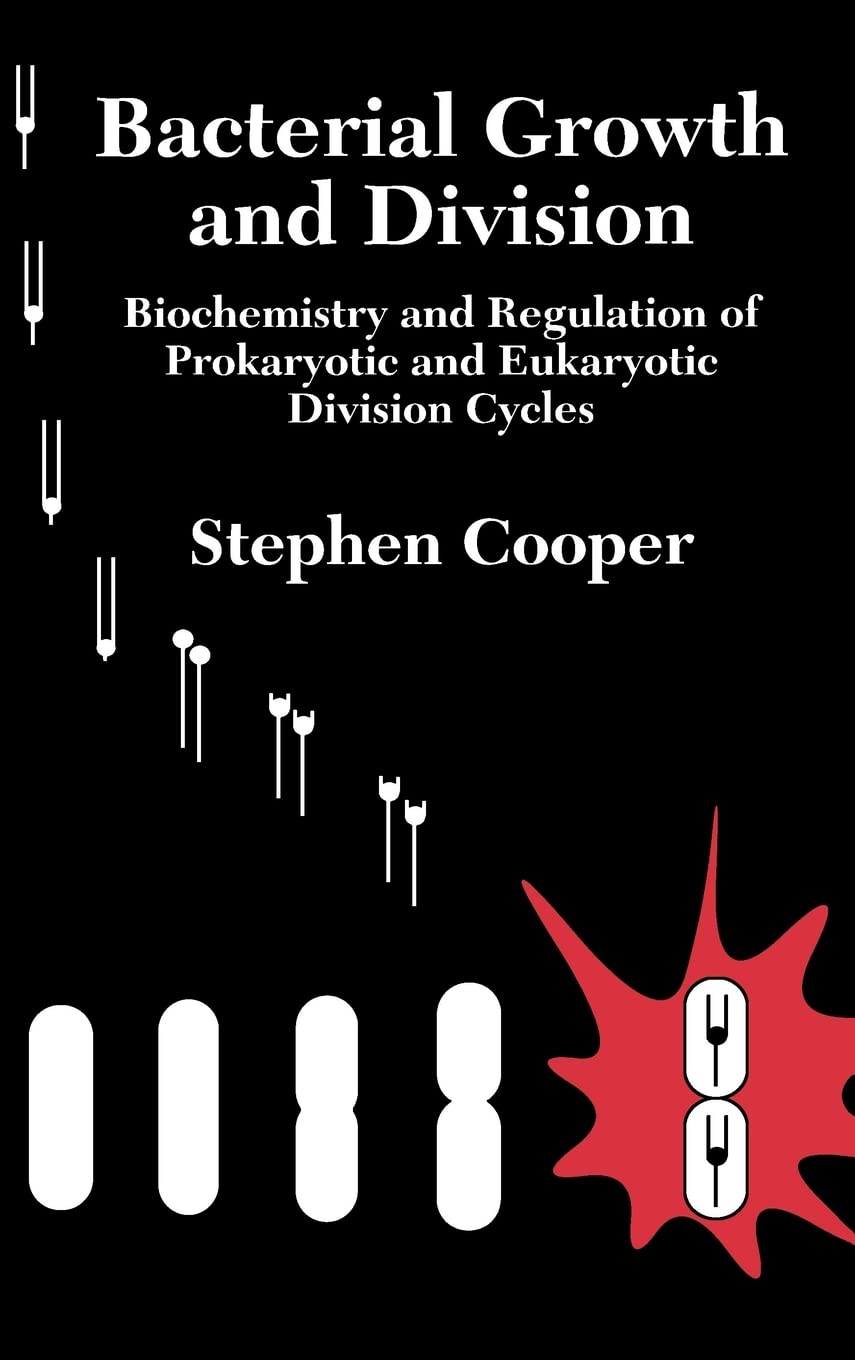
Title
Bacterial Growth and Division: Biochemistry and Regulation of Prokaryotic and Eukaryotic Division Cycles,New
Sold by Ergodebooks, an authorized reseller.
Returns accepted within 30 days | support@ergodebooks.com
Shipping Information
- Free Standard Shipping — United States only
- Processing Time: 3–5 business days
- Estimated Delivery: 6–10 business days after dispatch
- Double-boxed, fully insured & discreetly packaged
- Tracking number sent via email once dispatched
Returns & Refund
Returns accepted within 30 days of delivery.
Damaged or Defective Item
Free return shipping + replacement or full refund
Wrong Item Received
Free return shipping + replacement or full refund
Change of Mind
Return shipping at customer's expense · 25% restocking fee applies
Payment Option

How does a bacterial cell grow during the division cycle? This question is answered by the codeveloper of the CooperHelmstetter model of DNA replication. In a unique analysis of the bacterial division cycle, Cooper considers the major cell categories (cytoplasm, DNA, and cell surface) and presents a lucid description of bacterial growth during the division cycle.The concepts of bacterial physiology from Ole Maale's Copenhagen school are presented throughout the book and are applied to such topics as the origin of variability, the pattern of DNA segregation, and the principles underlying growth transitions.The results of research on E. coli are used to explain the division cycles of Caulobacter, Bacilli, Streptococci, and eukaryotes. Insightful reanalysis highlights significant similarities between these cells and E.coli.With over 25 years of experience in the study of the bacterial division cycle, Cooper has synthesized his ideas and research into an exciting presentation. He manages to write a comprehensive volume that will be of great interest to microbiologists, cell physiologists, cell and molecular biologists, researchers in cellcycle studies, and mathematicians and engineering scientists interested in modeling cell growth. Written by one of the codiscoverers of the CooperHelmstetter model Applies the results of research on E. coli to other groups, including Caulobacter, Bacilli, Streptococci, and eukaryotes; the Caulobacter reanalysis highlights significant similarities with the E. coli system Presents a unified description of the bacterial division cycle with relevance to eukaryotic systems Addresses the concepts of the Copenhagen School in a new and original way
⚠️ WARNING (California Proposition 65):
This product may contain chemicals known to the State of California to cause cancer, birth defects, or other reproductive harm.
For more information, please visit www.P65Warnings.ca.gov.