
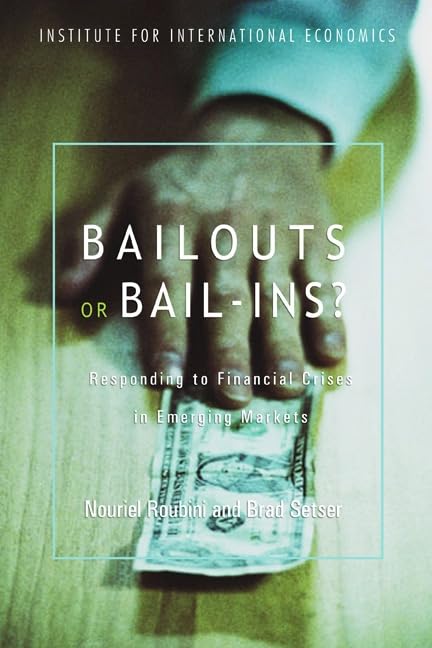
Title
Bailouts or BailIns?: Responding to Financial Crises in Emerging Economies,New
Sold by Ergodebooks, an authorized reseller.
Returns accepted within 30 days | support@ergodebooks.com
Shipping Information
- Free Standard Shipping — United States only
- Processing Time: 3–5 business days
- Estimated Delivery: 6–10 business days after dispatch
- Double-boxed, fully insured & discreetly packaged
- Tracking number sent via email once dispatched
Returns & Refund
Returns accepted within 30 days of delivery.
Damaged or Defective Item
Free return shipping + replacement or full refund
Wrong Item Received
Free return shipping + replacement or full refund
Change of Mind
Return shipping at customer's expense · 25% restocking fee applies
Payment Option

Roughly once a year, the managing director of the International Monetary Fund, the US treasury secretary and in some cases the finance ministers of other G7 countries will get a call from the finance minister of a large emerging market economy. The emerging market finance minister will indicate that the country is rapidly running out of foreign reserves, that it has lost access to international capital markets and, perhaps, that is has lost the confidence of its own citizens. Without a rescue loan, it will be forced to devalue its currency and default either on its government debt or on loans to the country's banks that the government has guaranteed.This book looks at these situations and the options available to alleviate the problem. It argues for a policy that recognizes that every crisis is different and that different cases need to be handled within a framework that provides consistency and predictability to borrowing countries as well as those who invest in their debt.
⚠️ WARNING (California Proposition 65):
This product may contain chemicals known to the State of California to cause cancer, birth defects, or other reproductive harm.
For more information, please visit www.P65Warnings.ca.gov.
- Q: How many pages does this book have? A: This book has three hundred forty-eight pages. It provides an in-depth analysis of financial crises in emerging economies.
- Q: What is the binding type of the book? A: The book is paperback. This makes it lightweight and portable for easy reading.
- Q: What are the dimensions of the book? A: The dimensions are six point zero two inches in length, zero point eight three inches in width, and nine point zero six inches in height. These dimensions make it a compact read.
- Q: Who is the author of this book? A: The author is Nouriel Roubini. He is a renowned economist known for his insights into global financial issues.
- Q: What is the main topic of the book? A: The book discusses financial crises in emerging economies. It details the challenges and policies that can help manage these crises.
- Q: Is this book suitable for beginners in economics? A: Yes, this book is suitable for beginners. It presents complex ideas in a way that is accessible to those unfamiliar with economic policies.
- Q: How can I apply the concepts from this book? A: You can apply the concepts by understanding case studies of financial crises. This can help in analyzing current economic situations.
- Q: What is the recommended reading level for this book? A: The recommended reading level is high school and above. It is written for those interested in economics and public policy.
- Q: How should I store this book? A: Store the book in a cool, dry place, away from direct sunlight. This will help preserve its condition over time.
- Q: Can I highlight or take notes in this book? A: Yes, you can highlight and take notes in the book. Many readers find this helpful for studying its content.
- Q: What should I do if the book arrives damaged? A: If the book arrives damaged, you should contact the seller for a return or exchange. Most retailers have policies in place for this.
- Q: Is there a warranty for this book? A: No, books typically do not come with a warranty. However, you can check return policies with the retailer.
- Q: How do I clean the book if it gets dirty? A: To clean the book, gently wipe the cover with a damp cloth. Avoid using harsh chemicals that could damage the material.
- Q: What if I don’t understand some concepts in the book? A: If you don’t understand some concepts, consider looking for additional resources or summaries online. Discussion forums can also provide insights.
- Q: Is this book appropriate for academic use? A: Yes, this book is appropriate for academic use. It offers valuable insights into economic policies relevant for studies in economics.
- Q: Will this book help me understand current financial issues? A: Yes, this book provides frameworks that can help you understand current financial issues in emerging economies. It draws on historical contexts to inform future decisions.