
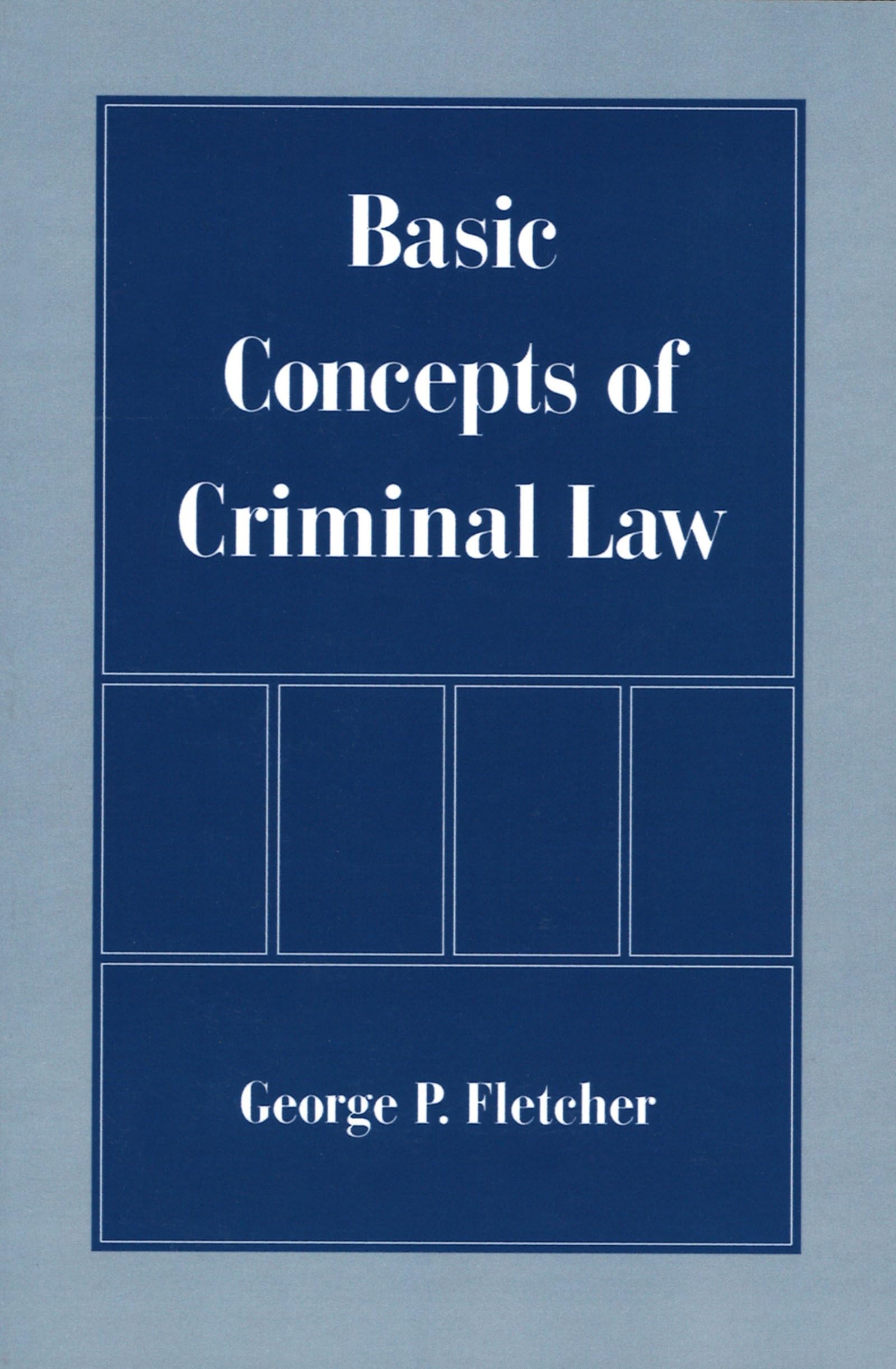
Title
Basic Concepts of Criminal Law,Used
Sold by Ergodebooks, an authorized reseller.
Returns accepted within 30 days | support@ergodebooks.com
Shipping Information
- Free Standard Shipping — United States only
- Processing Time: 3–5 business days
- Estimated Delivery: 6–10 business days after dispatch
- Double-boxed, fully insured & discreetly packaged
- Tracking number sent via email once dispatched
Returns & Refund
Returns accepted within 30 days of delivery.
Damaged or Defective Item
Free return shipping + replacement or full refund
Wrong Item Received
Free return shipping + replacement or full refund
Change of Mind
Return shipping at customer's expense · 25% restocking fee applies
Payment Option

In the United States today criminal justice can vary from state to state, as various states alter the Modern Penal Code to suit their own local preferences and concerns. In Eastern Europe, the postCommunist countries are quickly adopting new criminal codes to reflect their specific national concerns as they gain autonomy from what was once a centralized Soviet policy. As commonalities among countries and states disintegrate, how are we to view the basic concepts of criminal law as a whole?Eminent legal scholar George Fletcher acknowledges that criminal law is becoming increasingly localized, with every country and state adopting their own conception of punishable behavior, determining their own definitions of offenses. Yet by taking a step back from the details and linguistic variations of the criminal codes, Fletcher is able to perceive an underlying unity among diverse systems of criminal justice. Challenging common assumptions, he discovers a unity that emerges not on the surface of statutory rules and case law but in the underlying debates that inform them.Basic Concepts of Criminal Law identifies a set of twelve distinctions that shape and guide the controversies that inevitably break out in every system of criminal justice. Devoting a chapter to each of these twelve concepts, Fletcher maps out what he considers to be the deep structure of all systems of criminal law. Understanding these distinctions will not only enable students to appreciate the universal fundamental ideas of criminal law, but will enable them to understand the significance of local details and variations.This accessible illustration of the unity of diverse systems of criminal justice will provoke and inform students and scholars of law and the philosophy of law, as well as lawyers seeking a better understanding of the law they practice.
⚠️ WARNING (California Proposition 65):
This product may contain chemicals known to the State of California to cause cancer, birth defects, or other reproductive harm.
For more information, please visit www.P65Warnings.ca.gov.
- Q: How many pages does 'Basic Concepts of Criminal Law' have? A: This book has two hundred thirty-six pages. It provides a comprehensive overview of criminal law concepts across various jurisdictions.
- Q: What is the binding type of this book? A: The binding of 'Basic Concepts of Criminal Law' is paperback. This makes it lightweight and easy to handle for students and professionals alike.
- Q: What are the dimensions of this book? A: The dimensions of the book are nine point eighteen inches in length, six point forty-six inches in width, and zero point sixty-three inches in height. These measurements make it portable and convenient for reading.
- Q: Who is the author of 'Basic Concepts of Criminal Law'? A: The author is George P. Fletcher. He is an eminent legal scholar recognized for his contributions to the field of criminal law.
- Q: What topics are covered in this book? A: The book covers twelve fundamental distinctions in criminal law. Each chapter explores a specific concept that influences criminal justice systems.
- Q: Is 'Basic Concepts of Criminal Law' suitable for beginners? A: Yes, this book is suitable for beginners. It simplifies complex legal concepts, making it accessible for students new to criminal law.
- Q: Can law professionals benefit from reading this book? A: Yes, law professionals can benefit from this book. It provides insights into the underlying unity of diverse criminal justice systems, enhancing their understanding of local laws.
- Q: What reading level is appropriate for this book? A: The appropriate reading level for this book is college level. It is designed for students, scholars, and legal practitioners.
- Q: How should I care for this paperback book? A: To care for this paperback book, keep it in a cool, dry place and avoid exposure to direct sunlight. This will help preserve its physical condition.
- Q: Is there any specific way to store this book? A: Yes, store this book upright on a shelf or in a bookcase. This prevents warping and keeps the pages intact.
- Q: What if the book arrives damaged? A: If the book arrives damaged, contact the seller for a return or exchange. Most sellers have policies in place to address such issues.
- Q: What is the publisher of 'Basic Concepts of Criminal Law'? A: The publisher is Oxford University Press, USA. It is a reputable publisher known for high-quality academic and educational materials.
- Q: Does this book include any case studies? A: Yes, the book includes case studies that illustrate the principles discussed. These examples enhance comprehension of the material.
- Q: Is this book focused on any specific legal system? A: No, this book is not focused on a specific legal system. It explores concepts applicable to various jurisdictions, including the United States and Eastern Europe.
- Q: Are there any illustrations in this book? A: No, 'Basic Concepts of Criminal Law' does not contain illustrations. It relies on text to convey legal principles and arguments.
- Q: What genre does this book belong to? A: The book belongs to the genre of legal studies, specifically focusing on criminal law and its fundamental concepts.