
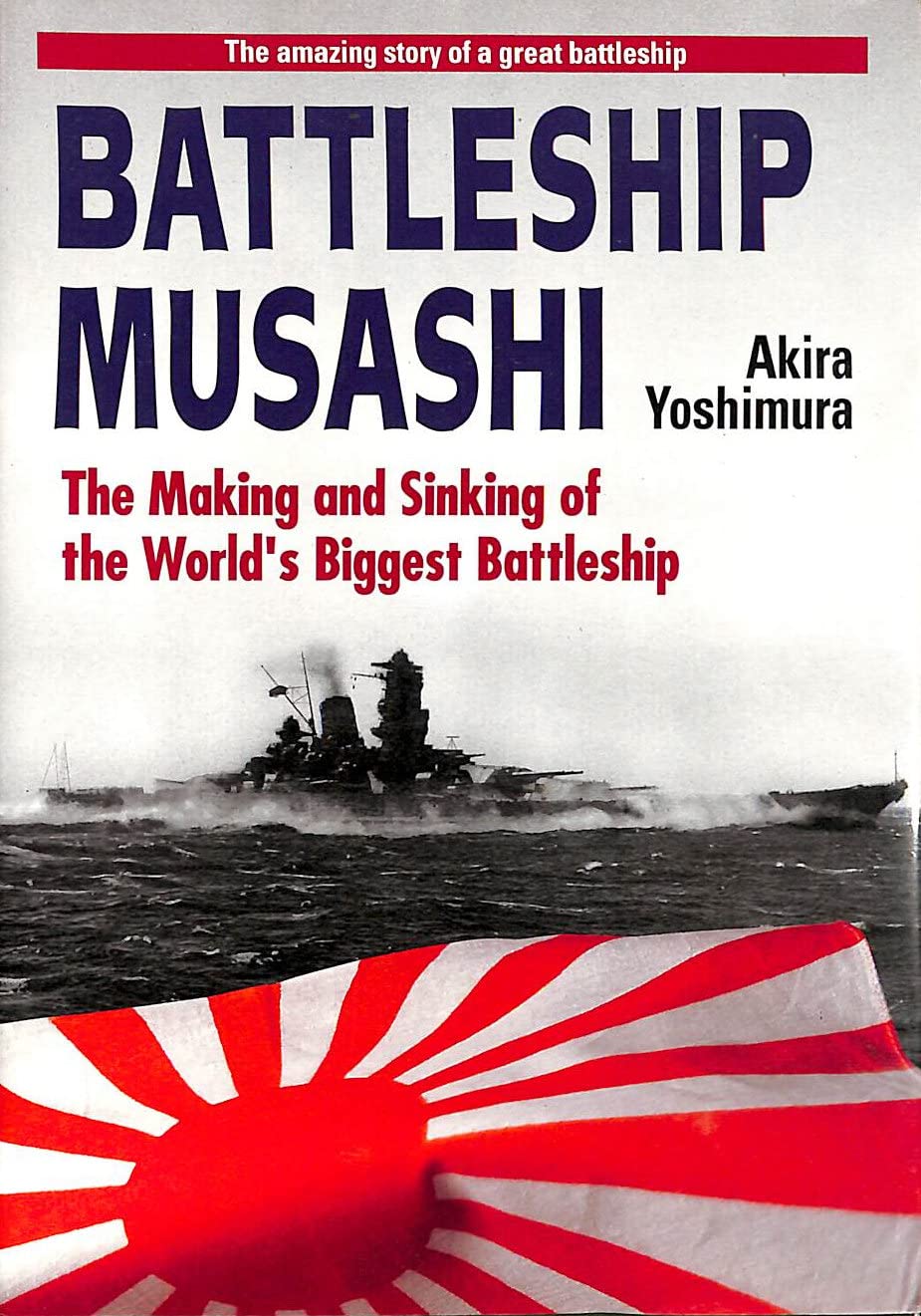
Title
Battleship Musashi: The Making and Sinking of the Worlds Biggest Battleship,Used
Sold by Ergodebooks, an authorized reseller.
Returns accepted within 30 days | support@ergodebooks.com
Shipping Information
- Free Standard Shipping — United States only
- Processing Time: 3–5 business days
- Estimated Delivery: 6–10 business days after dispatch
- Double-boxed, fully insured & discreetly packaged
- Tracking number sent via email once dispatched
Returns & Refund
Returns accepted within 30 days of delivery.
Damaged or Defective Item
Free return shipping + replacement or full refund
Wrong Item Received
Free return shipping + replacement or full refund
Change of Mind
Return shipping at customer's expense · 25% restocking fee applies
Payment Option

Admiral lsoroku Yamamoto, the man who planned the attack on Pearl Harbor, said that the three great follies of the world were the Great Wall of China, the Pyramids, and the battleship Musashi. Yamamoto understood that sheer size and firepower would not be decisive factors in the battle fornaval supremacy in the Pacific.The Musashi was massiveupright it would have approached the size of the Chrysler Building. Outfitted with eighteeninch armor plating and nine eighteeninch guns, the largest ever mounted on a warship, the Musashi was considered by its creators to be invincible and unsinkable. Yet during its twoyears of active duty with the Combined Fleet, it never fired a single shot against another ship. It was sunk, as Yamamoto had predicted, by torpedoes and bombs.Akira Yoshimura's dramatic reconstruction of the birth of the Musashi portrays a nation preparing for total war. Under these extreme conditions, courage, genius, and integrity coexisted with brutality, folly, and paranoia. During the more than four years it took to build and outfit it, shipyardengineers and their Navy mentors were faced with seemingly insurmountable technical problems and plagued by natural calamities and the constant fear of espionage. The solutions they found to each successive crisis were sometimes brilliant, sometimes absurd. Battleship Musashi is a tribute to the menwho achieved this engineering marvel and a testament to the excesses of bureaucratic militarism.
⚠️ WARNING (California Proposition 65):
This product may contain chemicals known to the State of California to cause cancer, birth defects, or other reproductive harm.
For more information, please visit www.P65Warnings.ca.gov.
- Q: What is the main subject of 'Battleship Musashi'? A: The book 'Battleship Musashi' focuses on the construction and eventual sinking of the Musashi, the world's largest battleship, as well as the historical context surrounding its creation and the individuals involved.
- Q: Who is the author of 'Battleship Musashi'? A: The author of 'Battleship Musashi' is Akira Yoshimura, known for his historical narratives and detailed accounts of wartime events.
- Q: What is the condition of the book being sold? A: The book is listed as 'Used Book in Good Condition' and is categorized as 'Very Good', indicating minimal wear and well-preserved quality.
- Q: How many pages does 'Battleship Musashi' have? A: The book contains 192 pages.
- Q: What type of binding does 'Battleship Musashi' have? A: This edition of 'Battleship Musashi' is available in paperback binding.
- Q: What category does this book fall under? A: The book is categorized under 'World War II', highlighting its historical significance during that era.
- Q: When was 'Battleship Musashi' published? A: The book was published on November 30, 1999.
- Q: Is there a specific edition of 'Battleship Musashi' being offered? A: Yes, the book is available in its 'First Edition'.
- Q: What themes are explored in 'Battleship Musashi'? A: The book explores themes of engineering challenges, military bureaucracy, and the human experiences during the wartime buildup leading to the Musashi's construction.
- Q: What makes the Musashi notable in naval history? A: The Musashi is notable for its size, being comparable to the Chrysler Building, and for its heavy armament, yet it is remembered for its tragic fate of being sunk without ever engaging in battle.