
Title
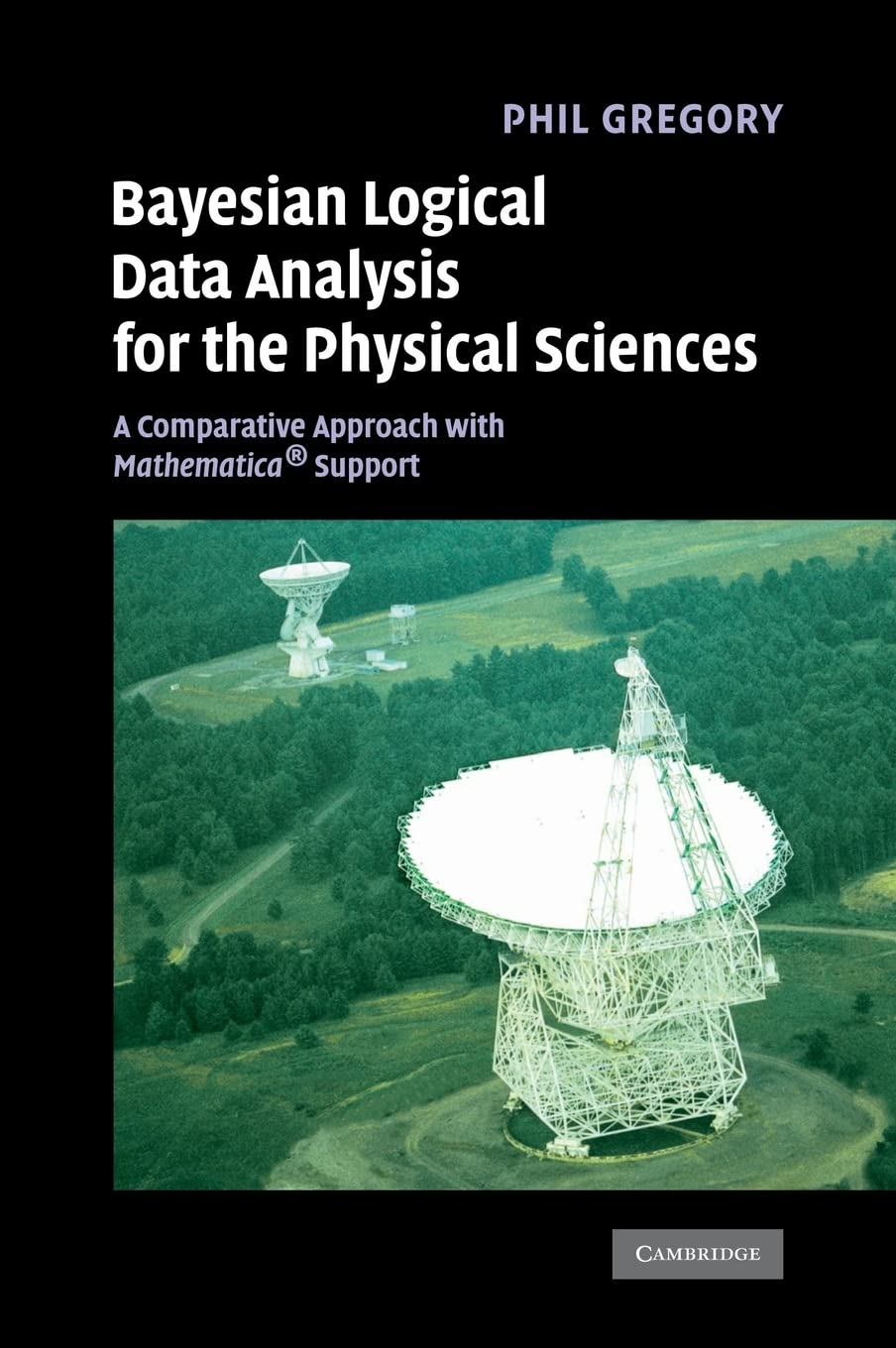
Bayesian Logical Data Analysis for the Physical Sciences: A Comparative Approach with Mathematica Support,Used
Sold by Ergodebooks, an authorized reseller.
Returns accepted within 30 days | support@ergodebooks.com
Shipping Information
- Free Standard Shipping — United States only
- Processing Time: 3–5 business days
- Estimated Delivery: 6–10 business days after dispatch
- Double-boxed, fully insured & discreetly packaged
- Tracking number sent via email once dispatched
Returns & Refund
Returns accepted within 30 days of delivery.
Damaged or Defective Item
Free return shipping + replacement or full refund
Wrong Item Received
Free return shipping + replacement or full refund
Change of Mind
Return shipping at customer's expense · 25% restocking fee applies
Payment Option

Bayesian inference provides a simple and unified approach to data analysis, allowing experimenters to assign probabilities to competing hypotheses of interest, on the basis of the current state of knowledge. By incorporating relevant prior information, it can sometimes improve model parameter estimates by many orders of magnitude. This book provides a clear exposition of the underlying concepts with many worked examples and problem sets. It also discusses implementation, including an introduction to Markov chain MonteCarlo integration and linear and nonlinear model fitting. Particularly extensive coverage of spectral analysis (detecting and measuring periodic signals) includes a selfcontained introduction to Fourier and discrete Fourier methods. There is a chapter devoted to Bayesian inference with Poisson sampling, and three chapters on frequentist methods help to bridge the gap between the frequentist and Bayesian approaches. Supporting Mathematica notebooks with solutions to selected problems, additional worked examples, and a Mathematica tutorial are available at www.cambridge.org/9780521150125.
⚠️ WARNING (California Proposition 65):
This product may contain chemicals known to the State of California to cause cancer, birth defects, or other reproductive harm.
For more information, please visit www.P65Warnings.ca.gov.
- Q: How many pages does this book have? A: This book has four hundred eighty-eight pages. It provides a comprehensive analysis of Bayesian inference and its applications.
- Q: What is the binding type of this book? A: The binding type is hardcover. This ensures durability and makes it suitable for frequent use.
- Q: What are the dimensions of this book? A: The book measures seven point twenty-four inches in length, zero point seventy-five inches in width, and ten inches in height. These dimensions make it a manageable size for reading.
- Q: How do I use this book for data analysis? A: You can use this book to understand Bayesian inference concepts and apply them in data analysis. It includes worked examples and problem sets to enhance your learning.
- Q: Is this book suitable for beginners? A: Yes, this book is suitable for beginners. It provides clear explanations and numerous examples to help readers grasp complex concepts.
- Q: Are there exercises included in the book? A: Yes, the book includes seventy-four exercises. These exercises complement the theoretical content and help reinforce learning.
- Q: How should I care for this hardcover book? A: To care for this hardcover book, store it in a cool, dry place and avoid exposure to direct sunlight. Clean it gently with a dry cloth to maintain its condition.
- Q: Is this book safe for all ages? A: Yes, this book is safe for all ages. However, it is primarily targeted towards readers with an interest in data analysis and statistics.
- Q: Can I find solutions to the exercises in this book? A: Yes, supporting Mathematica notebooks with solutions to selected problems are available online. You can access them at the Cambridge University Press website.
- Q: What if my book arrives damaged? A: If your book arrives damaged, you can return it for a replacement or refund. Check the return policy provided by the seller for specific instructions.
- Q: How does this book compare to other data analysis books? A: This book stands out due to its focus on Bayesian inference and its supportive Mathematica content. It provides a comparative approach, which is unique among data analysis resources.
- Q: What topics does this book cover? A: This book covers Bayesian inference, Markov chain Monte-Carlo integration, and spectral analysis among other topics. It also includes both Bayesian and frequentist perspectives.
- Q: Can this book help with statistical modeling? A: Yes, this book is designed to assist with statistical modeling. It discusses linear and nonlinear model fitting extensively.
- Q: Is there a tutorial included for Mathematica®? A: Yes, the book includes a Mathematica tutorial. This tutorial aids in understanding the computational aspects of the methods discussed.
- Q: Does this book include a glossary of terms? A: Yes, the book includes a glossary of terms related to Bayesian inference and data analysis. This is helpful for readers unfamiliar with the terminology.