
Title
Bayesian Modeling of Uncertainty in LowLevel Vision (The Springer International Series in Engineering and Computer Science, 79),New
Sold by Ergodebooks, an authorized reseller.
Returns accepted within 30 days | support@ergodebooks.com
Shipping Information
- Free Standard Shipping — United States only
- Processing Time: 3–5 business days
- Estimated Delivery: 6–10 business days after dispatch
- Double-boxed, fully insured & discreetly packaged
- Tracking number sent via email once dispatched
Returns & Refund
Returns accepted within 30 days of delivery.
Damaged or Defective Item
Free return shipping + replacement or full refund
Wrong Item Received
Free return shipping + replacement or full refund
Change of Mind
Return shipping at customer's expense · 25% restocking fee applies
Payment Option

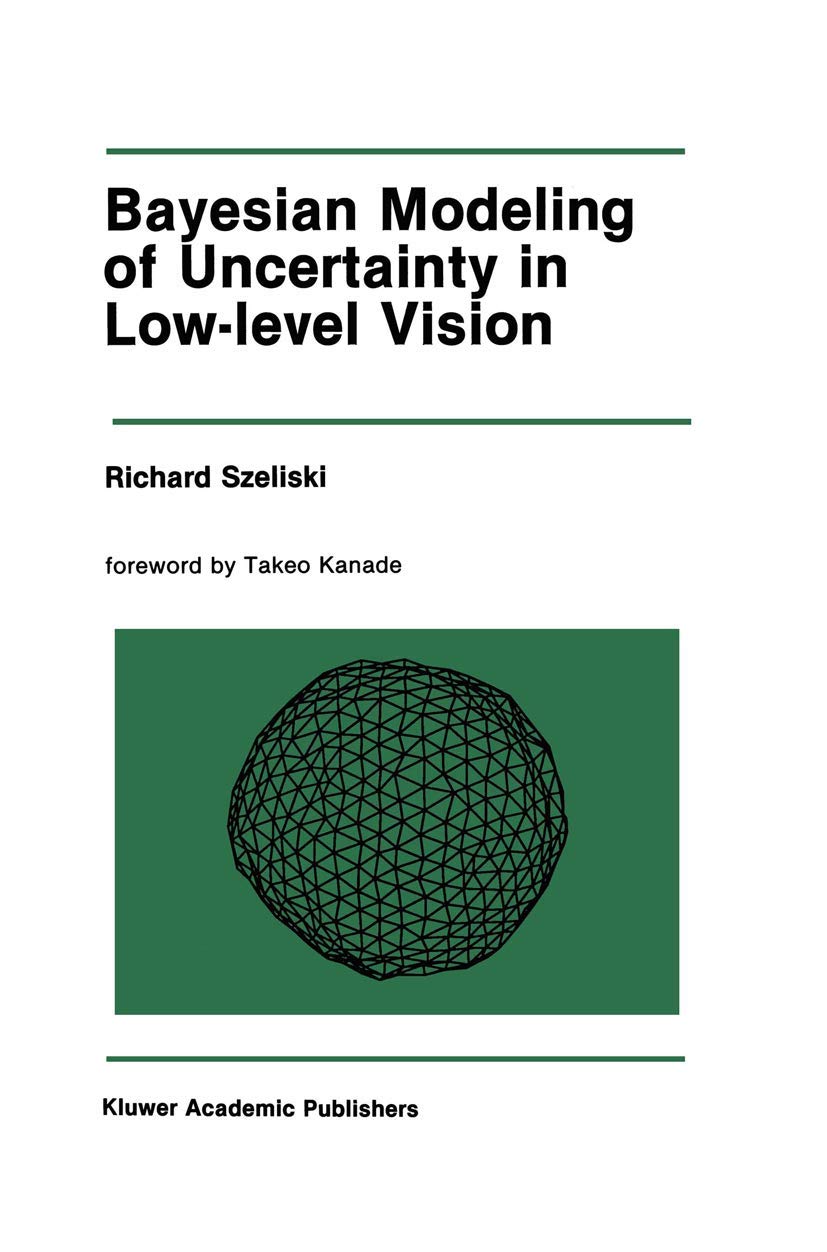
Vision has to deal with uncertainty. The sensors are noisy, the prior knowledge is uncertain or inaccurate, and the problems of recovering scene information from images are often illposed or underconstrained. This research monograph, which is based on Richard Szeliski's Ph.D. dissertation at Carnegie Mellon University, presents a Bayesian model for representing and processing uncertainty in low level vision. Recently, probabilistic models have been proposed and used in vision. Sze liski's method has a few distinguishing features that make this monograph im portant and attractive. First, he presents a systematic Bayesian probabilistic estimation framework in which we can define and compute the prior model, the sensor model, and the posterior model. Second, his method represents and computes explicitly not only the best estimates but also the level of uncertainty of those estimates using second order statistics, i.e., the variance and covariance. Third, the algorithms developed are computationally tractable for dense fields, such as depth maps constructed from stereo or range finder data, rather than just sparse data sets. Finally, Szeliski demonstrates successful applications of the method to several real world problems, including the generation of fractal surfaces, motion estimation without correspondence using sparse range data, and incremental depth from motion.
⚠️ WARNING (California Proposition 65):
This product may contain chemicals known to the State of California to cause cancer, birth defects, or other reproductive harm.
For more information, please visit www.P65Warnings.ca.gov.