
Title
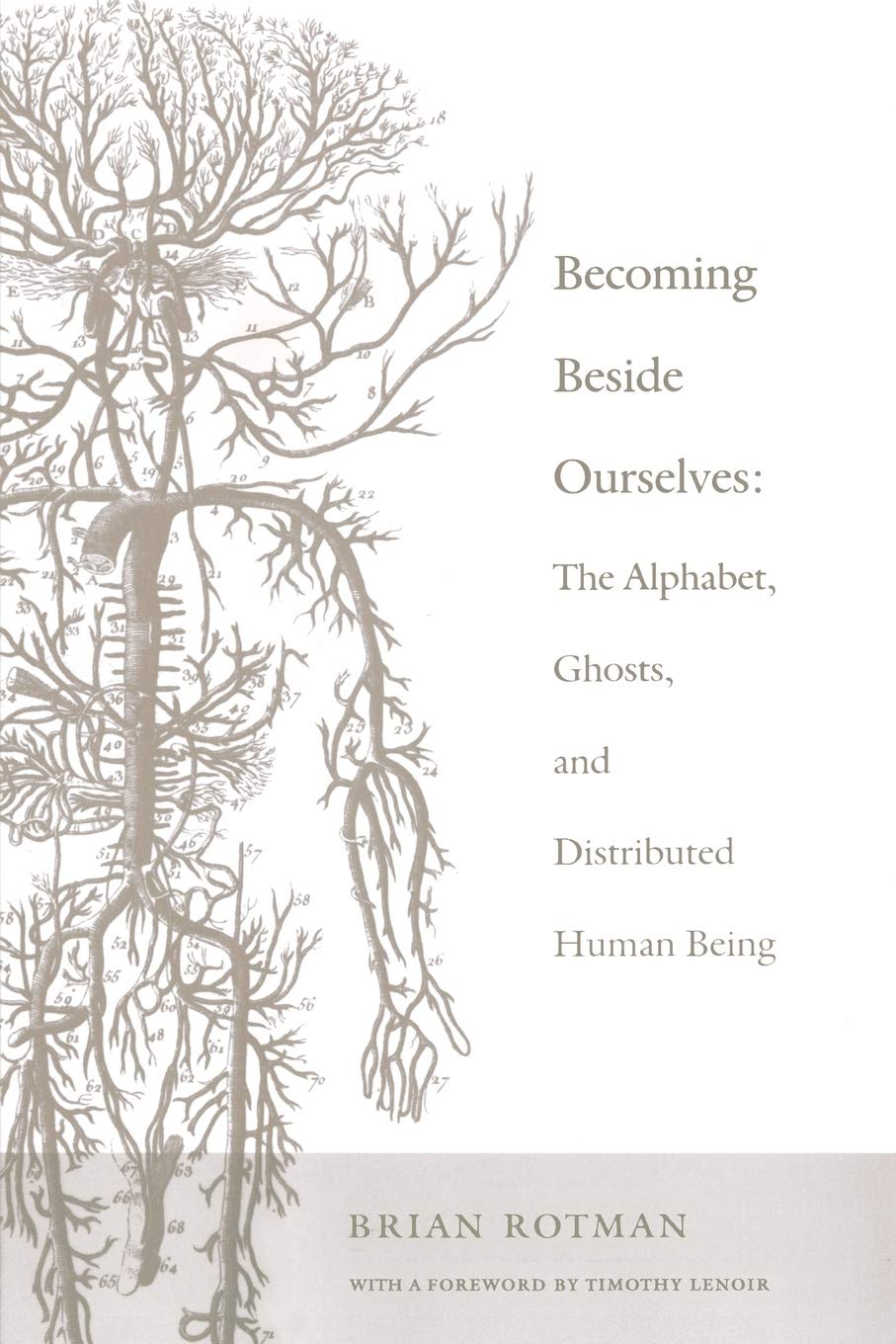
Becoming Beside Ourselves: The Alphabet, Ghosts, and Distributed Human Being,Used
Sold by Ergodebooks, an authorized reseller.
Returns accepted within 30 days | support@ergodebooks.com
Shipping Information
- Free Standard Shipping — United States only
- Processing Time: 3–5 business days
- Estimated Delivery: 6–10 business days after dispatch
- Double-boxed, fully insured & discreetly packaged
- Tracking number sent via email once dispatched
Returns & Refund
Returns accepted within 30 days of delivery.
Damaged or Defective Item
Free return shipping + replacement or full refund
Wrong Item Received
Free return shipping + replacement or full refund
Change of Mind
Return shipping at customer's expense · 25% restocking fee applies
Payment Option

Becoming Beside Ourselves continues the investigation that the renowned cultural theorist and mathematician Brian Rotman began in his previous books Signifying Nothing and Ad Infinitum...The Ghost in Turings Machine: exploring certain signs and the conceptual innovations and subjectivities that they facilitate or foreclose. In Becoming Beside Ourselves, Rotman turns his attention to alphabetic writing or the inscription of spoken language. Contending that all media configure what they mediate, he maintains that alphabetic writing has long served as the Wests dominant cognitive technology. Its logic and limitations have shaped thought and affect from its inception until the present. Now its grip on Western consciousness is giving way to virtual technologies and networked media, which are reconfiguring human subjectivity just as alphabetic texts have done for millennia.Alphabetic texts do not convey the bodily gestures of human speech: the hesitations, silences, and changes of pitch that infuse spoken language with affect. Rotman suggests that by removing the body from communication, alphabetic texts enable belief in singular, disembodied, authoritative forms of being such as God and the psyche. He argues that while disembodied agencies are credible and real to lettered selves, they are increasingly incompatible with selves and subjectivities formed in relation to new virtual technologies and networked media. Digital motioncapture technologies are restoring gesture and even touch to a prominent role in communication. Parallel computing is challenging the linear thought patterns and ideas of singularity facilitated by alphabetic language. Barriers between self and other are breaking down as the networked self is traversed by other selves to become multiple and distributed, formed through many actions and perceptions at once. The digital self is going plural, becoming beside itself.
⚠️ WARNING (California Proposition 65):
This product may contain chemicals known to the State of California to cause cancer, birth defects, or other reproductive harm.
For more information, please visit www.P65Warnings.ca.gov.
- Q: What is the main theme of 'Becoming Beside Ourselves'? A: The main theme of 'Becoming Beside Ourselves' revolves around the impact of alphabetic writing on human cognition and subjectivity, exploring how it has shaped thought, belief, and communication in the context of emerging digital technologies.
- Q: Who is the author of this book? A: 'Becoming Beside Ourselves' is written by Brian Rotman, a renowned cultural theorist and mathematician.
- Q: What is the publication date of this book? A: 'Becoming Beside Ourselves' was published on July 16, 2008.
- Q: What type of binding does this book have? A: This book is available in paperback binding.
- Q: How many pages are in 'Becoming Beside Ourselves'? A: The book contains 216 pages.
- Q: What condition is the used book in? A: The used book is listed as being in good condition.
- Q: Does this book discuss the relationship between technology and human communication? A: Yes, the book discusses how digital motion-capture technologies and networked media are reshaping communication and human subjectivity, in contrast to traditional alphabetic writing.
- Q: Is 'Becoming Beside Ourselves' suitable for readers interested in cultural theory? A: Yes, this book is particularly suitable for readers interested in cultural theory, cognitive technology, and the evolution of communication.
- Q: What are some key concepts explored in this book? A: Key concepts explored include the limitations of alphabetic writing, the nature of disembodied communication, and the implications of digital technologies on human identity.
- Q: What does the author argue about the future of human subjectivity? A: The author argues that the future of human subjectivity is increasingly plural and distributed due to the influence of digital technologies and networked communication.