
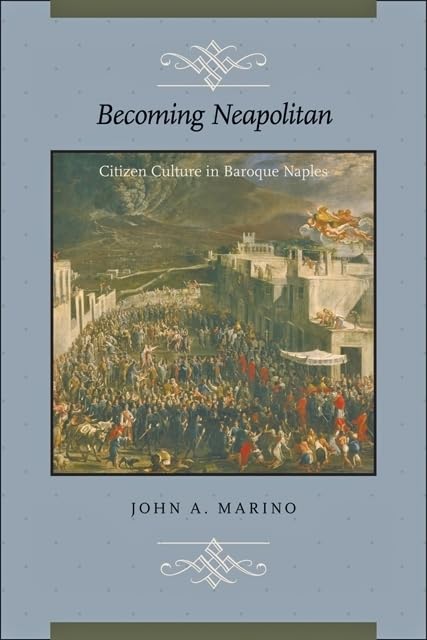
Title
Becoming Neapolitan: Citizen Culture in Baroque Naples,New
Sold by Ergodebooks, an authorized reseller.
Returns accepted within 30 days | support@ergodebooks.com
Shipping Information
- Free Standard Shipping — United States only
- Processing Time: 3–5 business days
- Estimated Delivery: 6–10 business days after dispatch
- Double-boxed, fully insured & discreetly packaged
- Tracking number sent via email once dispatched
Returns & Refund
Returns accepted within 30 days of delivery.
Damaged or Defective Item
Free return shipping + replacement or full refund
Wrong Item Received
Free return shipping + replacement or full refund
Change of Mind
Return shipping at customer's expense · 25% restocking fee applies
Payment Option

2011 Winner of the Phyllis Goodhart Gordan Book Prize of the Renaissance Society of AmericaNaples in the sixteenth and seventeenth centuries managed to maintain a distinct social character while under Spanish rule. John A. Marino's study explores how the population of the city of Naples constructed their identity in the face of Spanish domination.As Western Europes largest city, early modern Naples was a world unto itself. Its politics were decentralized and its neighborhoods diverse. Clergy, nobles, and commoners struggled to assert political and cultural power. Looking at these three groups, Marino unravels their complex interplay to show how such civic rituals as parades and festival days fostered a unified Neapolitan identity through the assimilation of Aragonese customs, Burgundian models, and Spanish governance. He discusses why the relationship between mythical and religious representations in ritual practices allowed Naples's inhabitants to identify themselves as citizens of an illustrious and powerful sovereignty and explains how this semblance of stability and harmony hid the city's political, cultural, and social fissures. In the process, Marino finds that being and becoming Neapolitan meant manipulating the city's rituals until their original content and meaning were lost. The consequent widening of divisions between rich and poor led Naples's vying castes to turn on one another as the Spanish monarchy weakened.Rich in source material and tightly integrated, this nuanced, synthetic overview of the disciplining of ritual life in early modern Naples digs deep into the construction of Neapolitan identity. Scholars of early modern Italy and of Italian and European history in general will find much to ponder in Marino's keen insights and compelling arguments.
⚠️ WARNING (California Proposition 65):
This product may contain chemicals known to the State of California to cause cancer, birth defects, or other reproductive harm.
For more information, please visit www.P65Warnings.ca.gov.
- Q: What is the main focus of 'Becoming Neapolitan: Citizen Culture in Baroque Naples'? A: The book explores how the population of Naples constructed their identity during the sixteenth and seventeenth centuries under Spanish rule, emphasizing the complex interplay among clergy, nobles, and commoners.
- Q: Who is the author of this book? A: The author is John A. Marino, a scholar specializing in early modern Italy.
- Q: When was 'Becoming Neapolitan' published? A: The book was published on January 3, 2011.
- Q: What are the key themes discussed in the book? A: Key themes include civic rituals, the assimilation of customs, the relationship between political power and cultural identity, and the social divisions in Naples during the Baroque period.
- Q: How many pages does this book contain? A: The book contains 360 pages.
- Q: Is 'Becoming Neapolitan' available in different formats? A: This book is available in hardcover format.
- Q: What is the condition of the book? A: The book is in new condition.
- Q: Who would benefit from reading this book? A: Scholars of early modern Italy and those interested in Italian and European history would find it particularly insightful.
- Q: What is the significance of the Phyllis Goodhart Gordan Book Prize mentioned? A: The book won the Phyllis Goodhart Gordan Book Prize awarded by the Renaissance Society of America, highlighting its scholarly importance.
- Q: Does the book discuss the impact of Spanish governance on Neapolitan identity? A: Yes, it examines how Spanish governance influenced the civic rituals and identity formation of Naples's inhabitants.