
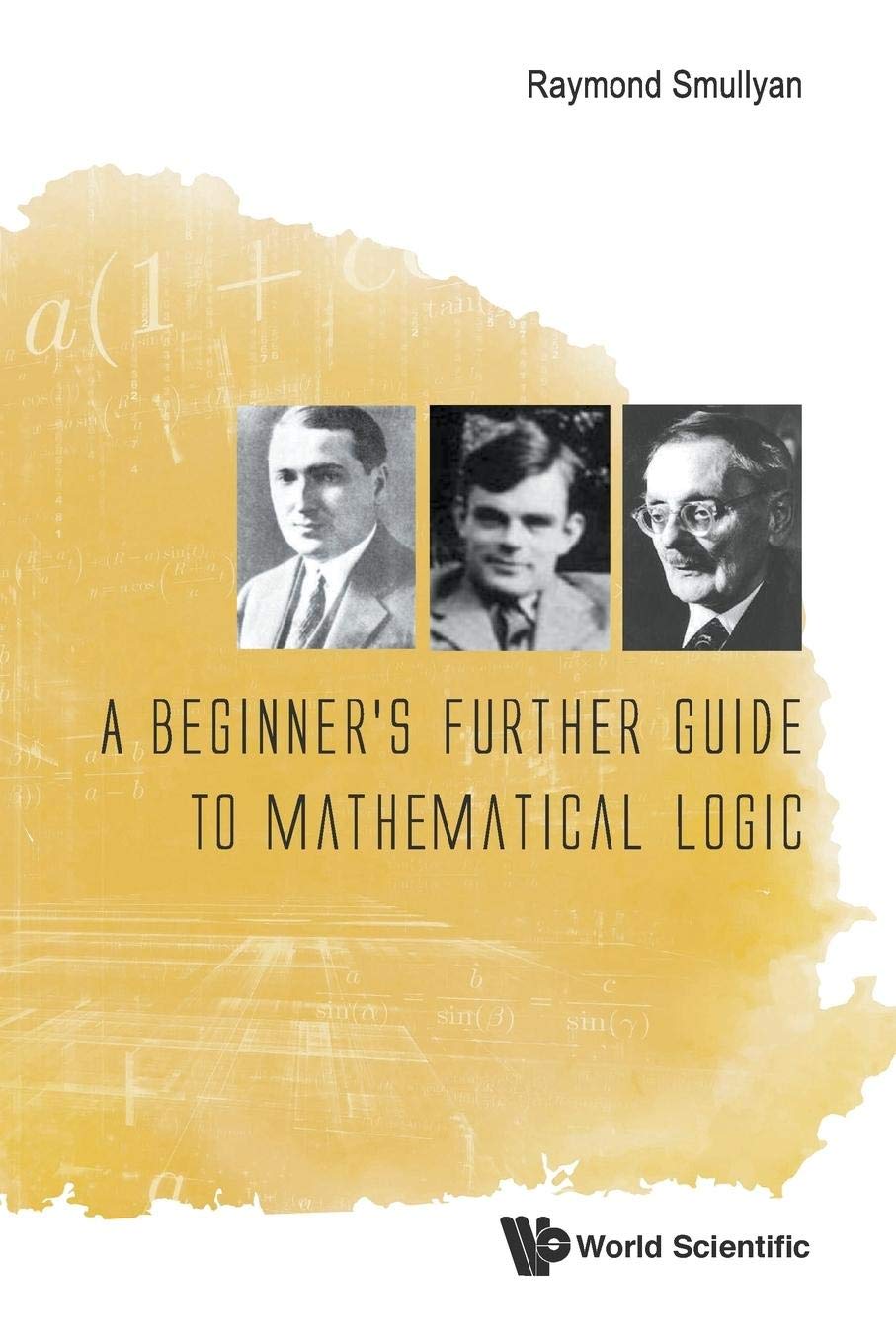
Title
Beginner's Further Guide To Mathematical Logic, A,New
Sold by Ergodebooks, an authorized reseller.
Returns accepted within 30 days | support@ergodebooks.com
Shipping Information
- Free Standard Shipping — United States only
- Processing Time: 3–5 business days
- Estimated Delivery: 6–10 business days after dispatch
- Double-boxed, fully insured & discreetly packaged
- Tracking number sent via email once dispatched
Returns & Refund
Returns accepted within 30 days of delivery.
Damaged or Defective Item
Free return shipping + replacement or full refund
Wrong Item Received
Free return shipping + replacement or full refund
Change of Mind
Return shipping at customer's expense · 25% restocking fee applies
Payment Option

A wealth of examples to which solutions are given permeate the text so the reader will certainly be active.' The Mathematical Gazette This is the final book written by the late great puzzle master and logician, Dr. Raymond Smullyan. This book is a sequel to my Beginner's Guide to Mathematical Logic. The previous volume deals with elements of propositional and firstorder logic, contains a bit on formal systems and recursion, and concludes with chapters on Gdel's famous incompleteness theorem, along with related results. The present volume begins with a bit more on propositional and firstorder logic, followed by what I would call a 'fein' chapter, which simultaneously generalizes some results from recursion theory, firstorder arithmetic systems, and what I dub a 'decision machine.' Then come five chapters on formal systems, recursion theory and metamathematical applications in a general setting. The concluding five chapters are on the beautiful subject of combinatory logic, which is not only intriguing in its own right, but has important applications to computer science. Argonne National Laboratory is especially involved in these applications, and I am proud to say that its members have found use for some of my results in combinatory logic. This book does not cover such important subjects as set theory, model theory, proof theory, and modern developments in recursion theory, but the reader, after studying this volume, will be amply prepared for the study of these more advanced topics.
⚠️ WARNING (California Proposition 65):
This product may contain chemicals known to the State of California to cause cancer, birth defects, or other reproductive harm.
For more information, please visit www.P65Warnings.ca.gov.
- Q: What is the main focus of 'Beginner's Further Guide To Mathematical Logic'? A: This book primarily focuses on advanced topics in mathematical logic, including propositional and first-order logic, formal systems, recursion theory, and combinatory logic.
- Q: Who is the author of this book? A: The author of 'Beginner's Further Guide To Mathematical Logic' is Dr. Raymond Smullyan, a renowned logician and puzzle master.
- Q: Is this book suitable for beginners in mathematical logic? A: While it is a sequel to 'Beginner's Guide to Mathematical Logic', this book assumes some prior knowledge of propositional and first-order logic, making it more suitable for readers who have completed the first volume.
- Q: How many pages does the book contain? A: The book contains a total of 288 pages.
- Q: When was 'Beginner's Further Guide To Mathematical Logic' published? A: This book was published on November 11, 2016.
- Q: What type of binding does this book have? A: The book is available in paperback binding.
- Q: Does the book include exercises or examples? A: Yes, the book is filled with a wealth of examples, many of which come with solutions to engage the reader actively.
- Q: What topics are covered in this book? A: The book covers advanced topics such as formal systems, recursion theory, metamathematical applications, and combinatory logic.
- Q: Can this book help in preparing for advanced studies in logic? A: Yes, after studying this volume, readers will be well-prepared for more advanced topics such as set theory, model theory, and modern recursion theory.
- Q: What is the item condition of the book? A: The book is in new condition.