
Title
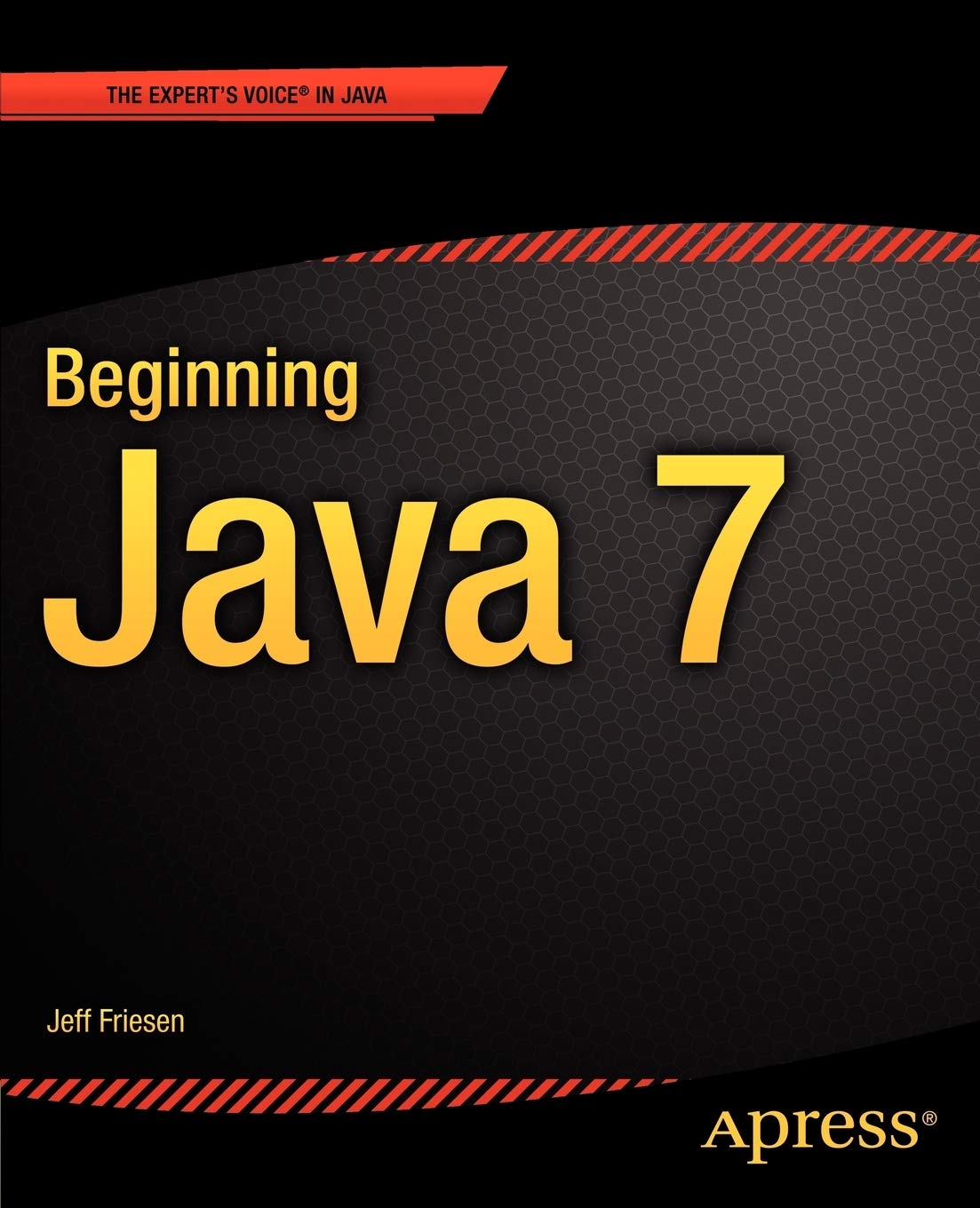
Beginning Java 7 (Expert's Voice in Java),Used
Sold by Ergodebooks, an authorized reseller.
Returns accepted within 30 days | support@ergodebooks.com
Shipping Information
- Free Standard Shipping — United States only
- Processing Time: 3–5 business days
- Estimated Delivery: 6–10 business days after dispatch
- Double-boxed, fully insured & discreetly packaged
- Tracking number sent via email once dispatched
Returns & Refund
Returns accepted within 30 days of delivery.
Damaged or Defective Item
Free return shipping + replacement or full refund
Wrong Item Received
Free return shipping + replacement or full refund
Change of Mind
Return shipping at customer's expense · 25% restocking fee applies
Payment Option

Beginning Java 7 guides you through version 7 of the Java language and a wide assortment of platform APIs. New Java 7 language features that are discussed include switchonstring and trywithresources. APIs that are discussed include Threading, the Collections Framework, the Concurrency Utilities, Swing, Java 2D, networking, JDBC, SAX, DOM, StAX, XPath, JAXWS, and SAAJ. This book also presents an introduction to Android app development so that you can apply some of its knowledge to the exciting world of Android app development.This book presents the following table of contents:Chapter 1 introduces you to Java and begins to cover the Java language by focusing on fundamental concepts such as comments, identifiers, variables, expressions, and statements.Chapter 2 continues to explore this language by presenting all of its features for working with classes and objects. You learn about features related to class declaration and object creation, encapsulation, information hiding, inheritance, polymorphism, interfaces, and garbage collection.Chapter 3 focuses on the more advanced language features related to nested classes, packages, static imports, exceptions, assertions, annotations, generics, and enums. Additional chapters introduce you to the few features not covered in Chapters 1through 3.Chapter 4 largely moves away from covering language features (although it does introduce class literals and strictfp) while focusing on languageoriented APIs. You learn about Math, StrictMath, Package, Primitive Type Wrapper Classes, Reference, Reflection, String, StringBuffer and StringBuilder, Threading, BigDecimal, and BigInteger in this chapter.Chapter 5 begins to explore Java's utility APIs by focusing largely on the Collections Framework. However, it also discusses legacy collectionoriented APIs and how to create your own collections.Chapter 6 continues to focus on utility APIsby presenting the concurrency utilities along with the Objects and Random classes.Chapter 7 moves you away from the commandline user interfaces that appear in previous chapters and toward graphical user interfaces. You first learn about the Abstract Window Toolkit foundation, and then explore the Java Foundation Classes interms of Swing and Java 2D. Appendix C explores Accessibility and Drag and Drop.Chapter 8 explores filesystemoriented I/O in terms of the File, RandomAccessFile, stream, and writer/reader classes.Chapter 9 introduces you to Java's network APIs (e.g., sockets). It also introduces you to the JDBC API for interacting with databases along with the Java DB database product.Chapter 10 dives into Java's XML support by first presenting an introduction to XML (including DTDs and schemas). It next explores the SAX, DOM, StAX, XPath, and XSLT APIs. It even briefly touches on the Validation API. While exploring XPath, you encounter namespace contexts, extension functions and function resolvers, and variables and variable resolvers.Chapter 11 introduces you to Java's support for SOAPbased and RESTful web services. As well as providing you with the basics of these web service categories, Chapter 11 presents some advanced topics, such as working with the SAAJ API to communicatewith a SOAPbased web service without having to rely on JAXWS. You will appreciate having learned about XML in Chapter 10 before diving into this chapter.Chapter 12 helps you put to use some of the knowledge you've gathered in previous chapters by showing you how to use Java to write an Android app's source code. This chapter introduces you to Android, discusses its architecture, shows you how toinstall necessary tools, and develops a simple app.Appendix A presents the solutions to the programming exercises that appear near the end of Chapters 1 through 12.Appendix B introduces you to Java's Scripting API along with Java 7's support for dynamically typed languages.Appendix C introduces you to additional APIs and architecture topics. Examples include Accessibility
⚠️ WARNING (California Proposition 65):
This product may contain chemicals known to the State of California to cause cancer, birth defects, or other reproductive harm.
For more information, please visit www.P65Warnings.ca.gov.