
Title
Behavior Trees in Robotics and AI: An Introduction (Chapman & Hall/CRC Artificial Intelligence and Robotics Series),Used
Sold by Ergodebooks, an authorized reseller.
Returns accepted within 30 days | support@ergodebooks.com
Shipping Information
- Free Standard Shipping — United States only
- Processing Time: 3–5 business days
- Estimated Delivery: 6–10 business days after dispatch
- Double-boxed, fully insured & discreetly packaged
- Tracking number sent via email once dispatched
Returns & Refund
Returns accepted within 30 days of delivery.
Damaged or Defective Item
Free return shipping + replacement or full refund
Wrong Item Received
Free return shipping + replacement or full refund
Change of Mind
Return shipping at customer's expense · 25% restocking fee applies
Payment Option

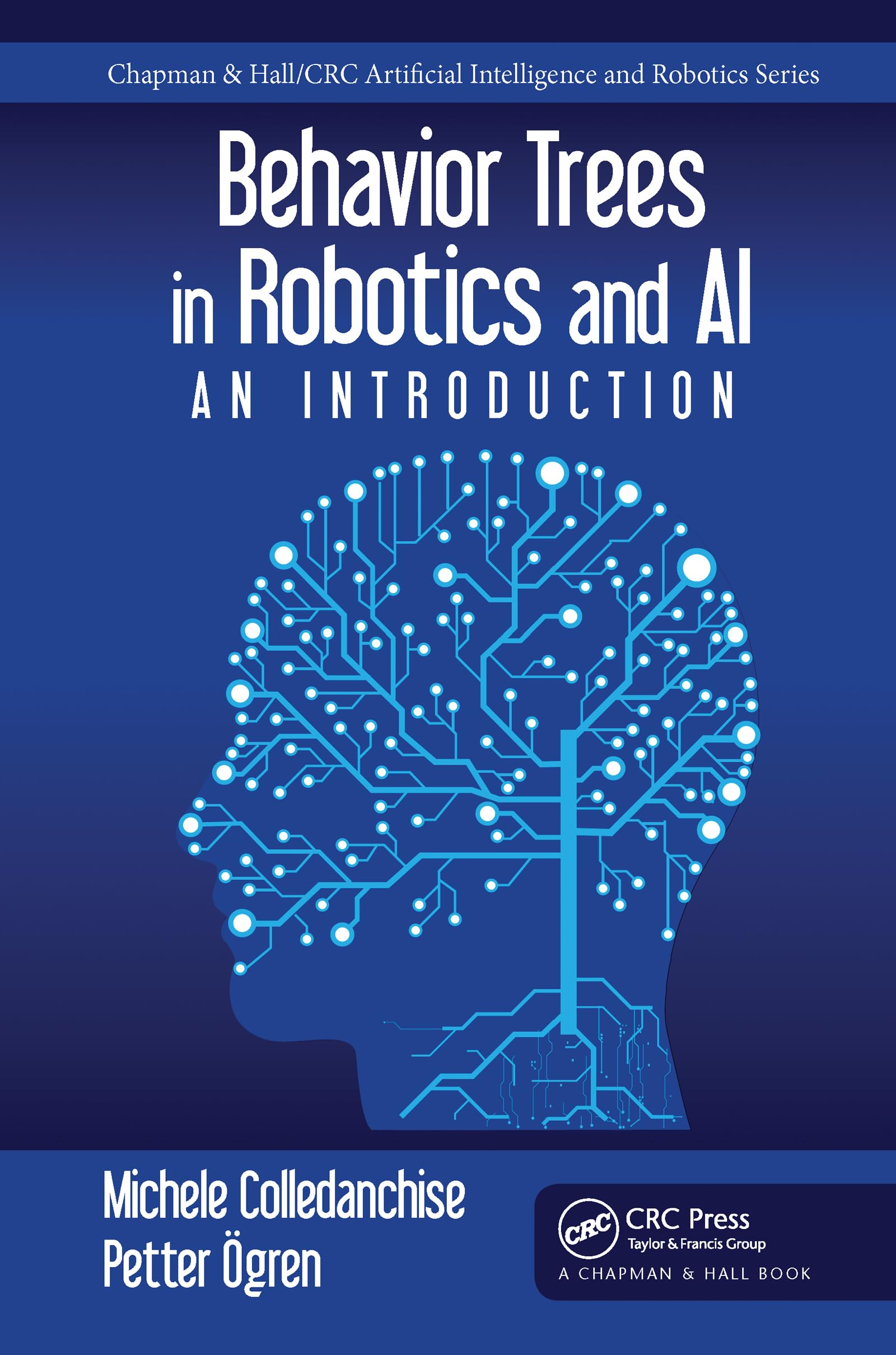
Behavior Trees (BTs) provide a way to structure the behavior of an artificial agent such as a robot or a nonplayer character in a computer game. Traditional design methods, such as finite state machines, are known to produce brittle behaviors when complexity increases, making it very hard to add features without breaking existing functionality. BTs were created to address this very problem, and enables the creation of systems that are both modular and reactive. Behavior Trees in Robotics and AI: An Introduction provides a broad introduction as well as an indepth exploration of the topic, and is the first comprehensive book on the use of BTs.This book introduces the subject of BTs from simple topics, such as semantics and design principles, to complex topics, such as learning and task planning. For each topic, the authors provide a set of examples, ranging from simple illustrations to realistic complex behaviors, to enable the reader to successfully combine theory with practice.Starting with an introduction to BTs, the book then describes how BTs relate to, and in many cases, generalize earlier switching structures, or control architectures. These ideas are then used as a foundation for a set of efficient and easy to use design principles. The book then presents a set of important extensions and provides a set of tools for formally analyzing these extensions using a state space formulation of BTs.With the new analysis tools, the book then formalizes the descriptions of how BTs generalize earlier approaches and shows how BTs can be automatically generated using planning and learning. The final part of the book provides an extended set of tools to capture the behavior of Stochastic BTs, where the outcomes of actions are described by probabilities. These tools enable the computation of both success probabilities and time to completion.This book targets a broad audience, including both students and professionals interested in modeling complex behaviors for robots, game characters, or other AI agents. Readers can choose at which depth and pace they want to learn the subject, depending on their needs and background.
⚠️ WARNING (California Proposition 65):
This product may contain chemicals known to the State of California to cause cancer, birth defects, or other reproductive harm.
For more information, please visit www.P65Warnings.ca.gov.