
Title
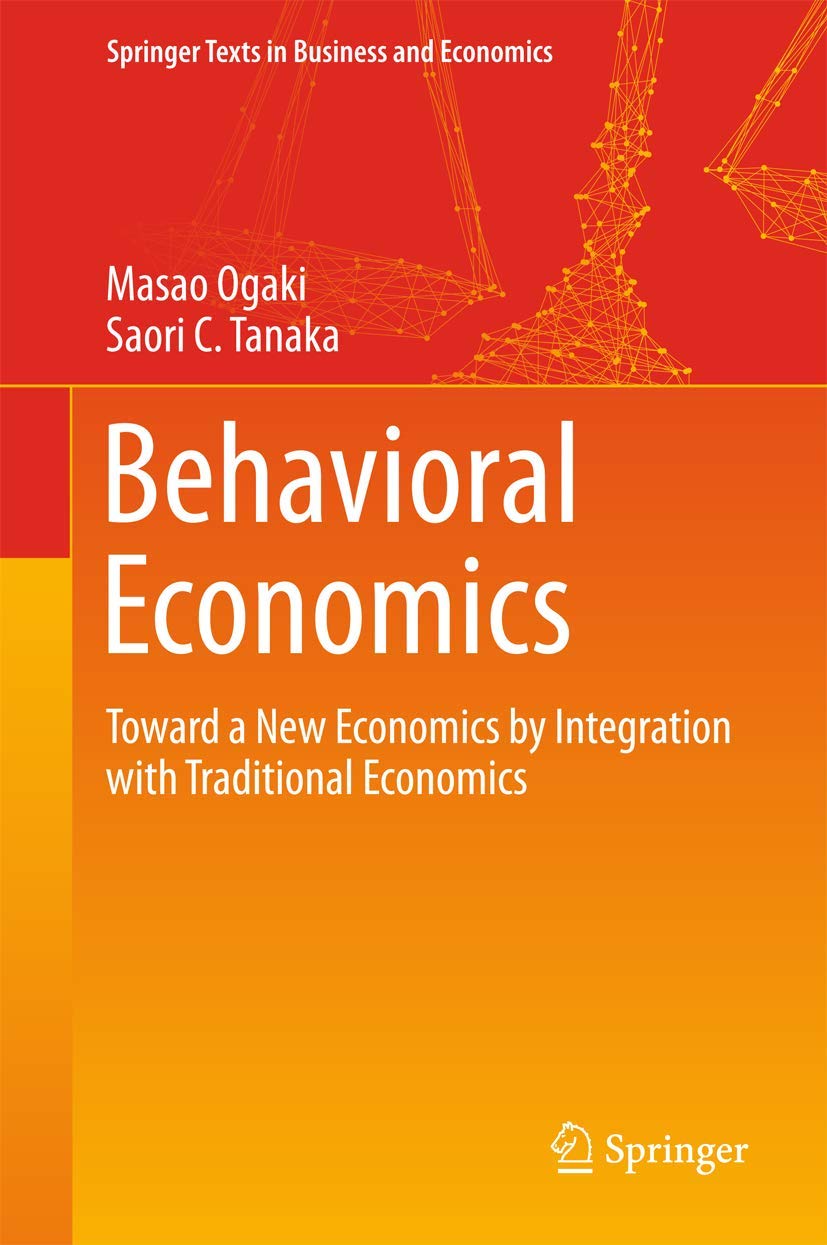
Behavioral Economics: Toward a New Economics by Integration with Traditional Economics (Springer Texts in Business and Economics,Used
Sold by Ergodebooks, an authorized reseller.
Returns accepted within 30 days | support@ergodebooks.com
Shipping Information
- Free Standard Shipping — United States only
- Processing Time: 3–5 business days
- Estimated Delivery: 6–10 business days after dispatch
- Double-boxed, fully insured & discreetly packaged
- Tracking number sent via email once dispatched
Returns & Refund
Returns accepted within 30 days of delivery.
Damaged or Defective Item
Free return shipping + replacement or full refund
Wrong Item Received
Free return shipping + replacement or full refund
Change of Mind
Return shipping at customer's expense · 25% restocking fee applies
Payment Option

This book is intended as a textbook for a course in behavioral economics for advanced undergraduate and graduate students who have already learned basic economics. The book will also be useful for introducing behavioral economics to researchers. Unlike some general audience books that discuss behavioral economics, this book does not take a position of completely negating traditional economics. Its position is that both behavioral and traditional economics are tools that have their own uses and limitations. Moreover, this work makes clear that knowledge of traditional economics is a necessary basis to fully understand behavioral economics. Some of the special features compared with other textbooks on behavioral economics are that this volume has full chapters on neuroeconomics, cultural and identity economics, and economics of happiness. These are distinctive subfields of economics that are different from, but closely related to, behavioral economics with many important overlaps with behavioral economics. Neuroeconomics, which is developing fast partly because of technological progress, seeks to understand how the workings of our minds affect our economic decision making. In addition to a full chapter on neuroeconomics, the book provides explanations of findings in neuroeconomics in chapters on prospect theory (a major decision theory of behavioral economics under uncertainty), intertemporal economic behavior, and social preferences (preferences that exhibit concerns for others). Cultural and identity economics seek to explain how cultures and peoples identities affect economic behaviors, and economics of happiness utilizes measures of subjective wellbeing. There is also a full chapter on behavioral normative economics, which evaluates economic policies based on findings and theories of behavioral economics.
⚠️ WARNING (California Proposition 65):
This product may contain chemicals known to the State of California to cause cancer, birth defects, or other reproductive harm.
For more information, please visit www.P65Warnings.ca.gov.