
Title
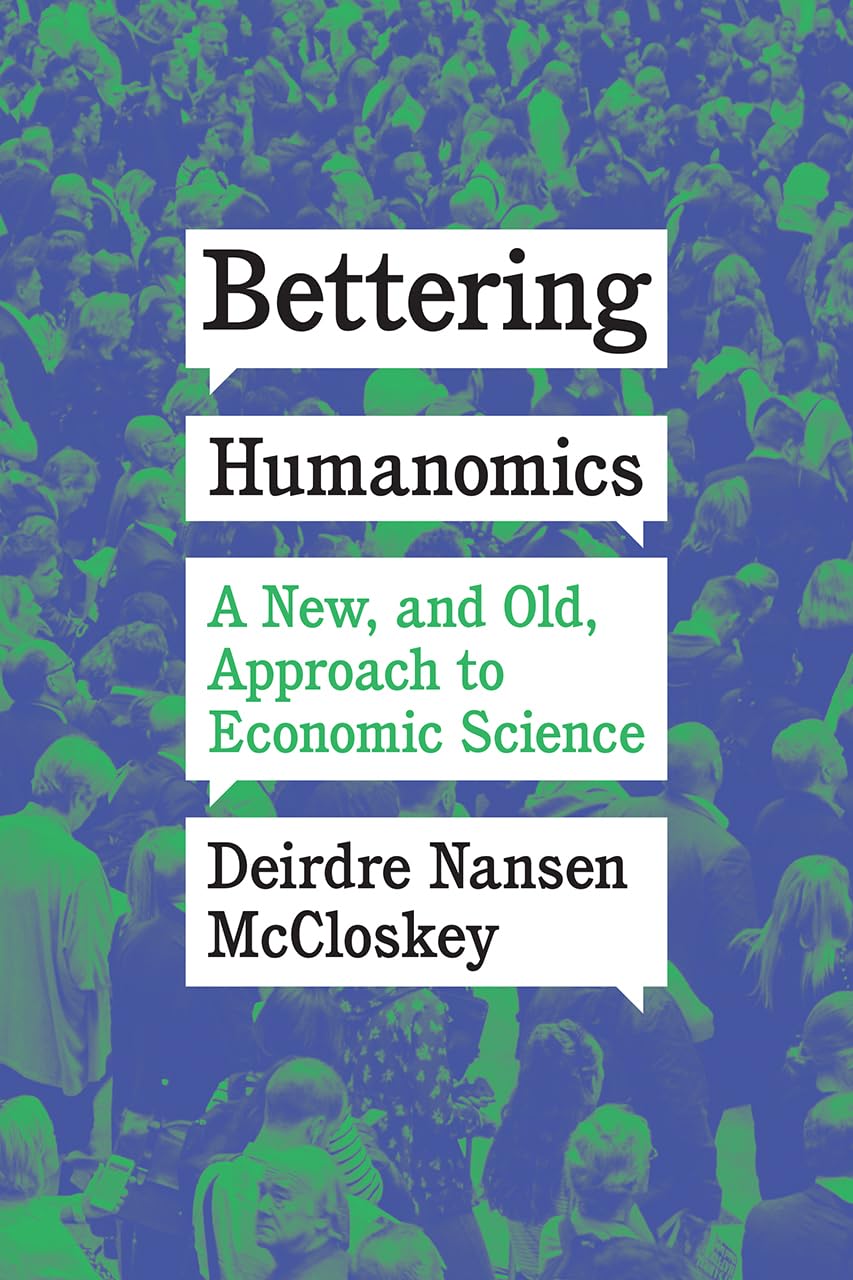
Bettering Humanomics: A New, And Old, Approach To Economic Science,New
Sold by Ergodebooks, an authorized reseller.
Returns accepted within 30 days | support@ergodebooks.com
Shipping Information
- Free Standard Shipping — United States only
- Processing Time: 3–5 business days
- Estimated Delivery: 6–10 business days after dispatch
- Double-boxed, fully insured & discreetly packaged
- Tracking number sent via email once dispatched
Returns & Refund
Returns accepted within 30 days of delivery.
Damaged or Defective Item
Free return shipping + replacement or full refund
Wrong Item Received
Free return shipping + replacement or full refund
Change of Mind
Return shipping at customer's expense · 25% restocking fee applies
Payment Option

Deirdre Nansen Mccloskey'S Latest Meticulous Work Examines How Economics Can Become A More 'Human' Science.Economic Historian Deirdre Nansen Mccloskey Has Distinguished Herself Through Her Writing On The Great Enrichment And The Betterment Of The Poornot Just Materially But Spiritually. In Bettering Humanomics She Continues Her Intellectually Playful Yet Rigorous Analysis With A Focus On Humans Rather Than The Institutions. Going Against The Grain Of Contemporary Neoinstitutional And Behavioral Economics Which Privilege Observation Over Understanding, She Asserts Her Vision Of Humanomics, Which Draws On The Work Of Bart Wilson, Vernon Smith, And Most Prominently, Adam Smith. She Argues For An Economics That Uses A Comprehensive Understanding Of Human Action Beyond Behaviorism.Mccloskey Clearly Articulates Her Points Of Contention With Believers In Imperfections, From Samuelson To Stiglitz, Claiming That They Have Neglected Scientific Analysis In Their Haste To Diagnose The Ills Of The System. In An Engaging And Erudite Manner, She Reaffirms The Global Successes Of Markettested Betterment And Calls For Empirical Investigation That Advances From Material Incentives To An Awareness Of The Human Within Historical And Ethical Frameworks. Bettering Humanomics Offers A Critique Of Contemporary Economics And A Proposal For An Economics As A Better Human Science.
⚠️ WARNING (California Proposition 65):
This product may contain chemicals known to the State of California to cause cancer, birth defects, or other reproductive harm.
For more information, please visit www.P65Warnings.ca.gov.
- Q: How many pages does 'Bettering Humanomics' have? A: This book has one hundred forty-four pages. It offers a thorough examination of economic science through a human-centric lens.
- Q: What are the dimensions of 'Bettering Humanomics'? A: The book measures six inches in length, zero point five one inches in width, and nine point zero two inches in height. These dimensions make it easy to handle.
- Q: What type of binding does 'Bettering Humanomics' have? A: The book is hardcover bound. This type of binding provides durability and a premium feel.
- Q: Who is the author of 'Bettering Humanomics'? A: The author is Deirdre Nansen McCloskey. She is known for her work in economic history.
- Q: What category does 'Bettering Humanomics' fall under? A: This book is categorized under Economic History. It blends historical insights with economic theory.
- Q: What themes does 'Bettering Humanomics' explore? A: The book explores themes of human action in economics. It critiques contemporary economic theories and advocates for a more human-focused approach.
- Q: Is 'Bettering Humanomics' suitable for beginners in economics? A: Yes, the book is suitable for beginners. McCloskey presents complex ideas in an engaging and accessible manner.
- Q: What kind of reader would benefit from 'Bettering Humanomics'? A: Readers interested in economic theory, history, and human behavior will benefit. It offers insights into how economics can be a more human-centered science.
- Q: Can I use 'Bettering Humanomics' as a textbook? A: Yes, it can be used as a supplementary textbook. Its rigorous analysis provides valuable insights for students.
- Q: How should I store 'Bettering Humanomics' to keep it in good condition? A: Store the book upright in a cool, dry place. Avoid direct sunlight to preserve its binding and pages.
- Q: What if 'Bettering Humanomics' arrives damaged? A: If the book arrives damaged, you can return it for a replacement or refund. Check the seller's return policy for details.
- Q: How should I clean 'Bettering Humanomics'? A: To clean the book, use a soft, dry cloth to gently wipe the cover. Avoid using water or cleaners on the pages.
- Q: Is there a warranty for 'Bettering Humanomics'? A: Typically, there is no warranty for books. However, check with the retailer for any specific guarantees.
- Q: What is the main argument of 'Bettering Humanomics'? A: The main argument is that economics should focus on human action rather than just behavior. McCloskey advocates for a more ethical framework.
- Q: Does 'Bettering Humanomics' reference other economists? A: Yes, it references economists like Bart Wilson, Vernon Smith, and Adam Smith. These references support McCloskey's arguments.
- Q: What critiques does 'Bettering Humanomics' offer? A: The book critiques contemporary economic theories for prioritizing observation over understanding. McCloskey emphasizes the importance of human context.