
Title
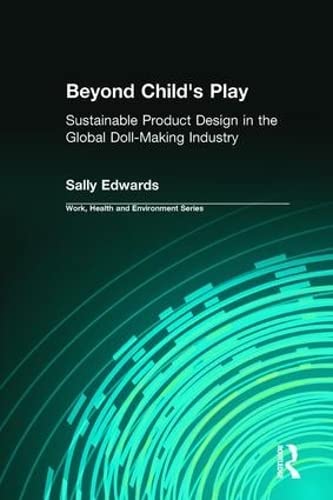
Beyond Child's Play: Sustainable Product Design in the Global Dollmaking Industry (Work, Health and Environment Series),Used
Sold by Ergodebooks, an authorized reseller.
Returns accepted within 30 days | support@ergodebooks.com
Shipping Information
- Free Standard Shipping — United States only
- Processing Time: 3–5 business days
- Estimated Delivery: 6–10 business days after dispatch
- Double-boxed, fully insured & discreetly packaged
- Tracking number sent via email once dispatched
Returns & Refund
Returns accepted within 30 days of delivery.
Damaged or Defective Item
Free return shipping + replacement or full refund
Wrong Item Received
Free return shipping + replacement or full refund
Change of Mind
Return shipping at customer's expense · 25% restocking fee applies
Payment Option

Sustainable product design is more than eco design: it goes beyond 'green' to consider the work environment, community impacts, consumer health, and economic viability, as well as environmental attributes. "Beyond Child's Play" explores the concept of sustainable product design in the context of the global dollmaking industry. To initiate this research, the author reviewed eco design parameters and developed criteria for sustainable product design in the dollmaking industry. Using this framework, she conducted three case studies of do I making: the American Girl doll produced in China, the Kathe Kruse doll produced in Germany and the Q'ewar Project doll produced in Peru. Themes emerged from this research that have relevance beyond the dollmaking industry: the value of making a product with care; designing work for human dignity; intention and vision for sustainability; the implications of materials choices; and, transparency and sustainability. Sustainable product design calls for fundamentally new thinking. By connecting the term 'sustainable' to 'product', we raise expectations for a radically different approach to design, production, and consumption. This framework integrates the eco design principles of detoxification and dematerialization with the principle of 'humanization', to ensure that the work environment where the product is made is safe and healthy and that local communities benefit from production. This approach places increased responsibility on the industrial designer and decisionmakers throughout the supply chain, including governments, corporations, and citizens. Sustainable product design can be implemented effectively only when systems are in place that support sustainable production and consumption.
⚠️ WARNING (California Proposition 65):
This product may contain chemicals known to the State of California to cause cancer, birth defects, or other reproductive harm.
For more information, please visit www.P65Warnings.ca.gov.