
Title
Beyond Economic Man: A New Foundation for Microeconomics,Used
Sold by Ergodebooks, an authorized reseller.
Returns accepted within 30 days | support@ergodebooks.com
Shipping Information
- Free Standard Shipping — United States only
- Processing Time: 3–5 business days
- Estimated Delivery: 6–10 business days after dispatch
- Double-boxed, fully insured & discreetly packaged
- Tracking number sent via email once dispatched
Returns & Refund
Returns accepted within 30 days of delivery.
Damaged or Defective Item
Free return shipping + replacement or full refund
Wrong Item Received
Free return shipping + replacement or full refund
Change of Mind
Return shipping at customer's expense · 25% restocking fee applies
Payment Option

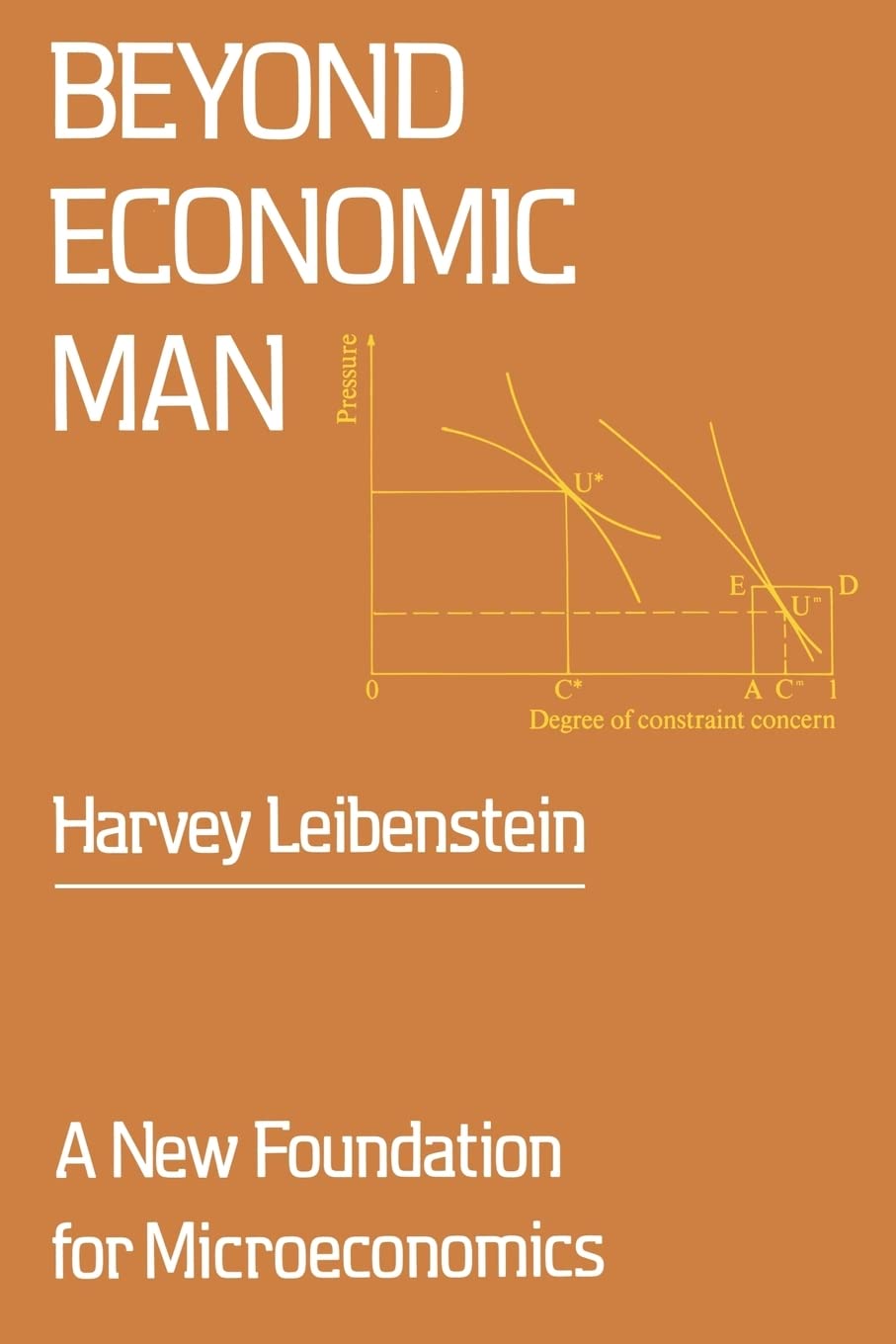
Harvey Leibenstein has written a major new book in microeconomic theory. It is a sophisticated reorientation of microtheory that breaks away from the conventional, highly refined neoclassical theory, which in turn is in the direct line of descent from Adam Smith's The Wealth of Nations (1776). The author accomplishes this feat by introducing modern psychological concepts to microtheory, by using individuals instead of collections of individuals as his basic units of study, and by suggesting that relating the theory to the concept of effort (an Xefficiency factor) will provide the most significant results.His innovative central variable, effort, is an X factor, he reminds us, because of its relatively unknown character in affecting output. Basically this leads to a new mode of thinking about economic problems in which the optimizing assumption of standard theory becomes a special extreme case.The Xefficiency factorsmotivation, effort, and so onallow for a restatement of microtheory. and for new applications and new conclusions: (1) businesses do not minimize costs or maximize profits; (2) actual productivity is very far from optimal even under conditions that approximate competition; (3) current modes of regulating monopolistic industries are apt to be inefficient at the expense of the consumer.Lebensteins new theory also has practical applications for the problems faced by management of businesses in the private or public sector, and in the fiscal affairs of the nation. When the theory is applied to inflation one salient and timely example it leads to results implying that inflation may be a cause of unemployment rather than an influence that reduces unemployment.
⚠️ WARNING (California Proposition 65):
This product may contain chemicals known to the State of California to cause cancer, birth defects, or other reproductive harm.
For more information, please visit www.P65Warnings.ca.gov.