
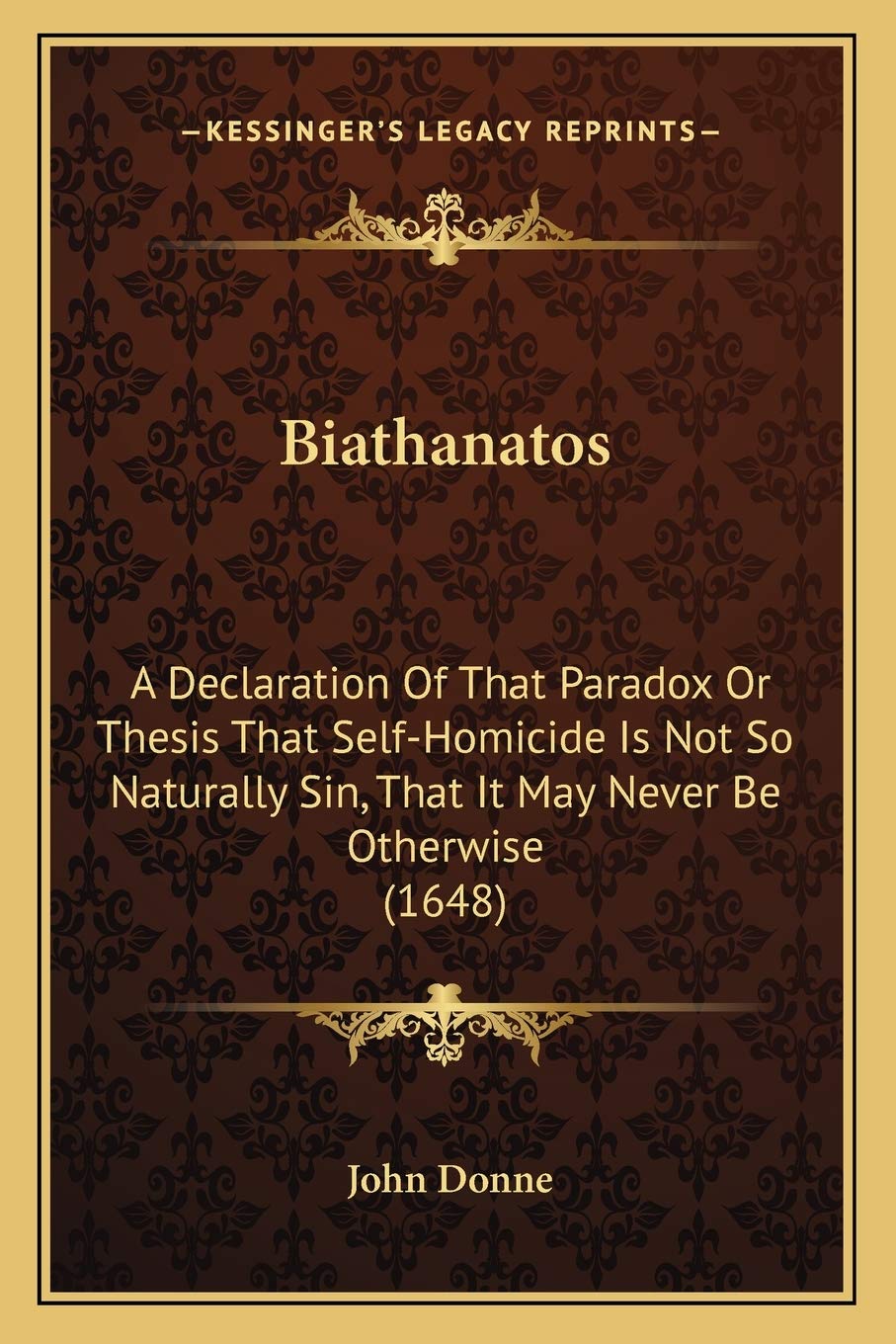
Title
Biathanatos: A Declaration Of That Paradox Or Thesis That SelfHomicide Is Not So Naturally Sin, That It May Never Be Otherwise ,New
Sold by Ergodebooks, an authorized reseller.
Returns accepted within 30 days | support@ergodebooks.com
Shipping Information
- Free Standard Shipping — United States only
- Processing Time: 3–5 business days
- Estimated Delivery: 6–10 business days after dispatch
- Double-boxed, fully insured & discreetly packaged
- Tracking number sent via email once dispatched
Returns & Refund
Returns accepted within 30 days of delivery.
Damaged or Defective Item
Free return shipping + replacement or full refund
Wrong Item Received
Free return shipping + replacement or full refund
Change of Mind
Return shipping at customer's expense · 25% restocking fee applies
Payment Option

Biathanatos is a philosophical treatise written by John Donne in 1648, exploring the controversial topic of suicide. In this work, Donne argues that selfhomicide is not inherently sinful, and that there are circumstances in which it may be justified. He explores the historical and cultural attitudes towards suicide, as well as the theological and moral implications of the act. The book is divided into several sections, each examining a different aspect of the topic, including the nature of death, the role of God in human affairs, and the ethics of suicide. Despite its controversial subject matter, Biathanatos is a thoughtful and nuanced exploration of a complex issue, and remains a significant work in the history of philosophy and theology.This scarce antiquarian book is a facsimile reprint of the old original and may contain some imperfections such as library marks and notations. Because we believe this work is culturally important, we have made it available as part of our commitment for protecting, preserving, and promoting the world's literature in affordable, high quality, modern editions, that are true to their original work.
⚠️ WARNING (California Proposition 65):
This product may contain chemicals known to the State of California to cause cancer, birth defects, or other reproductive harm.
For more information, please visit www.P65Warnings.ca.gov.
- Q: What is the main topic of 'Biathanatos'? A: 'Biathanatos' is a philosophical treatise by John Donne that explores the controversial topic of suicide, arguing that self-homicide is not inherently sinful.
- Q: Who is the author of 'Biathanatos'? A: The author of 'Biathanatos' is John Donne, a notable poet and cleric from the 17th century.
- Q: When was 'Biathanatos' published? A: 'Biathanatos' was published in 1648, although this edition is a reprint from 2010.
- Q: What is the format of 'Biathanatos'? A: 'Biathanatos' is available in paperback format, making it accessible for readers.
- Q: How many pages does 'Biathanatos' have? A: 'Biathanatos' consists of 242 pages, offering an in-depth exploration of its themes.
- Q: What are some key themes discussed in 'Biathanatos'? A: Key themes in 'Biathanatos' include the nature of death, theological implications of suicide, and cultural attitudes towards self-homicide.
- Q: Is this edition of 'Biathanatos' a facsimile reprint? A: Yes, this edition of 'Biathanatos' is a facsimile reprint of the original work, which may contain some imperfections.
- Q: What is the significance of 'Biathanatos' in philosophy and theology? A: 'Biathanatos' is considered a significant work in the history of philosophy and theology due to its thoughtful examination of a complex issue.
- Q: Does 'Biathanatos' contain any illustrations or additional features? A: This reprint does not mention any illustrations or additional features, focusing primarily on the text.
- Q: Can 'Biathanatos' be suitable for modern readers? A: 'Biathanatos' is suitable for modern readers interested in philosophical discussions around ethics and morality regarding suicide.