If you have any questions, you are always welcome to contact us. We'll get back to you as soon as possible, withing 24 hours on weekdays.
Customer service
All questions about your order, return and delivery must be sent to our customer service team by e-mail at yourstore@yourdomain.com
Sale & Press
If you are interested in selling our products, need more information about our brand or wish to make a collaboration, please contact us at press@yourdomain.com
Help
If you have any questions, you are always welcome to contact us. We'll get back to you as soon as possible, withing 24 hours on weekdays.
Customer service
All questions about your order, return and delivery must be sent to our customer service team by e-mail at yourstore@yourdomain.com
Sale & Press
If you are interested in selling our products, need more information about our brand or wish to make a collaboration, please contact us at press@yourdomain.com
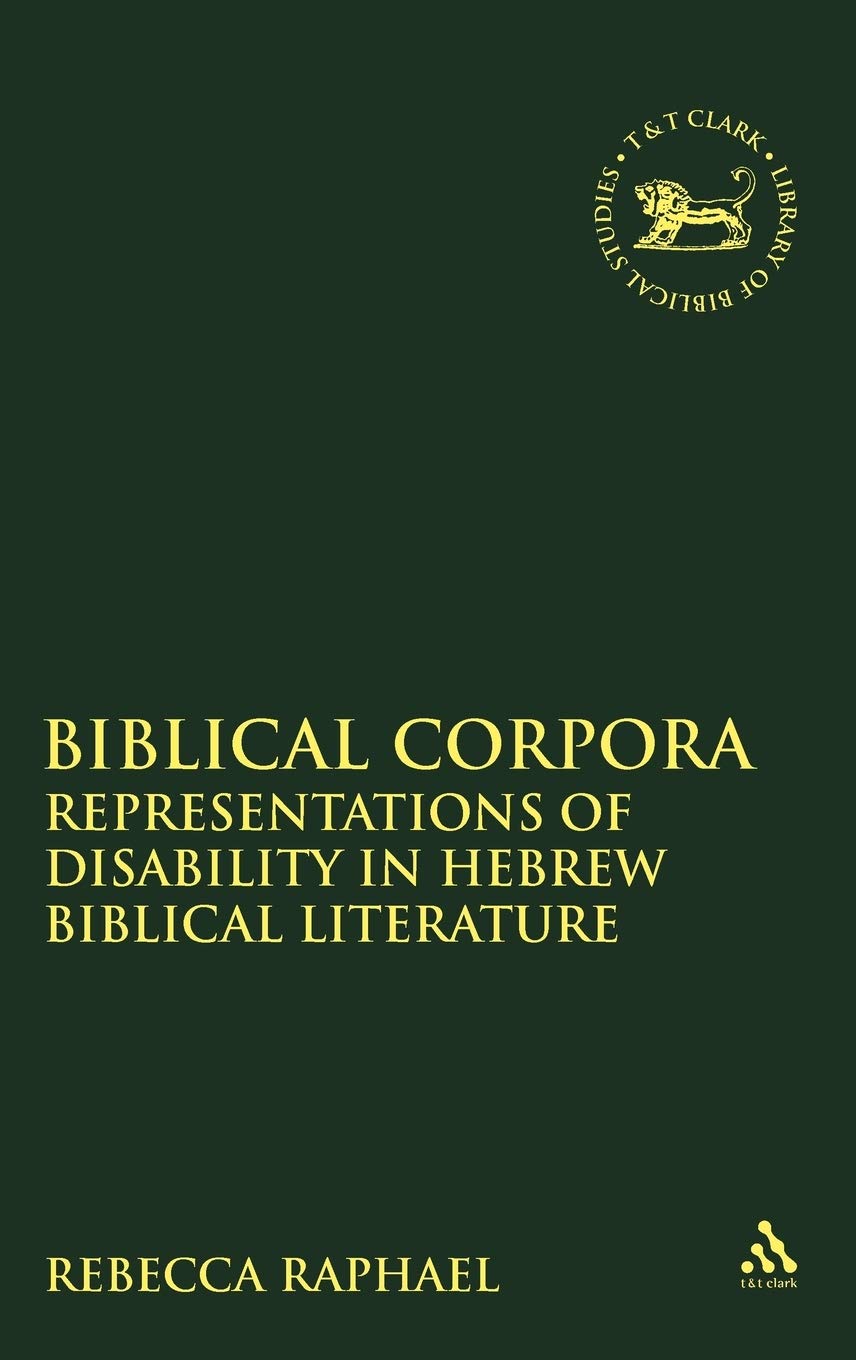
The book is organized by genre of biblical literature. First, the priestly literature articulates a binary concept of disability as impure and passive, i.e. as 'other' to the pure, holy, and active. By contrast, in the prophetic literature and the Psalms, images of disability structure communication among God, prophets, leaders, and people. Here, disability does not simply mean impurity; its valuation depends on its possessor. Wisdom literature and narrative present figures (e.g. Job, Mephibosheth) whose innate or acquired disabilities are nevertheless placed, and not simply as impurities, within cosmic and social order. Although priestly literature seems anomalous, all strata of biblical literature use disability imagery not primarily to represent disabled persons, but mainly to represent the power of Israel's God. Physical norms and disability thus play a pervasive and previously neglected role in biblical categories of holy/unholy, pure/impure, election/rejection, and God/idols.This book provides a literary critical method focused on representation in the canonical form of the text allows a comprehensive view of how images of disability operate in relation to major concepts, and also provides a foundation for studies in the history of interpretation. All discussion of biblical passages and books draw on existing historical studies as a necessary precondition for understanding.
⚠️ WARNING (California Proposition 65):
This product may contain chemicals known to the State of California to cause cancer,
birth defects, or other reproductive harm.
For MAP (Minimum Advertised Price) violations and Intellectual Property (IP) or Trademark concerns, please contact:
support@ergodebooks.com
⚠️ California Proposition 65 Warning: Some products sold on this website may expose you to chemicals known to the State of California to cause cancer, birth defects, or other reproductive harm. For more information, visit www.P65Warnings.ca.gov.