
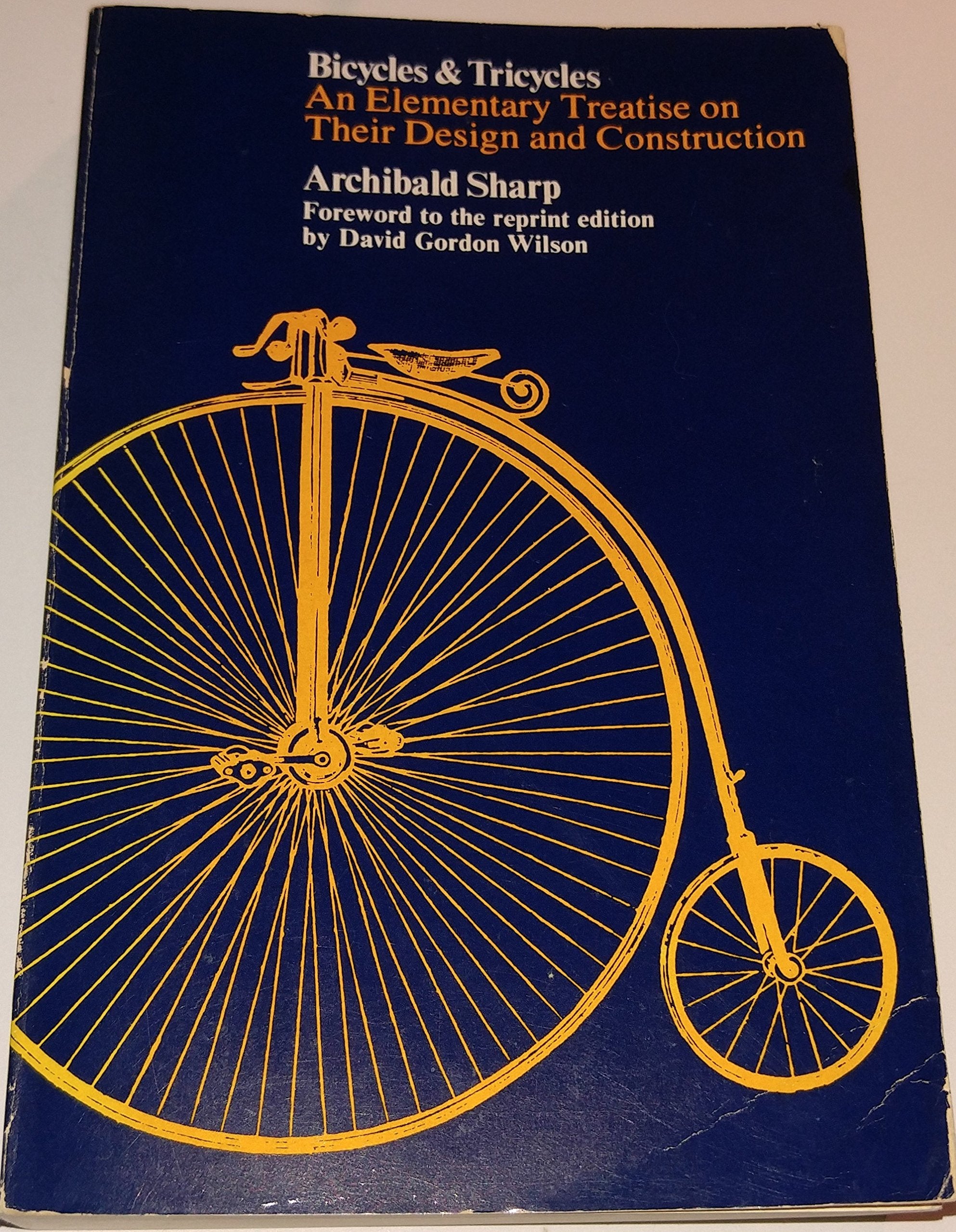
Title

Bicycles And Tricycles: An Elementary Treatise On Their Design And Construction
Sold by Ergodebooks, an authorized reseller.
Returns accepted within 30 days | support@ergodebooks.com
Shipping Information
- Free Standard Shipping — United States only
- Processing Time: 3–5 business days
- Estimated Delivery: 6–10 business days after dispatch
- Double-boxed, fully insured & discreetly packaged
- Tracking number sent via email once dispatched
Returns & Refund
Returns accepted within 30 days of delivery.
Damaged or Defective Item
Free return shipping + replacement or full refund
Wrong Item Received
Free return shipping + replacement or full refund
Change of Mind
Return shipping at customer's expense · 25% restocking fee applies
Payment Option

Foreword By David Gordon Wilsonpublished In 1896, Bicycles And Tricycles Was The First Serious, Scientifically Based Study Of The Bicycle. It Begins With A General Exposition Of Mechanical Principles: Dynamic, Static, And Straining Forces. It Then Covers Successive Experiments At Bicycle And Tricycle Design, Including Several Mechanical Monstrosities.With The Aid Of Elegant, Sometimes Humorous Drawings, The Book Examines Various Designs For Their Relative Stability, Steering Advantages, Gearing And Resistance Properties. The Final Selection Discusses The Design Of Individual Components In Detail, Including The Frame (From The Point Of View Of Stress Analysis); Wheels; Bearings; Chains And Chain Gearing; Toothedwheel Gearing; The Leverandcrank Gear; Tires; Pedals, Cranks And Bottom Brackets; Springs And Saddles; And Brakes.A Definitive Work In Its Own Time, Bicycles And Tricycles Is A Collector'S Item For Historylovers As Well As Bicycleenthusiastsa Treat For Tinkerers And All Those Interested In The History Of Invention.
⚠️ WARNING (California Proposition 65):
This product may contain chemicals known to the State of California to cause cancer, birth defects, or other reproductive harm.
For more information, please visit www.P65Warnings.ca.gov.
- Q: What is the binding type of this book? A: The binding type of this book is paperback. This makes it lightweight and flexible, ideal for easy reading.
- Q: How many pages does this book have? A: This book has four hundred pages. It provides an in-depth exploration of bicycle and tricycle design.
- Q: What are the dimensions of this book? A: The dimensions of this book are five inches in length, one point twenty-six inches in width, and seven point fifty-two inches in height. This compact size makes it portable.
- Q: Who is the author of this book? A: The author of this book is Archibald Sharp. He provides detailed insights into the mechanics of bicycles and tricycles.
- Q: What is the publication date of this book? A: This book was published in eighteen ninety-six. It is a historical text that examines early bicycle design.
- Q: What category does this book fall under? A: This book falls under the Civil & Environmental category. It discusses engineering concepts related to bicycle design.
- Q: How can I use this book for research? A: You can use this book for research on bicycle mechanics and historical design principles. It offers foundational knowledge for enthusiasts and professionals.
- Q: Is this book suitable for beginners? A: Yes, this book is suitable for beginners. It explains mechanical principles in an accessible manner, making it easy to understand.
- Q: What topics are covered in this book? A: This book covers topics such as mechanical principles, design experiments, and component specifications. Each section provides detailed insights into bicycle engineering.
- Q: How should I store this book? A: You should store this book in a cool, dry place away from direct sunlight. This will help preserve the binding and pages.
- Q: Can this book be read by children? A: Yes, children can read this book, but adult supervision is recommended for younger readers. The content is educational and historically significant.
- Q: What is the best way to care for this book? A: The best way to care for this book is to handle it gently and avoid exposure to moisture. Keeping it in a protective cover can also help.
- Q: What if the book arrives damaged? A: If the book arrives damaged, you can contact customer support for a return or replacement. Make sure to provide details and photos of the damage.
- Q: Is there a warranty for this book? A: No, there is no warranty for this book. However, you can check the return policy for any issues upon arrival.
- Q: How does this book compare to modern bicycle design texts? A: This book provides historical context that modern texts may not cover. It is invaluable for understanding the evolution of bicycle design.