If you have any questions, you are always welcome to contact us. We'll get back to you as soon as possible, withing 24 hours on weekdays.
Customer service
All questions about your order, return and delivery must be sent to our customer service team by e-mail at yourstore@yourdomain.com
Sale & Press
If you are interested in selling our products, need more information about our brand or wish to make a collaboration, please contact us at press@yourdomain.com
Help
If you have any questions, you are always welcome to contact us. We'll get back to you as soon as possible, withing 24 hours on weekdays.
Customer service
All questions about your order, return and delivery must be sent to our customer service team by e-mail at yourstore@yourdomain.com
Sale & Press
If you are interested in selling our products, need more information about our brand or wish to make a collaboration, please contact us at press@yourdomain.com
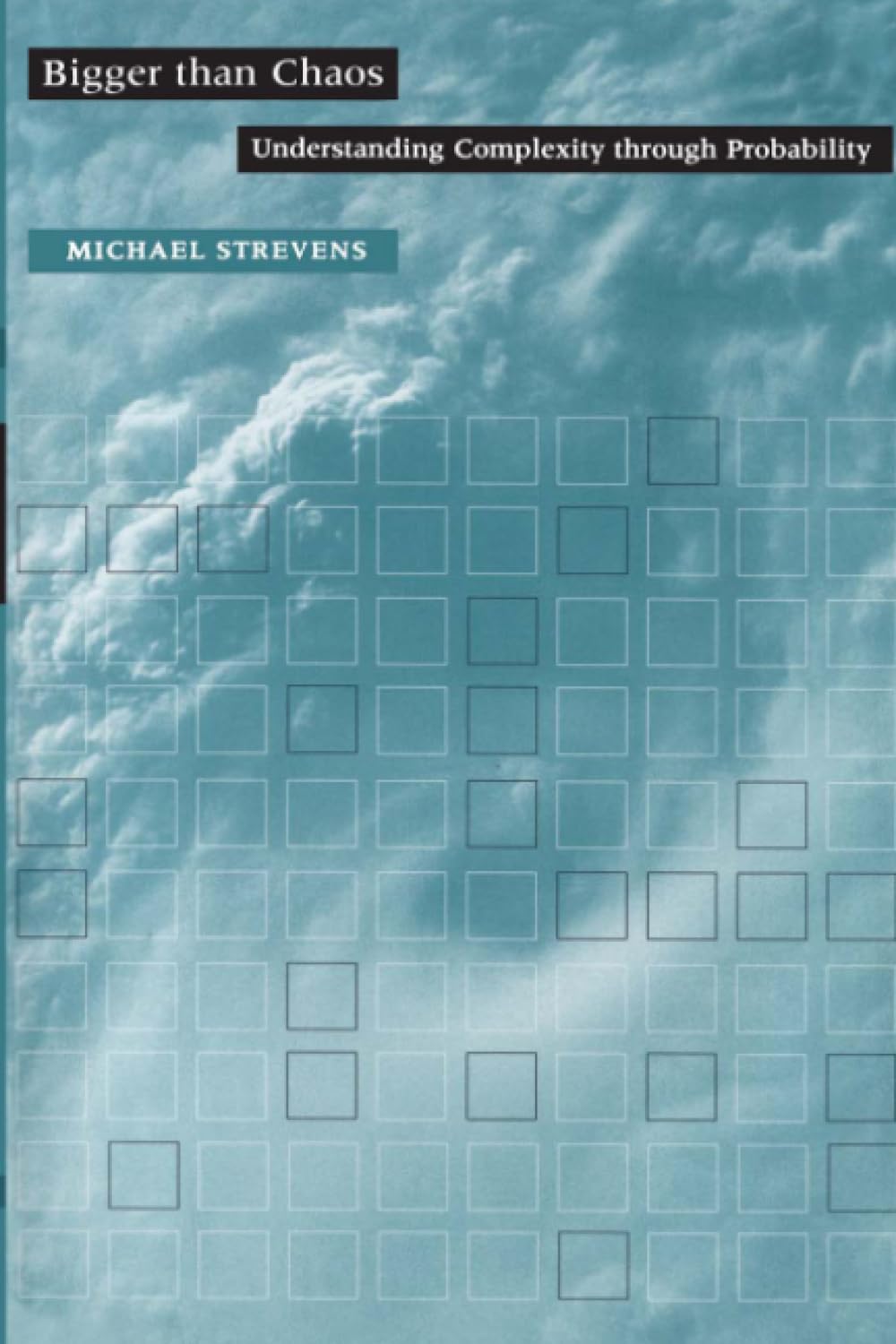
Many complex systemsfrom immensely complicated ecosystems to minute assemblages of moleculessurprise us with their simple behavior. Consider, for instance, the snowflake, in which a great number of water molecules arrange themselves in patterns with sixway symmetry. How is it that molecules moving seemingly at random become organized according to the simple, sixfold rule? How do the comings, goings, meetings, and eatings of individual animals add up to the simple dynamics of ecosystem populations? More generally, how does complex and seemingly capricious microbehavior generate stable, predictable macrobehavior?In this book, Michael Strevens aims to explain how simplicity can coexist with, indeed be caused by, the tangled interconnections between a complex systems many parts. At the center of Strevenss explanation is the notion of probability and, more particularly, probabilistic independence. By examining the foundations of statistical reasoning about complex systems such as gases, ecosystems, and certain social systems, Strevens provides an understanding of how simplicity emerges from complexity. Along the way, he draws lessons concerning the lowlevel explanation of highlevel phenomena and the basis for introducing probabilistic concepts into physical theory.
⚠️ WARNING (California Proposition 65):
This product may contain chemicals known to the State of California to cause cancer,
birth defects, or other reproductive harm.
For MAP (Minimum Advertised Price) violations and Intellectual Property (IP) or Trademark concerns, please contact:
support@ergodebooks.com
⚠️ California Proposition 65 Warning: Some products sold on this website may expose you to chemicals known to the State of California to cause cancer, birth defects, or other reproductive harm. For more information, visit www.P65Warnings.ca.gov.