
Title
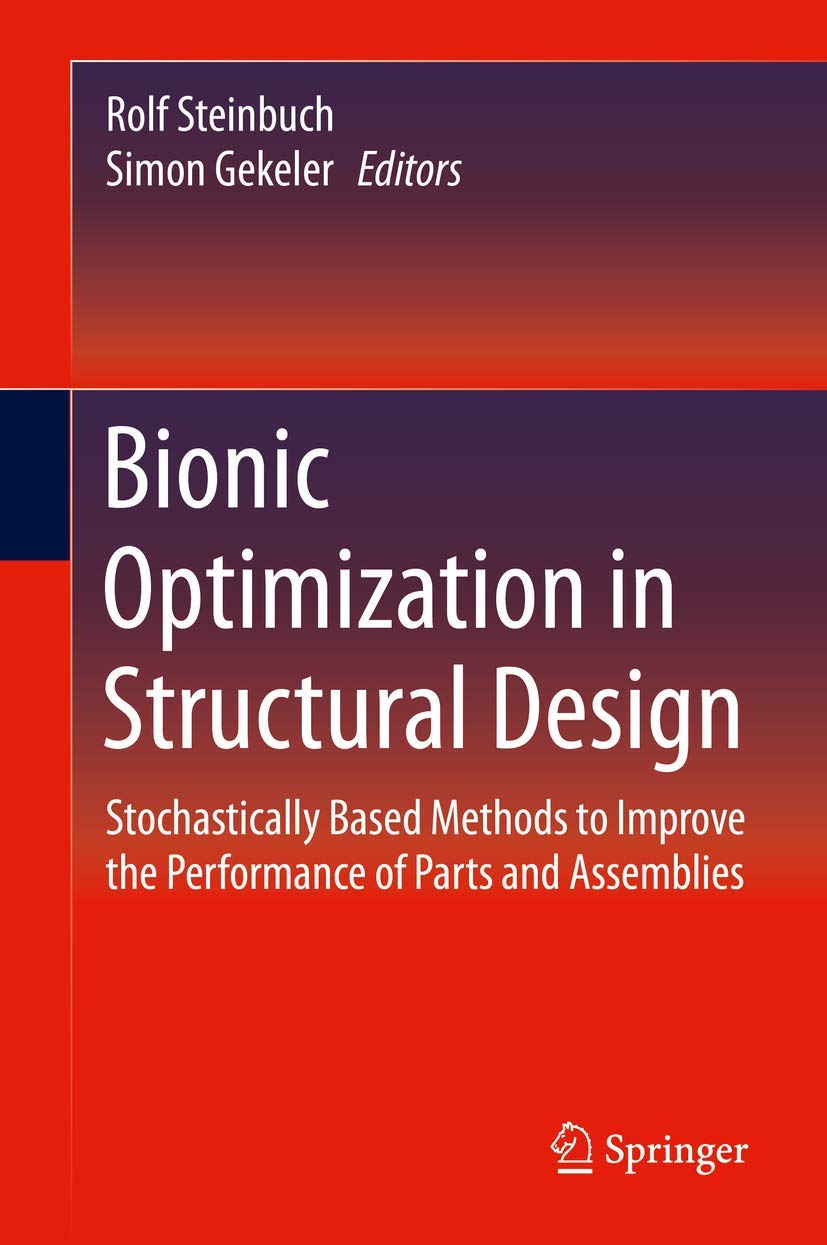
Bionic Optimization in Structural Design: Stochastically Based Methods to Improve the Performance of Parts and Assemblies,Used
Sold by Ergodebooks, an authorized reseller.
Returns accepted within 30 days | support@ergodebooks.com
Shipping Information
- Free Standard Shipping — United States only
- Processing Time: 3–5 business days
- Estimated Delivery: 6–10 business days after dispatch
- Double-boxed, fully insured & discreetly packaged
- Tracking number sent via email once dispatched
Returns & Refund
Returns accepted within 30 days of delivery.
Damaged or Defective Item
Free return shipping + replacement or full refund
Wrong Item Received
Free return shipping + replacement or full refund
Change of Mind
Return shipping at customer's expense · 25% restocking fee applies
Payment Option

The book provides suggestions on how to start using bionic optimization methods, including pseudocode examples of each of the important approaches and outlines of how to improve them. The most efficient methods for accelerating the studies are discussed. These include the selection of size and generations of a studys parameters, modification of these driving parameters, switching to gradient methods when approaching local maxima, and the use of parallel working hardware.Bionic Optimization means finding the best solution to a problem using methods found in nature. As Evolutionary Strategies and Particle Swarm Optimization seem to be the most important methods for structural optimization, we primarily focus on them. Other methods such as neural nets or ant colonies are more suited to control or process studies, so their basic ideas are outlined in order to motivate readers to start using them.A set of sample applications shows how Bionic Optimization works in practice. From academic studies on simple frames made of rods to earthquakeresistant buildings, readers follow the lessons learned, difficulties encountered and effective strategies for overcoming them. For the problem of tuned mass dampers, which play an important role in dynamic control, changing the goal and restrictions paves the way for MultiObjectiveOptimization. As most structural designers today use commercial software such as FECodes or CAE systems with integrated simulation modules, ways of integrating Bionic Optimization into these software packages are outlined and examples of typical systems and typical optimization approaches are presented.The closing section focuses on an overview and outlook on reliable and robust as well as on MultiObjectiveOptimization, including discussions of current and upcoming research topics in the field concerning a unified theory for handling stochastic design processes.
⚠️ WARNING (California Proposition 65):
This product may contain chemicals known to the State of California to cause cancer, birth defects, or other reproductive harm.
For more information, please visit www.P65Warnings.ca.gov.