If you have any questions, you are always welcome to contact us. We'll get back to you as soon as possible, withing 24 hours on weekdays.
Customer service
All questions about your order, return and delivery must be sent to our customer service team by e-mail at yourstore@yourdomain.com
Sale & Press
If you are interested in selling our products, need more information about our brand or wish to make a collaboration, please contact us at press@yourdomain.com
Help
If you have any questions, you are always welcome to contact us. We'll get back to you as soon as possible, withing 24 hours on weekdays.
Customer service
All questions about your order, return and delivery must be sent to our customer service team by e-mail at yourstore@yourdomain.com
Sale & Press
If you are interested in selling our products, need more information about our brand or wish to make a collaboration, please contact us at press@yourdomain.com
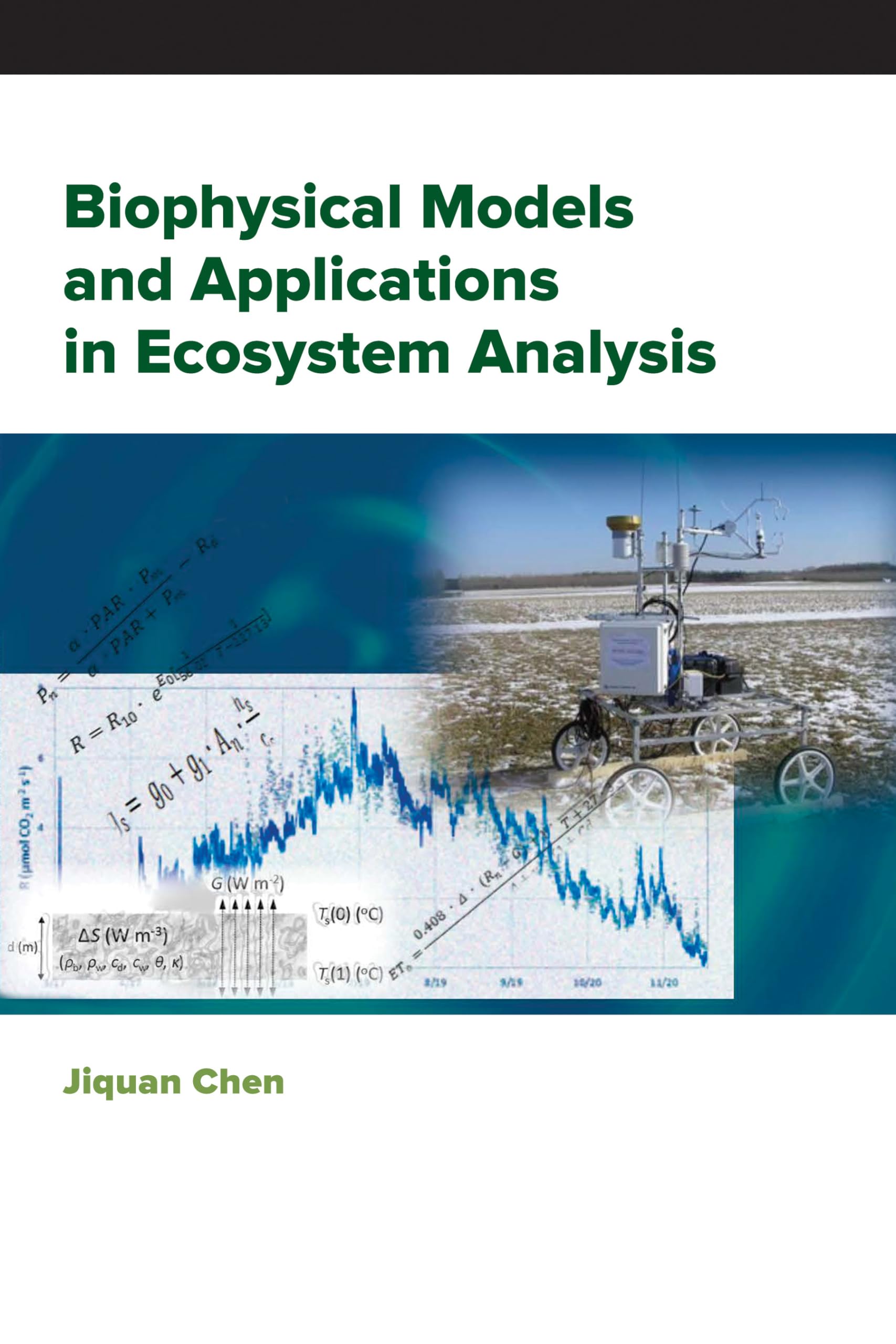
The past five decades have witnessed a rapid growth of computer models for simulating ecosystem functions and dynamics. This has been fueled by the availability of remote sensing data, computation capability, and crossdisciplinary knowledge. These models contain many submodules for simulating different processes and forcing mechanisms, albeit it has become challenging to truly understand the details due to their complexity. Most ecosystem models, fortunately, are rooted in a few core biophysical foundations, such as the widely recognized Farquhar model, BallBerryLeuning and Medlyn family models, PenmanMonteith equation, PriestleyTaylor model, and MichaelisMenten kinetics. After an introduction of biophysical essentials, four chapters present the core algorithms and their behaviors in modeling ecosystem production, respiration, evapotranspiration, and global warming potentials. Each chapter is composed of a brief introduction of the literature, in which model algorithms, their assumptions, and performances are described in detail. Spreadsheet (or Python codes) templates are included in each chapter for modeling exercises with different input parameters as online materials, which include datasets, parameter estimation, and realworld applications (e.g., calculations of global warming potentials). Users can also apply their own datasets. The materials included in this volume serve as effective tools for users to understand model behaviors and uses with specified conditions and in situ applications.
⚠️ WARNING (California Proposition 65):
This product may contain chemicals known to the State of California to cause cancer,
birth defects, or other reproductive harm.
For MAP (Minimum Advertised Price) violations and Intellectual Property (IP) or Trademark concerns, please contact:
support@ergodebooks.com
⚠️ California Proposition 65 Warning: Some products sold on this website may expose you to chemicals known to the State of California to cause cancer, birth defects, or other reproductive harm. For more information, visit www.P65Warnings.ca.gov.