
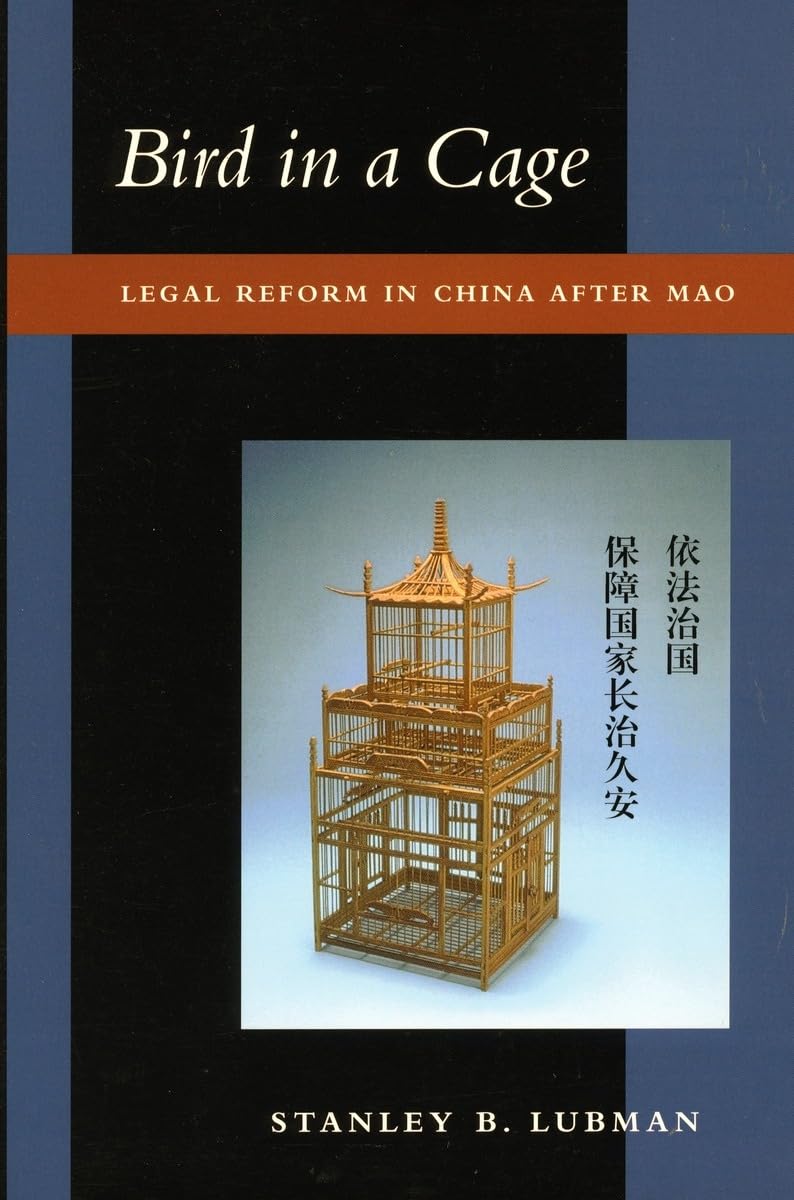
Title
Bird In A Cage: Legal Reform In China After Mao,Used
Sold by Ergodebooks, an authorized reseller.
Returns accepted within 30 days | support@ergodebooks.com
Shipping Information
- Free Standard Shipping — United States only
- Processing Time: 3–5 business days
- Estimated Delivery: 6–10 business days after dispatch
- Double-boxed, fully insured & discreetly packaged
- Tracking number sent via email once dispatched
Returns & Refund
Returns accepted within 30 days of delivery.
Damaged or Defective Item
Free return shipping + replacement or full refund
Wrong Item Received
Free return shipping + replacement or full refund
Change of Mind
Return shipping at customer's expense · 25% restocking fee applies
Payment Option

Since 1979, China has been building new legal institutions made necessary by economic reforms that have reduced the role of state planning, and by the decline of Maoist totalitarianism. This book analyzes the principal legal institutions that have emerged and assesses the prospects for increasing the rule of law in China. The book first establishes the cultural and institutional context in which legal reforms take place. It traces the main features of preCommunist Chinese legal tradition, the drastic impact on law of thirty years of Maoist rule, and the extensive changes throughout Chinese society since Maos death, notably the rise of the local partystate at the expense of central government power. The books analysis begins with the Chinese leaderships policy toward law, identifying basic ambivalence toward law that makes the Chinese commitment to legality incomplete. It then surveys major developments, emphasizing the creation of new rights, revision of criminal law and procedure, and construction of a nascent administrative law. The book then examines in detail dispute resolution by extrajudicial mediation and the courts. Although mediation is no longer infused with Maoism, it is still used as an instrument to maintain public order. The study of the courts examines court organization, the selection and training of judges, the rise of litigation, the critical influence of localism, and ongoing conflicts between professionalism and a continuing tendency to view the judge as a soldier of the state. The author suggests that the limited role that Chinese courts are today permitted to play combines with the organization of the judicial process and the mentality of the judiciary to make Chinese adjudication more akin to bureaucratic decision making than judging in the West. How should the accomplishments of legal reform and the continuing obstacles to further reform affect U.S. policy toward China? The book concludes by appraising implications for U.S. policy on such issues as human rights, Chinese involvement with the World Trade Organization, and bilateral relations generally. The author argues that U.S. policy makers must neither moralize about the rule of law nor dismiss it as a concept alien to China. They must also curb both optimism and expectations that legal reform will lead to political reform. Chinese law can only grow slowly, no matter how urgently the West may desire quick progress.
⚠️ WARNING (California Proposition 65):
This product may contain chemicals known to the State of California to cause cancer, birth defects, or other reproductive harm.
For more information, please visit www.P65Warnings.ca.gov.