
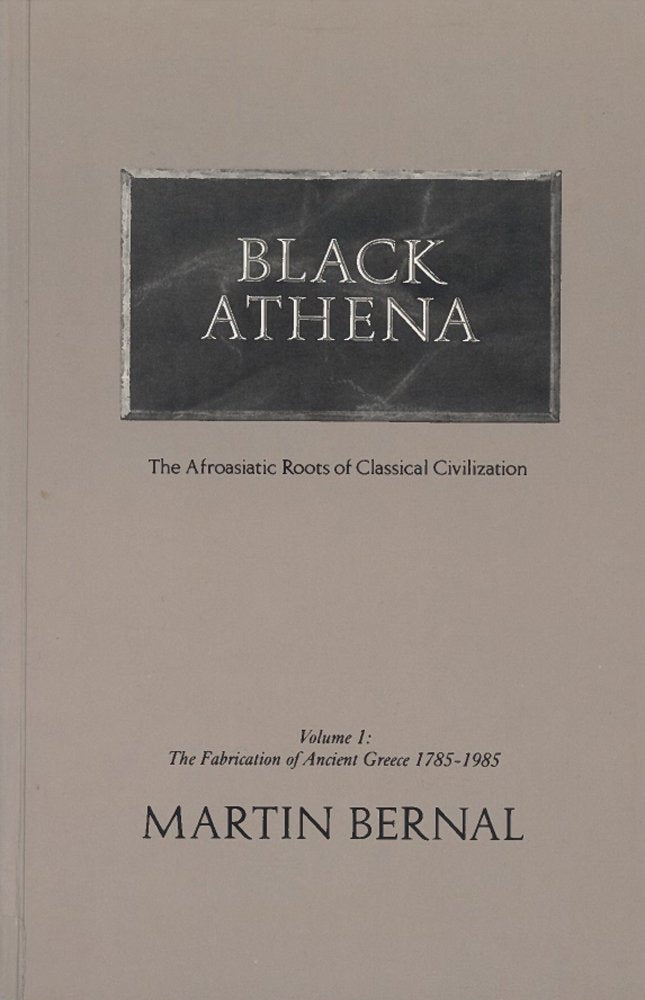
Title
Black Athena: The Afroasiatic Roots of Classical Civilization (Volume 2: The Archaeological and Documentary Evidence),Used
Sold by Ergodebooks, an authorized reseller.
Returns accepted within 30 days | support@ergodebooks.com
Shipping Information
- Free Standard Shipping — United States only
- Processing Time: 3–5 business days
- Estimated Delivery: 6–10 business days after dispatch
- Double-boxed, fully insured & discreetly packaged
- Tracking number sent via email once dispatched
Returns & Refund
Returns accepted within 30 days of delivery.
Damaged or Defective Item
Free return shipping + replacement or full refund
Wrong Item Received
Free return shipping + replacement or full refund
Change of Mind
Return shipping at customer's expense · 25% restocking fee applies
Payment Option

Winner of the American Book Award, 1990.This volume is the second in a projected fourpart series concerned with the competition between two historical models for the origins of Greek civilization. The model current today is the Aryan Model, according to which Greek culture arose as the result of the conquest from the north by IndoEuropean speakers or 'Aryans' of the native 'preHellenes.' The Ancient Model, which was the model maintained in Classical Greece, held that the native population of Greece had initially been civilized by Egyptian and Phoenician colonists and that more Near Eastern culture had been introduced to Greece by Greeks studying in Egypt and Southwest Asia. In these and later volumes, Martin Bernal proposes a Revised Ancient Model. According to this, the IndoEuropean aspects of Greek language and culture should be recognized as fundamental and the considerable nonIndoEuropean elements should be seen largely as Egyptian and Levantine additions to this basis.Volume II is concerned with the archaeological and documentary evidence for contacts between Egypt and the Levant on the one hand and the Aegean on the other, during the Bronze Age from c. 3400 B.C. to c. 1100 B.C. These approaches are supplemented by information from later Greek myths, legends, religious cults, and language. The author concludes that contact between the two regions was far more extensive and influential than is generally believed. In the introduction to this volume, Bernal also responds to some reviews and criticisms of Volume I of Black Athena.
⚠️ WARNING (California Proposition 65):
This product may contain chemicals known to the State of California to cause cancer, birth defects, or other reproductive harm.
For more information, please visit www.P65Warnings.ca.gov.
- Q: How many pages does this book have? A: This book has seven hundred thirty-six pages. It is a comprehensive volume that covers extensive archaeological and documentary evidence.
- Q: What is the binding type of this book? A: The binding type is paperback. This makes it lightweight and portable, ideal for reading on the go.
- Q: What are the dimensions of this book? A: The dimensions are approximately nine point two one inches in length, one point eight one inches in width, and six point two inches in height. These dimensions make it a standard size for paperback books.
- Q: Who is the author of this book? A: The author is Martin Bernal. He is known for his critical analysis of the origins of Greek civilization.
- Q: What is the main subject of this book? A: The main subject is the Afroasiatic roots of Classical civilization. It explores historical models and archaeological evidence relating to Greek culture.
- Q: What is the target audience for this book? A: The target audience includes researchers, students, and anyone interested in ancient civilizations. It is suitable for readers looking for in-depth historical analysis.
- Q: How should I care for this paperback book? A: To care for this paperback book, store it upright in a dry place and avoid exposure to direct sunlight. This helps preserve the binding and pages.
- Q: Can I read this book if I'm a beginner in ancient history? A: Yes, you can read this book as a beginner. However, some background knowledge of ancient civilizations may enhance your understanding.
- Q: Is this book suitable for academic research? A: Yes, this book is suitable for academic research. It provides extensive archaeological and documentary evidence relevant to the study of ancient civilizations.
- Q: What if I receive a damaged copy of the book? A: If you receive a damaged copy, you should contact the seller for a return or replacement. Most sellers have policies to handle such issues.
- Q: What is the historical period covered in this book? A: The historical period covered is from approximately three thousand four hundred B.C. to one thousand one hundred B.C. It focuses on the Bronze Age.
- Q: Is this book part of a series? A: Yes, this book is the second volume in a projected four-part series. It builds on the themes introduced in the first volume.
- Q: Does this book include illustrations or maps? A: The book may include illustrations or maps related to archaeological findings. However, specific details about visual content are not provided in the description.
- Q: How does this book relate to contemporary discussions on Greek civilization? A: This book challenges the Aryan Model of Greek civilization and proposes a Revised Ancient Model, reflecting contemporary debates in historical scholarship.
- Q: What kind of evidence does this book focus on? A: The book focuses on archaeological and documentary evidence. It examines contacts between Egypt, the Levant, and the Aegean during the Bronze Age.