
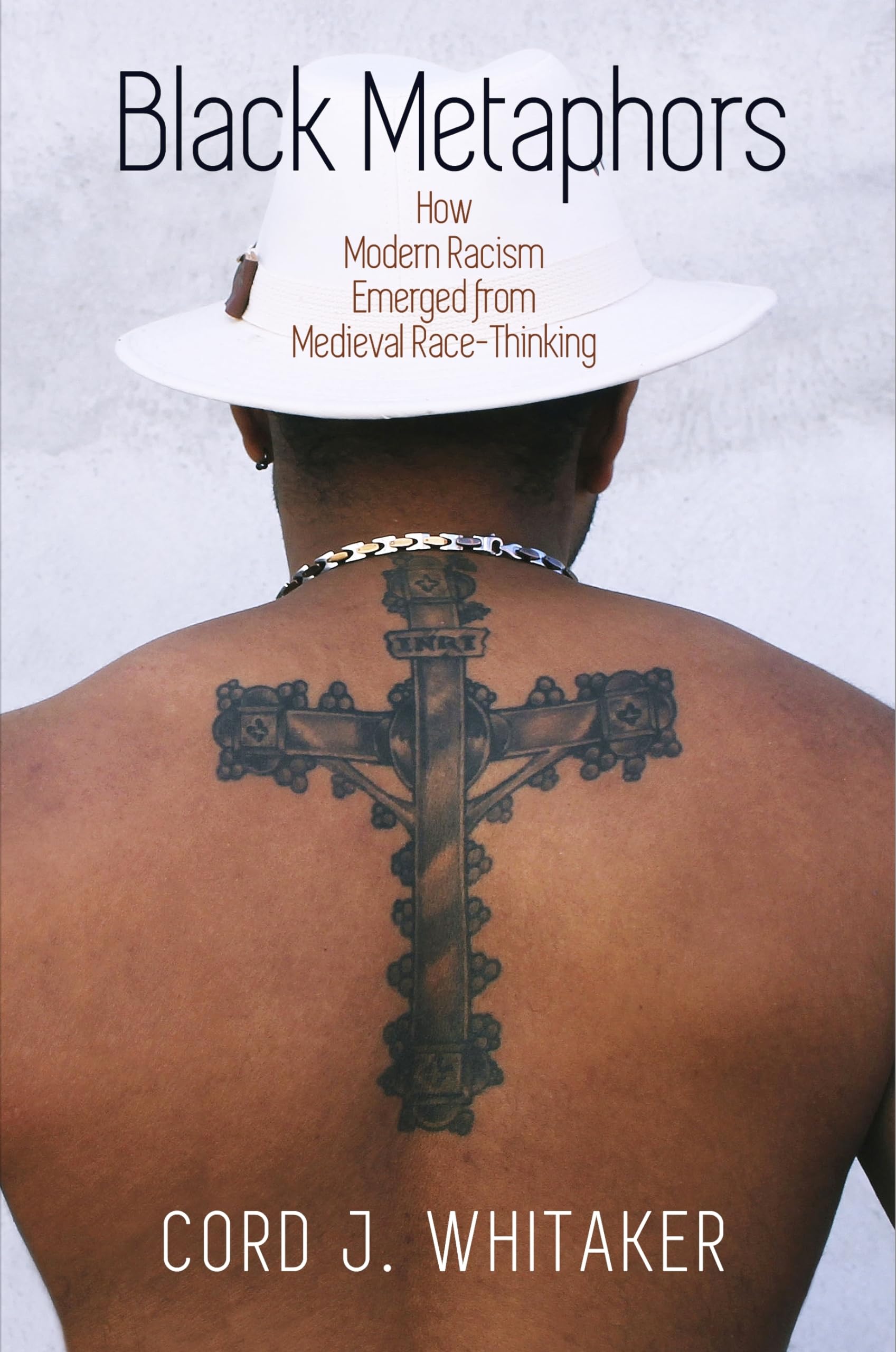
Title
Black Metaphors: How Modern Racism Emerged From Medieval Racethinking (The Middle Ages Series),New
Sold by Ergodebooks, an authorized reseller.
Returns accepted within 30 days | support@ergodebooks.com
Shipping Information
- Free Standard Shipping — United States only
- Processing Time: 3–5 business days
- Estimated Delivery: 6–10 business days after dispatch
- Double-boxed, fully insured & discreetly packaged
- Tracking number sent via email once dispatched
Returns & Refund
Returns accepted within 30 days of delivery.
Damaged or Defective Item
Free return shipping + replacement or full refund
Wrong Item Received
Free return shipping + replacement or full refund
Change of Mind
Return shipping at customer's expense · 25% restocking fee applies
Payment Option

In the late Middle Ages, Christian conversion could wash a black person's skin whiteor at least that is what happens when a black sultan converts to Christianity in the English romance King of Tars. In Black Metaphors, Cord J. Whitaker examines the rhetorical and theological moves through which blackness and whiteness became metaphors for sin and purity in the English and European Middle Agesmetaphors that guided the development of notions of race in the centuries that followed. From a modern perspective, moments like the sultan's transformation present blackness and whiteness as opposites in which each condition is forever marked as a negative or positive attribute; medieval readers were instead encouraged to remember that things that are ostensibly and strikingly different are not so separate after all, but mutually construct one another. Indeed, Whitaker observes, for medieval scholars and writers, blackness and whiteness, and the sin and salvation they represent, were held in tension, forming a unified whole.Whitaker asks not so much whether race mattered to the Middle Ages as how the Middle Ages matters to the study of race in our fraught times. Looking to the treatment of color and difference in works of rhetoric such as John of Garland's Synonyma, as well as in a range of vernacular theological and imaginative texts, including Robert Manning's Handlyng Synne, and such lesser known romances as The Turke and Sir Gawain, he illuminates the process by which one interpretation among many became established as the truth, and demonstrates how modern movementsfrom Black Lives Matter to the altrightare animated by the medieval origins of the blackwhite divide.
⚠️ WARNING (California Proposition 65):
This product may contain chemicals known to the State of California to cause cancer, birth defects, or other reproductive harm.
For more information, please visit www.P65Warnings.ca.gov.
- Q: How many pages does this book have? A: This book has two hundred fifty-six pages. It provides a comprehensive exploration of medieval perceptions of race.
- Q: What are the dimensions of this book? A: The book measures six point twenty-six inches in length, zero point seventy-five inches in width, and nine point twenty-five inches in height.
- Q: What is the binding type of this book? A: This book is hardcover. Hardcover books are known for their durability and elegant presentation.
- Q: Who is the author of this book? A: The author is Cord J. Whitaker. He examines historical perspectives on race and identity in his writing.
- Q: What genre does this book fall under? A: This book falls under the medieval genre. It explores themes of race and conversion in historical contexts.
- Q: How do I read this book? A: You can read this book like any standard novel. It is suitable for readers interested in history and race studies.
- Q: Is this book suitable for academic study? A: Yes, this book is suitable for academic study. It provides insights into medieval thought and its relevance to modern discussions of race.
- Q: What age group is this book appropriate for? A: This book is appropriate for adults and advanced students. It deals with complex themes of race and theology.
- Q: How should I store this book? A: Store this book upright on a shelf. Keeping it in a dry place will help preserve its condition.
- Q: Can I clean the cover of this book? A: Yes, you can clean the cover gently with a dry cloth. Avoid using water or solvents that may damage the material.
- Q: What should I do if the book arrives damaged? A: Contact the seller for a return or exchange. Most sellers will assist if a book arrives in poor condition.
- Q: Is there a return policy for this book? A: Yes, there is typically a return policy. Check with the retailer for specific details regarding returns.
- Q: How do I handle this book to keep it in good condition? A: Handle this book with clean hands. Avoid bending the spine to prevent damage.
- Q: Is this book suitable for beginners in medieval studies? A: Yes, it can be suitable for beginners, but some prior knowledge of medieval history may enhance understanding.
- Q: What themes are explored in this book? A: This book explores themes of race, conversion, and the historical context of blackness and whiteness.
- Q: Does the author have other works? A: Yes, Cord J. Whitaker has other works focusing on race and medieval studies. Explore his bibliography for more.