
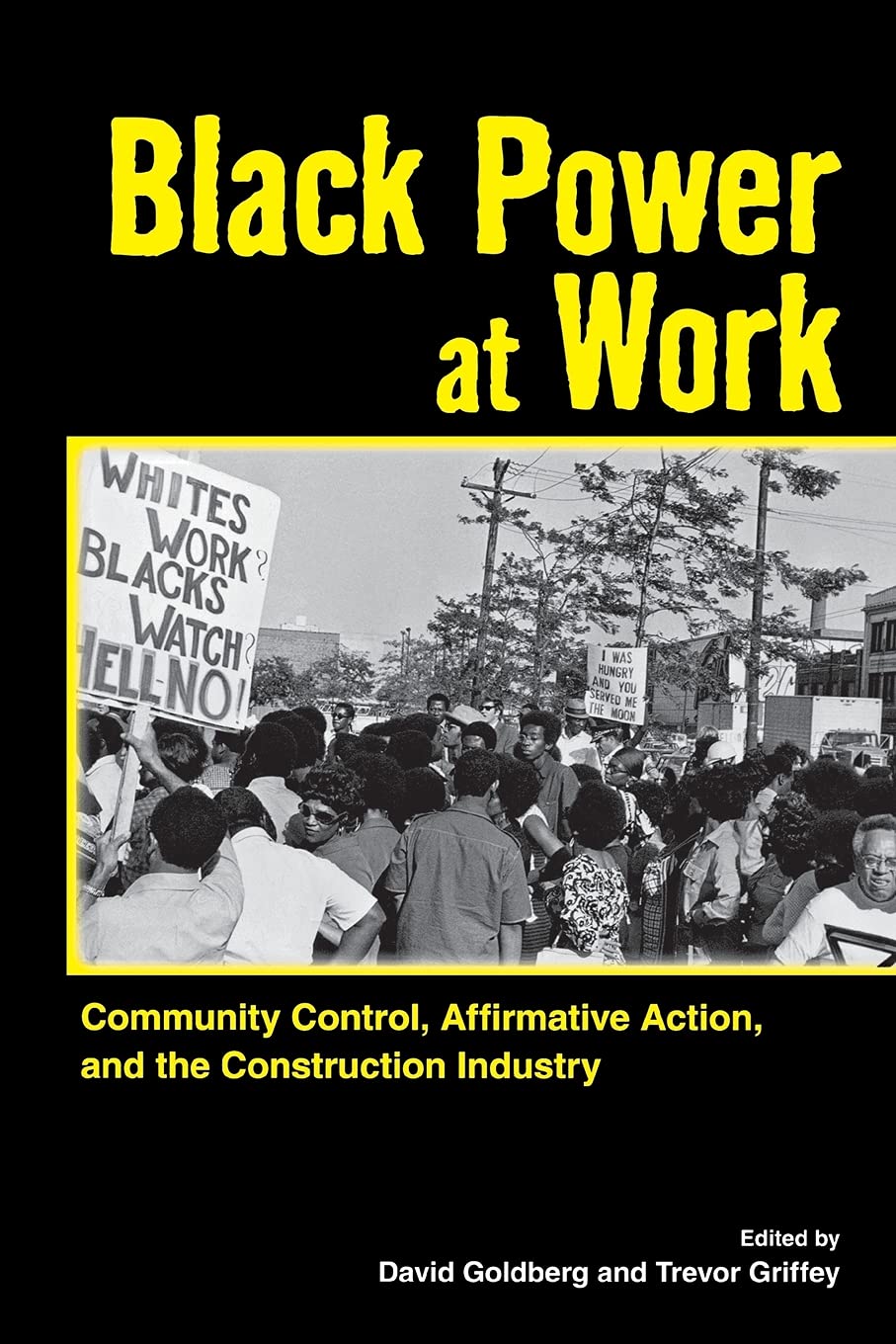
Title


Black Power At Work: Community Control, Affirmative Action, And The Construction Industry
Sold by Ergodebooks, an authorized reseller.
Returns accepted within 30 days | support@ergodebooks.com
Shipping Information
- Free Standard Shipping — United States only
- Processing Time: 3–5 business days
- Estimated Delivery: 6–10 business days after dispatch
- Double-boxed, fully insured & discreetly packaged
- Tracking number sent via email once dispatched
Returns & Refund
Returns accepted within 30 days of delivery.
Damaged or Defective Item
Free return shipping + replacement or full refund
Wrong Item Received
Free return shipping + replacement or full refund
Change of Mind
Return shipping at customer's expense · 25% restocking fee applies
Payment Option

Black Power At Work Chronicles The History Of Direct Action Campaigns To Open Up The Construction Industry To Black Workers In The 1960S And 1970S. The Book'S Case Studies Of Local Movements In Brooklyn, Newark, The Bay Area, Detroit, Chicago, And Seattle Show How Struggles Against Racism In The Construction Industry Shaped The Emergence Of Black Power Politics Outside The U.S. South. In The Process, Community Control Of The Construction Industryespecially Government War On Poverty And Postrebellion Urban Reconstruction Projects Became Central To Community Organizing For Black Economic Selfdetermination And Political Autonomy.The History Of Black Power'S Community Organizing Tradition Shines A Light On More Recent Debates About Job Training And Placement For Unemployed, Underemployed, And Underrepresented Workers. Politicians Responded To Black Power Protests At Federal Construction Projects By Creating Modern Affirmative Action And Minority Setaside Programs In The Late 1960S And Early 1970S, But These Programs Relied On Voluntary Compliance By Contractors And Unions, Government Enforcement Was Inadequate, And They Were Not Connected To Jobs Programs. Forty Years Later, The Struggle To Have Construction Jobs Serve As A Pathway Out Of Poverty For Inner City Residents Remains An Unfinished Part Of The Struggle For Racial Justice And Labor Union Reform In The United States.
⚠️ WARNING (California Proposition 65):
This product may contain chemicals known to the State of California to cause cancer, birth defects, or other reproductive harm.
For more information, please visit www.P65Warnings.ca.gov.
- Q: How many pages does the book have? A: This book has two hundred eighty pages. It offers a comprehensive look at the history of Black Power and its impact on the construction industry.
- Q: What is the binding type of the book? A: The book is paperback. This makes it flexible and lightweight, ideal for easy reading and portability.
- Q: What are the dimensions of the book? A: The book measures six point twelve inches in length, zero point seventy-one inches in width, and nine point twenty-five inches in height.
- Q: Who is the author of the book? A: The author of the book is David Goldberg. His expertise in economic history provides valuable insights into the subject matter.
- Q: What category does this book belong to? A: The book is categorized under Economic History. It explores the intersection of race, labor, and politics in the construction industry.
- Q: Is this book suitable for beginners? A: Yes, this book is suitable for beginners. It provides a detailed yet accessible history of Black Power movements.
- Q: What themes are explored in the book? A: The book explores themes of community control, affirmative action, and racial justice in the construction industry.
- Q: What is the reading level of this book? A: The reading level is appropriate for adults and younger readers interested in social justice and economic history.
- Q: How can I use this book for research? A: You can use this book as a primary source for understanding historical movements related to Black Power and labor rights.
- Q: Is the book in good condition? A: Yes, the book is listed as used but in good condition. This means it should have minimal wear and be readable.
- Q: How should I store this book? A: Store the book in a cool, dry place, upright on a shelf to prevent bending or damage to the spine.
- Q: Can I clean the book if it gets dirty? A: Yes, you can clean the cover with a damp cloth. Avoid using harsh chemicals to preserve the book's condition.
- Q: What do I do if the book arrives damaged? A: If the book arrives damaged, you can contact the seller for return instructions or a replacement.
- Q: Is there a warranty for this book? A: There is no warranty for this book. However, return policies may apply based on the seller.
- Q: How does this book compare to others in its category? A: This book stands out for its detailed case studies on Black Power movements compared to other Economic History books.
- Q: Who would benefit from reading this book? A: Students, historians, and anyone interested in racial justice and economic history would benefit from this book.