If you have any questions, you are always welcome to contact us. We'll get back to you as soon as possible, withing 24 hours on weekdays.
Customer service
All questions about your order, return and delivery must be sent to our customer service team by e-mail at yourstore@yourdomain.com
Sale & Press
If you are interested in selling our products, need more information about our brand or wish to make a collaboration, please contact us at press@yourdomain.com
Help
If you have any questions, you are always welcome to contact us. We'll get back to you as soon as possible, withing 24 hours on weekdays.
Customer service
All questions about your order, return and delivery must be sent to our customer service team by e-mail at yourstore@yourdomain.com
Sale & Press
If you are interested in selling our products, need more information about our brand or wish to make a collaboration, please contact us at press@yourdomain.com
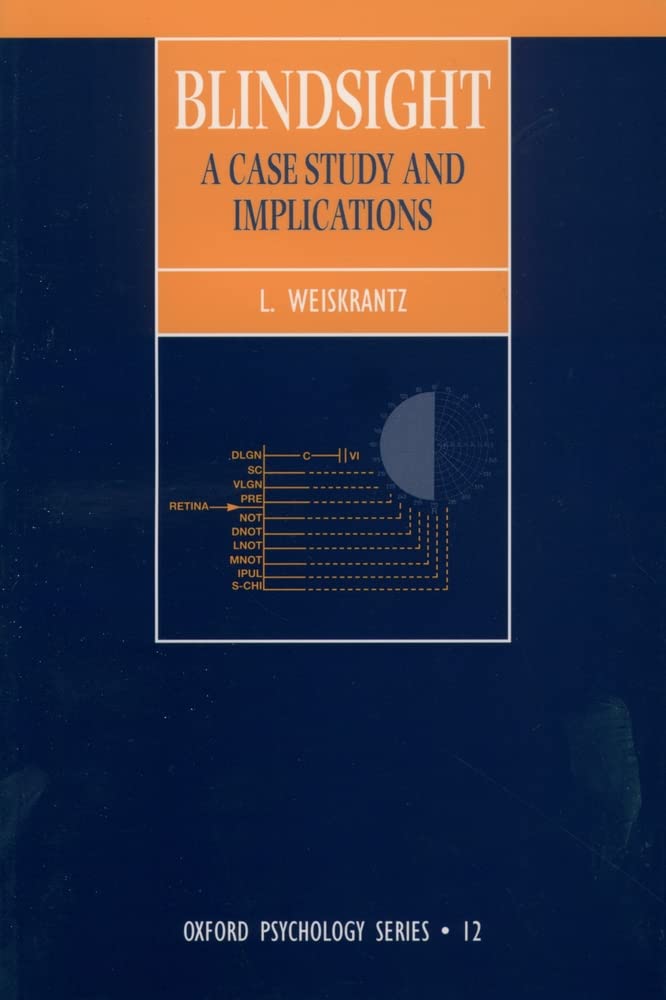
Damage to the neocortex is generally understood to result in blindness. Studies of some patients who have suffered from this form of blindness have, nevertheless, revealed that they can discriminate certain types of visual events within their "blind" field. However, patients do so without being aware of this ability: they think they are only "guessing". This phenomenon has been termed "blindsight" by Professor Weiskrantz and his collaborators, who were among the first to describe it. It has attracted considerable interest among neuroscientists, psychologists, and philosophers, who see possible implications for theories of perception and for consciousness.This now classic book, first published in 1986, gives an account of research over the number of years into a particular case blindsight, together with a discussion of the historical and neurological background. A other cases reported by other investigators and a number of theoretical and practical issues and implications are reviewed. All neuroscientists and psychologists with an interest in the phenomena will welcome this reissued version.
⚠️ WARNING (California Proposition 65):
This product may contain chemicals known to the State of California to cause cancer,
birth defects, or other reproductive harm.
For MAP (Minimum Advertised Price) violations and Intellectual Property (IP) or Trademark concerns, please contact:
support@ergodebooks.com
⚠️ California Proposition 65 Warning: Some products sold on this website may expose you to chemicals known to the State of California to cause cancer, birth defects, or other reproductive harm. For more information, visit www.P65Warnings.ca.gov.