
Title
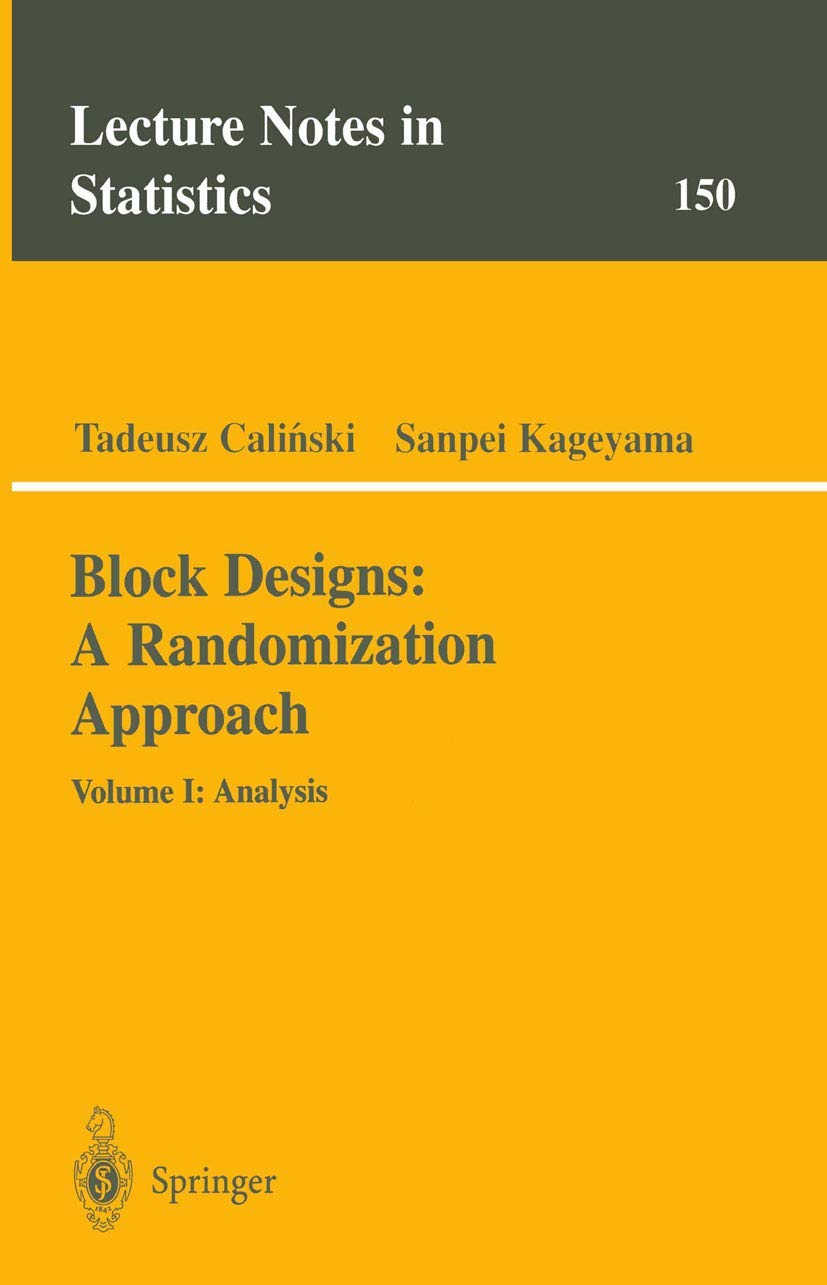
Block Designs: A Randomization Approach: Volume I: Analysis (Lecture Notes in Statistics, 150),New
Sold by Ergodebooks, an authorized reseller.
Returns accepted within 30 days | support@ergodebooks.com
Shipping Information
- Free Standard Shipping — United States only
- Processing Time: 3–5 business days
- Estimated Delivery: 6–10 business days after dispatch
- Double-boxed, fully insured & discreetly packaged
- Tracking number sent via email once dispatched
Returns & Refund
Returns accepted within 30 days of delivery.
Damaged or Defective Item
Free return shipping + replacement or full refund
Wrong Item Received
Free return shipping + replacement or full refund
Change of Mind
Return shipping at customer's expense · 25% restocking fee applies
Payment Option

In most of the literature on block designs, when considering the analysis of experimental results, it is assumed that the expected value of the response of an experimental unit is the sum of three separate components, a general mean parameter, a parameter measuring the effect of the treatment applied and a parameter measuring the effect of the block in which the experimental unit is located. In addition, it is usually assumed that the responses are uncorrelated, with the same variance. Adding to this the assumption of normal distribution of the responses, one obtains the socalled 'normaltheory model' on which the usual analysis of variance is based. Referring to it, Scheffe (1959, p. 105) writes that 'there is nothing in the 'normaltheory model' of the twoway layout . . . that reflects the increased accuracy possible by good blocking. ' Moreover, according to him, such a model 'is inappropriate to those randomizedblocks experiments where the 'errors' are caused mainly by differences among the experimental units rather than measurement errors. ' In view of this opinion, he has devoted one of the chapters of his book (Chapter 9) to randomization models, being convinced that 'an understanding of the nature of the error distribution generated by the physical act of randomization should be part of our knowledge of the basic theory of the analysis of variance.
⚠️ WARNING (California Proposition 65):
This product may contain chemicals known to the State of California to cause cancer, birth defects, or other reproductive harm.
For more information, please visit www.P65Warnings.ca.gov.