
Title
Border Theory,Used
Sold by Ergodebooks, an authorized reseller.
Returns accepted within 30 days | support@ergodebooks.com
Shipping Information
- Free Standard Shipping — United States only
- Processing Time: 3–5 business days
- Estimated Delivery: 6–10 business days after dispatch
- Double-boxed, fully insured & discreetly packaged
- Tracking number sent via email once dispatched
Returns & Refund
Returns accepted within 30 days of delivery.
Damaged or Defective Item
Free return shipping + replacement or full refund
Wrong Item Received
Free return shipping + replacement or full refund
Change of Mind
Return shipping at customer's expense · 25% restocking fee applies
Payment Option

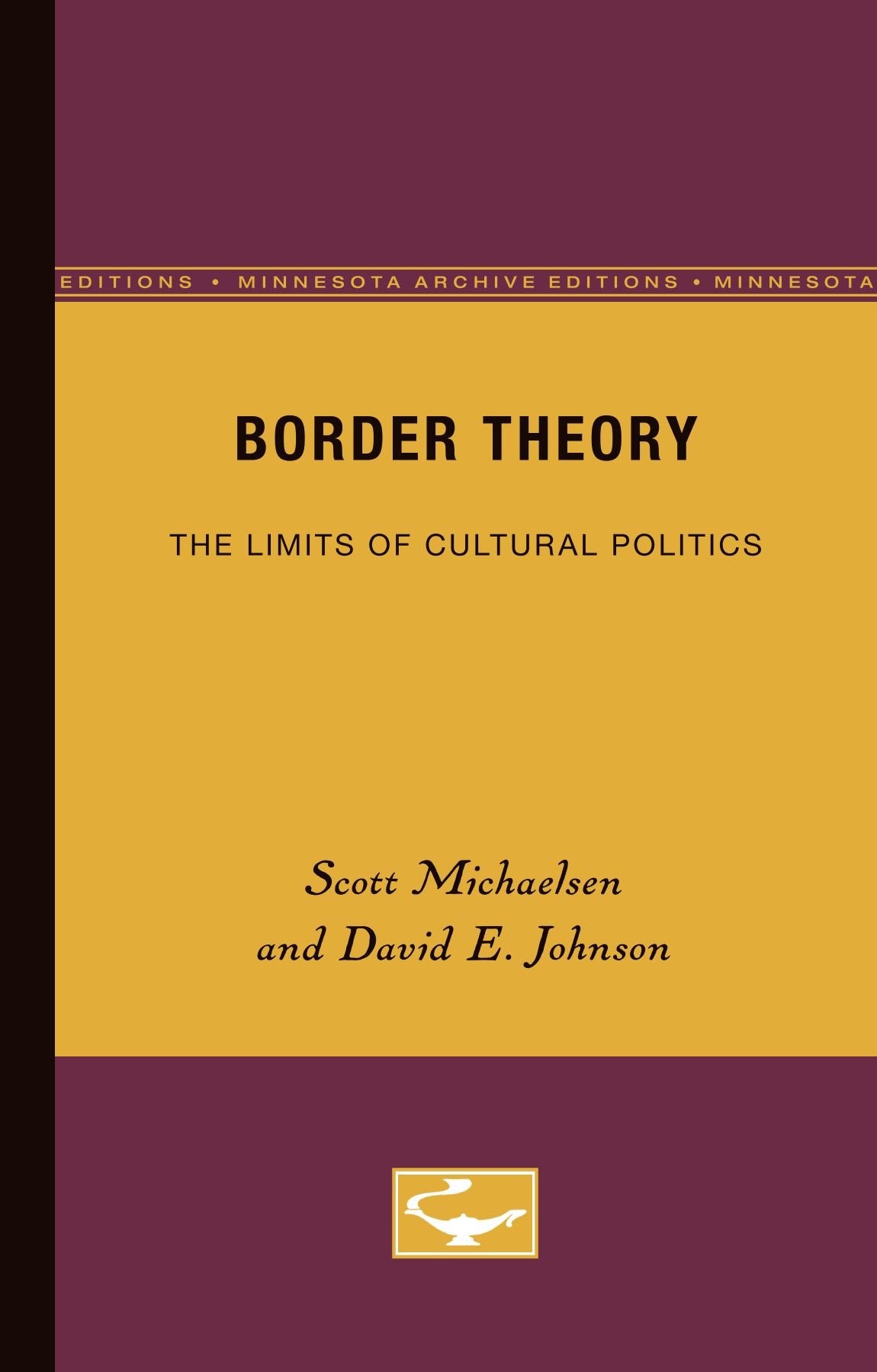
Border Theory was first published in 1997. Minnesota Archive Editions uses digital technology to make longunavailable books once again accessible, and are published unaltered from the original University of Minnesota Press editions.Challenging the prevailing assumption that border studies occurs only in 'the borderlands' where Mexico and the United States meet, the authors gathered in this volume examine the multiple borders that define the United States and the Americas, including the MasonDixon line, the U.S. Canadian border, the shifting boundaries of urban diasporas, and the colonization and confinement of American Indians. The texts assembled here examine the way border studies beckons us to rethink all objects of study and intellectual disciplines as versions of a border problematic.These writersdrawn from anthropology, history, and language studiescritique the terrain, limits, and possibilities of border theory. They examine, among other topics, the 'soft' or 'friendly' borders produced by ethnic studies, antiassimilationist or 'difference' multiculturalisms, liberal anthropologies, and benevolent nationalisms. Referring to a range of theory (anthropological, sociological, feminist, Marxist, European postmodernist and poststructuralist, postcolonial, and ethnohistorical), the authors trace the genealogical and logical links between these discourses and border studies.A timely critique of a field just now revealing its explosive potential, this volume maps the intellectual topography of border theory and challenges the epistemological and political foundations of border studies.Contributors are Russ Castronovo, Elaine K. Chang, Louis Kaplan, Alejandro Lugo, Benjamin Alire Senz, and Patricia Seed.Scott Michaelsen is assistant professor of English at Michigan State University. David E. Johnson is lecturer in the Department of Modern Languages at the State University of New York at Buffalo.
⚠️ WARNING (California Proposition 65):
This product may contain chemicals known to the State of California to cause cancer, birth defects, or other reproductive harm.
For more information, please visit www.P65Warnings.ca.gov.
- Q: What is the main topic of 'Border Theory'? A: 'Border Theory' examines the various borders that define the United States and the Americas, challenging the notion that border studies only occur in specific geographical areas.
- Q: Who are the contributors to 'Border Theory'? A: The contributors to 'Border Theory' include Russ Castronovo, Elaine K. Chang, Louis Kaplan, Alejandro Lugo, Benjamin Alire Sáenz, and Patricia Seed.
- Q: What academic disciplines does 'Border Theory' draw upon? A: 'Border Theory' integrates perspectives from anthropology, history, and language studies to critique and analyze border studies.
- Q: What is the publication date of 'Border Theory'? A: 'Border Theory' was first published on January 1, 1997.
- Q: What is the edition of 'Border Theory'? A: This book is published as the Minnesota Archive Edition.
- Q: How many pages are in 'Border Theory'? A: 'Border Theory' contains a total of 280 pages.
- Q: What is the binding type of 'Border Theory'? A: 'Border Theory' is available in paperback format.
- Q: What condition is 'Border Theory' in? A: 'Border Theory' is in new condition.
- Q: Who is the author of 'Border Theory'? A: The author of 'Border Theory' is Scott Michaelsen.
- Q: What themes are explored in 'Border Theory'? A: 'Border Theory' explores themes such as the critique of multiculturalism, the implications of liberal anthropology, and the connections between various theoretical discourses and border studies.