
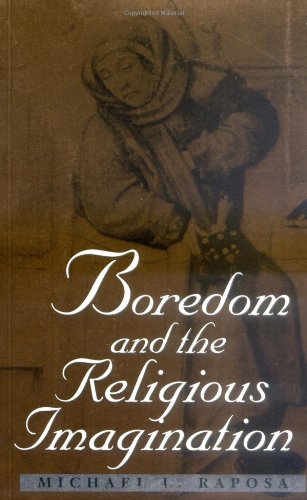
Title
Boredom And The Religious Imagination (Studies In Religion And Culture)
Sold by Ergodebooks, an authorized reseller.
Returns accepted within 30 days | support@ergodebooks.com
Shipping Information
- Free Standard Shipping — United States only
- Processing Time: 3–5 business days
- Estimated Delivery: 6–10 business days after dispatch
- Double-boxed, fully insured & discreetly packaged
- Tracking number sent via email once dispatched
Returns & Refund
Returns accepted within 30 days of delivery.
Damaged or Defective Item
Free return shipping + replacement or full refund
Wrong Item Received
Free return shipping + replacement or full refund
Change of Mind
Return shipping at customer's expense · 25% restocking fee applies
Payment Option

Boredom Matters, Writes Michael Raposa, Because It Represents A Threat To Spiritual Life. Boredom Can Undermine Prayer And Meditation And Signal The Failure Of Religious Imagination. If You Engage It Seriously, However, It Can Also Be The Starting Point For Philosophical Reflection And Spiritual Insight. It Can Serve As A Prelude To The Discovery Or Rebirth Of Religious Meaning.Boredom, Then, Is A Paradox, Surprisingly Complex And Ambiguous. Being Bored With Someone Or Something Can Represent A Trivial Matterbeing Bored With One'S Clothes Or A Magazine Articleor A Matter Of Significant Consequencebeing Bored With One'S Marriage Or The Music One Loves To Play. Boredom Can Signify A Moral Failure Or The Presence Of Virtue. Appreciating The Value Of Boredom Does Not Require That One Welcome, Much Less Celebrate, Its Occurrence. Raposa Simply Invites Us To Pay Attention To Boredom'S Many Possible Lessons.The Principal Methods Raposa Employs Are Philosophical. Drawing On Peirce'S Idea That All Experience Is Interpreted Experience, Raposa Sees Boredom As A Failure Of Interpretation, An Inability To Read Signs In Life As Religiously Meaningful. The Gospel Of Mark Depicts A Prayerful And Passionate Jesus Juxtaposed With His Drowsy Disciples In Gethsemane. Their Failure To Discern What Is Happening In Their Midst, Raposa Suggests, Is A Powerful Example Of What Medieval Christian Theologians Called Acedia, Their Term For Boredom With The Rituals Of Spiritual Devotion. But These Descriptions Of Acedia Bear A Striking Resemblance To Mystical Accounts Of The Dark Night, A Terrifying But Necessary Stage In The Mystic'S Spiritual Journey.Drawing On This Notion And Others From Eastern And Western Religious Traditions, Raposa Asks Us To See Boredom Playing An Ambivalent Role In Spiritual Life, Often Serving As A Metaphorical Midwife For The Birth Of Religious Knowledge. His Subject, He Admits, Seems Tongueincheek At First, But A Stunning Depth Is Quickly Revealed. His Lucid, Witty, And Intelligent Discussion Offers A Path To The Kind Of Meaning That Is A Fundamental Desideratum In Human Experience.
⚠️ WARNING (California Proposition 65):
This product may contain chemicals known to the State of California to cause cancer, birth defects, or other reproductive harm.
For more information, please visit www.P65Warnings.ca.gov.
- Q: What is the page count of the book? A: The book has one hundred ninety-nine pages. It provides a thorough exploration of boredom and its implications in spiritual life.
- Q: What are the dimensions of 'Boredom and the Religious Imagination'? A: The book measures five point five one inches in length, one inch in width, and eight point five inches in height. These dimensions make it a compact paperback.
- Q: What binding type does this book have? A: This book is available in paperback binding. This makes it lightweight and easy to handle.
- Q: Who is the author of this book? A: The author of the book is Michael L. Raposa. His insights into boredom and spirituality are central to the text.
- Q: What is the main theme of the book? A: The main theme explores the relationship between boredom and spiritual life. It discusses how boredom can both challenge and enrich religious imagination.
- Q: Is this book suitable for academic study? A: Yes, this book is suitable for academic study. It draws on philosophical methods and references various religious traditions.
- Q: How should I approach reading this book? A: To get the most out of this book, engage with it reflectively. Consider how the themes of boredom relate to your own spiritual experiences.
- Q: Is this book appropriate for younger readers? A: This book is more suitable for adult readers. It discusses complex themes related to spirituality and philosophical reflection.
- Q: What insights does the book offer about boredom? A: The book suggests boredom can signal a failure of spiritual imagination but also serves as a pathway to deeper religious meaning.
- Q: How can I apply the lessons from this book? A: You can apply its lessons by reflecting on your own experiences with boredom. Consider how these moments might lead to spiritual insights.
- Q: What kind of philosophical methods does the author use? A: The author employs philosophical methods that draw on various religious traditions. He uses these to interpret boredom and its implications.
- Q: What does the book say about the relationship between boredom and acedia? A: The book compares boredom to acedia, describing it as a moral failure or spiritual challenge that can lead to significant insights.
- Q: Are there any practical exercises in the book? A: No, the book does not contain specific practical exercises. Instead, it invites readers to reflect on their own spiritual journeys.
- Q: How does the author connect boredom to religious meaning? A: The author connects boredom to religious meaning by suggesting it can serve as a metaphorical midwife for the birth of new spiritual insights.
- Q: What is the publisher of this book? A: The book is published by the University of Virginia Press. This publisher is known for its scholarly works in various fields.
- Q: What makes this book unique in its approach to boredom? A: This book uniquely approaches boredom by treating it as a complex spiritual phenomenon rather than merely a trivial annoyance.