
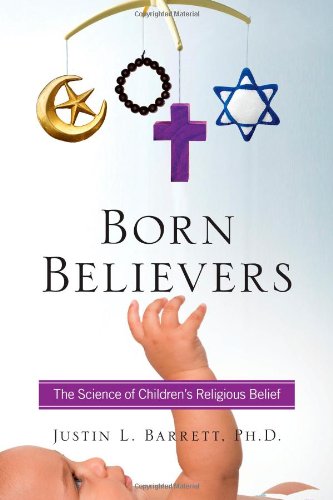
Title
Born Believers: The Science of Children's Religious Belief,Used
Sold by Ergodebooks, an authorized reseller.
Returns accepted within 30 days | support@ergodebooks.com
Shipping Information
- Free Standard Shipping — United States only
- Processing Time: 3–5 business days
- Estimated Delivery: 6–10 business days after dispatch
- Double-boxed, fully insured & discreetly packaged
- Tracking number sent via email once dispatched
Returns & Refund
Returns accepted within 30 days of delivery.
Damaged or Defective Item
Free return shipping + replacement or full refund
Wrong Item Received
Free return shipping + replacement or full refund
Change of Mind
Return shipping at customer's expense · 25% restocking fee applies
Payment Option

From a noted developmental psychologist and anthropologist at Oxford University, this fascinating theory about the value of religious faith finds that we are all predisposed to believe in God from birth.Infants have a lot to make sense of in the world: Why does the sun shine and night fall; why do some objects move in response to words, while others wont budge; who is it that looks over them and cares for them? How the developing brain grapples with these and other questions leads children, across cultures, to naturally develop a belief in a divine power of remarkably consistent traitsa god that is a powerful creator, knowing, immortal, and goodexplains noted developmental psychologist and anthropologist Justin L. Barrett in this enlightening and provocative book. In short, we are all born believers.Belief begins in the brain. Under the sway of powerful internal and external influences, children understand their environments by imagining at least one creative and intelligent agent, a grand creator and controller that brings order and purpose to the world. Further, these beliefs in unseen super beings help organize childrens intuitions about morality and surprising life events, making life meaningful. Summarizing scientific experiments conducted with children across the globe, Professor Barrett illustrates the ways human beings have come to develop complex belief systems about Gods omniscience, the afterlife, and the immortality of deities. He shows how the science of childhood religiosity reveals, across humanity, a natural religion, the organization of those beliefs that humans gravitate to organically, and how it underlies all of the worlds major religions, uniting them under one common source.For believers and nonbelievers alike, Barrett offers a compelling argument for the human instinct for religion, as he guides all parents in how to effectively encourage children in developing a healthy constellation of beliefs about the world around them.
⚠️ WARNING (California Proposition 65):
This product may contain chemicals known to the State of California to cause cancer, birth defects, or other reproductive harm.
For more information, please visit www.P65Warnings.ca.gov.
- Q: How many pages does this book have? A: This book has three hundred twenty pages. It provides an in-depth exploration of children's religious belief development.
- Q: What is the book's binding type? A: The book is hardcover. This ensures durability and longevity for readers.
- Q: What are the dimensions of this book? A: The book measures six inches in length, one point one inches in width, and nine point zero two inches in height. These dimensions make it portable and easy to handle.
- Q: Who is the author of this book? A: The author is Justin L. Barrett. He is a noted developmental psychologist and anthropologist at Oxford University.
- Q: What is the book about? A: This book discusses the science behind children's natural inclination toward religious belief from birth. It offers insights into how children perceive and understand divine concepts.
- Q: Is this book suitable for all ages? A: Yes, this book is suitable for both adults and children. It provides valuable insights for parents and educators regarding children’s belief systems.
- Q: How can parents use this book? A: Parents can use this book as a guide to understanding and encouraging healthy religious beliefs in their children. It offers practical advice on fostering belief systems.
- Q: What themes are explored in this book? A: The book explores themes such as innate belief in a creator, morality, and the universal traits of deities across cultures. It connects these ideas to major world religions.
- Q: How does the book suggest beliefs are formed in children? A: The book suggests that beliefs are formed through a combination of internal and external influences. Children often imagine a creative agent to make sense of their environment.
- Q: What is the main argument of this book? A: The main argument is that humans are naturally predisposed to believe in God. This inclination is rooted in early childhood development.
- Q: How should this book be stored? A: This book should be stored upright on a shelf to maintain its shape. Keeping it in a dry place will also help preserve the binding.
- Q: Can this book be a resource for educators? A: Yes, this book can serve as a valuable resource for educators. It provides insights into children's development of religious beliefs, enhancing classroom discussions.
- Q: What makes this book unique? A: This book is unique because it combines psychology and anthropology to explain why children develop religious beliefs. It presents scientific experiments to support its claims.
- Q: Is there a specific audience for this book? A: The book appeals to both believers and nonbelievers. It is designed for anyone interested in understanding the psychological aspects of religious belief.
- Q: What is the overall tone of the book? A: The overall tone of the book is enlightening and provocative. It challenges readers to reconsider their views on childhood religiosity.