If you have any questions, you are always welcome to contact us. We'll get back to you as soon as possible, withing 24 hours on weekdays.
Customer service
All questions about your order, return and delivery must be sent to our customer service team by e-mail at yourstore@yourdomain.com
Sale & Press
If you are interested in selling our products, need more information about our brand or wish to make a collaboration, please contact us at press@yourdomain.com
Help
If you have any questions, you are always welcome to contact us. We'll get back to you as soon as possible, withing 24 hours on weekdays.
Customer service
All questions about your order, return and delivery must be sent to our customer service team by e-mail at yourstore@yourdomain.com
Sale & Press
If you are interested in selling our products, need more information about our brand or wish to make a collaboration, please contact us at press@yourdomain.com
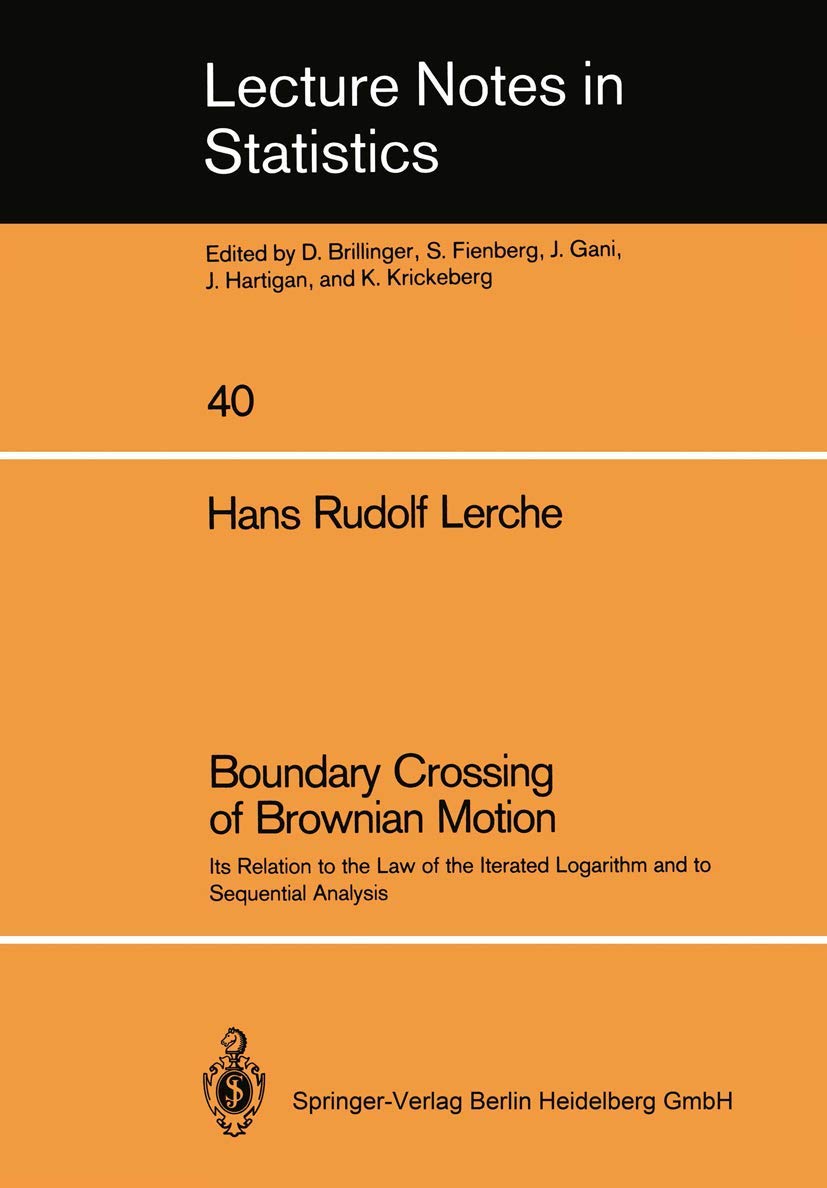
This is a research report about my work on sequential statistic~ during 1980 1984. Two themes are treated which are closely related to each other and to the law of the iterated logarithm: I) curved boundary first passage distributions of Brownian motion, 11) optimal properties of sequential tests with parabolic and nearly parabolic boundaries. In the first chapter I discuss the tangent approximation for Brownianmotion as a global approximation device. This is an extension of Strassen' s approach to t'he law of the iterated logarithm which connects results of fluctuation theory of Brownian motion with classical methods of sequential statistics. In the second chapter I make use of these connections and derive optimal properties of tests of power one and repeated significance tests for the simpiest model of sequential statistics, the Brownian motion with unknown drift. To both topics:there under1ies an asymptotic approach which is closely linked to large deviation theory: the stopping boundaries recede to infinity. This is a wellknown approach in sequential sttistics which is extensively discussed in Siegmund's recent book Sequential Analysis". This approach also leads to some new insights about the law of the iterated logarithm (LIL). Although the LIL has been studied for nearly seventy years the belief is still common that it applies only for large sampIe sizes which can never be obser ved in practice.
⚠️ WARNING (California Proposition 65):
This product may contain chemicals known to the State of California to cause cancer,
birth defects, or other reproductive harm.
For MAP (Minimum Advertised Price) violations and Intellectual Property (IP) or Trademark concerns, please contact:
support@ergodebooks.com
⚠️ California Proposition 65 Warning: Some products sold on this website may expose you to chemicals known to the State of California to cause cancer, birth defects, or other reproductive harm. For more information, visit www.P65Warnings.ca.gov.