If you have any questions, you are always welcome to contact us. We'll get back to you as soon as possible, withing 24 hours on weekdays.
Customer service
All questions about your order, return and delivery must be sent to our customer service team by e-mail at yourstore@yourdomain.com
Sale & Press
If you are interested in selling our products, need more information about our brand or wish to make a collaboration, please contact us at press@yourdomain.com
Help
If you have any questions, you are always welcome to contact us. We'll get back to you as soon as possible, withing 24 hours on weekdays.
Customer service
All questions about your order, return and delivery must be sent to our customer service team by e-mail at yourstore@yourdomain.com
Sale & Press
If you are interested in selling our products, need more information about our brand or wish to make a collaboration, please contact us at press@yourdomain.com
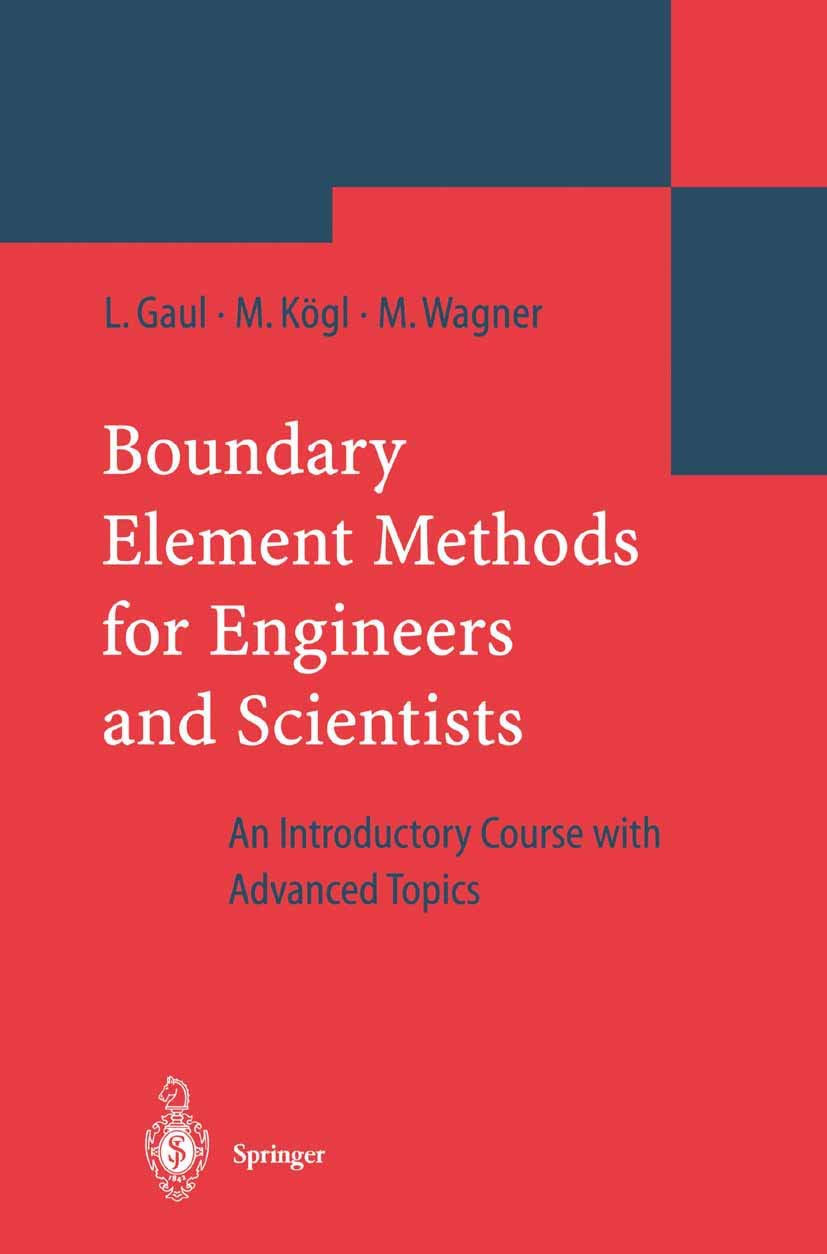
Over the past decades, the Boundary Element Method has emerged as a ver satile and powerful tool for the solution of engineering problems, presenting in many cases an alternative to the more widely used Finite Element Method. As with any numerical method, the engineer or scientist who applies it to a practical problem needs to be acquainted with, and understand, its basic principles to be able to apply it correctly and be aware of its limitations. It is with this intention that we have endeavoured to write this book: to give the student or practitioner an easytounderstand introductory course to the method so as to enable him or her to apply it judiciously. As the title suggests, this book not only serves as an introductory course, but also cov ers some advanced topics that we consider important for the researcher who needs to be uptodate with new developments. This book is the result of our teaching experiences with the Boundary Element Method, along with research and consulting activities carried out in the field. Its roots lie in a graduate course on the Boundary Element Method given by the authors at the university of Stuttgart. The experiences gained from teaching and the remarks and questions of the students have contributed to shaping the 'Introductory course' (Chapters 18) to the needs of the stu dents without assuming a background in numerical methods in general or the Boundary Element Method in particular.
⚠️ WARNING (California Proposition 65):
This product may contain chemicals known to the State of California to cause cancer,
birth defects, or other reproductive harm.
For MAP (Minimum Advertised Price) violations and Intellectual Property (IP) or Trademark concerns, please contact:
support@ergodebooks.com
⚠️ California Proposition 65 Warning: Some products sold on this website may expose you to chemicals known to the State of California to cause cancer, birth defects, or other reproductive harm. For more information, visit www.P65Warnings.ca.gov.