
Title
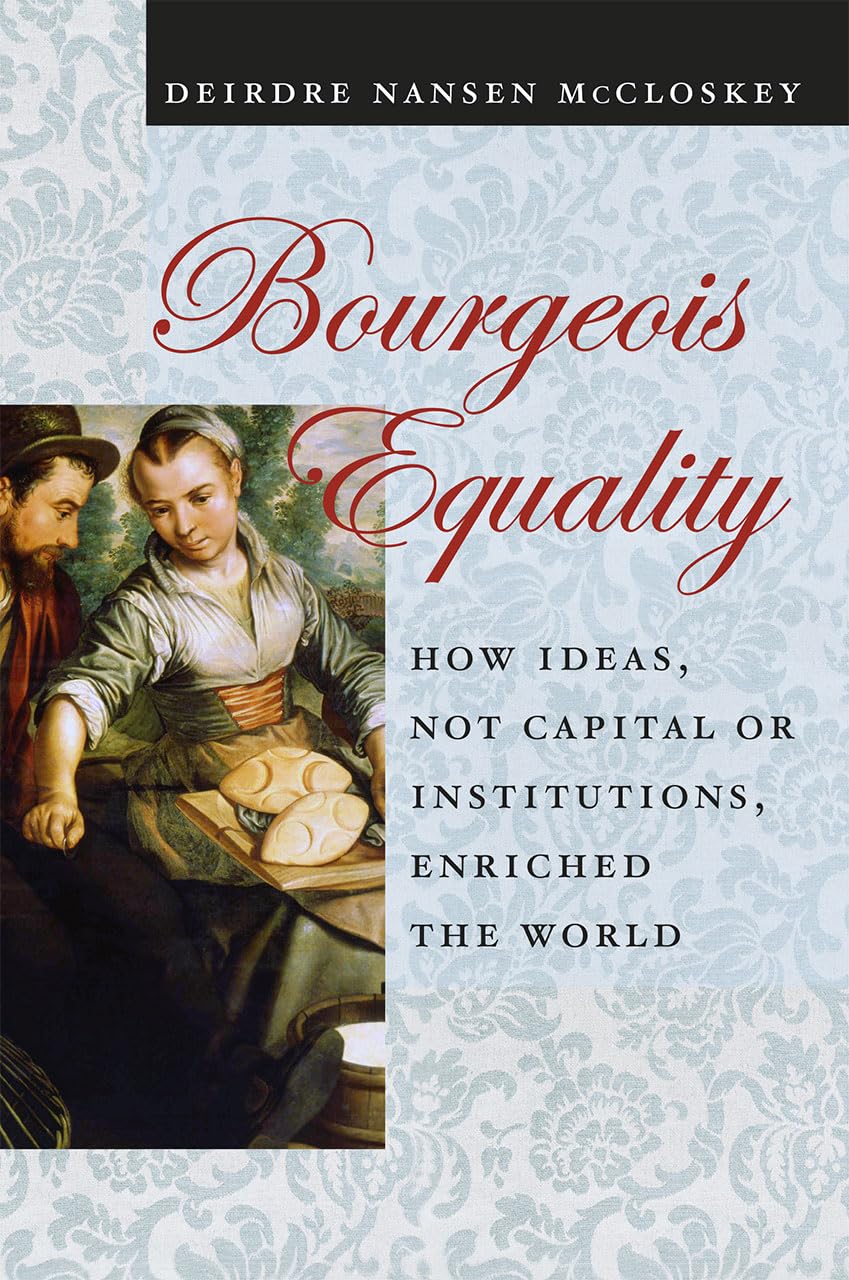
Bourgeois Equality: How Ideas, Not Capital or Institutions, Enriched the World,Used
Sold by Ergodebooks, an authorized reseller.
Returns accepted within 30 days | support@ergodebooks.com
Shipping Information
- Free Standard Shipping — United States only
- Processing Time: 3–5 business days
- Estimated Delivery: 6–10 business days after dispatch
- Double-boxed, fully insured & discreetly packaged
- Tracking number sent via email once dispatched
Returns & Refund
Returns accepted within 30 days of delivery.
Damaged or Defective Item
Free return shipping + replacement or full refund
Wrong Item Received
Free return shipping + replacement or full refund
Change of Mind
Return shipping at customer's expense · 25% restocking fee applies
Payment Option

Theres little doubt that most humans today are better off than their forebears. Stunningly so, the economist and historian Deirdre McCloskey argues in the concluding volume of her trilogy celebrating the oftderided virtues of the bourgeoisie. The poorest of humanity, McCloskey shows, will soon be joining the comparative riches of Japan and Sweden and Botswana.Why? Most economistsfrom Adam Smith and Karl Marx to Thomas Pikettysay the Great Enrichment since 1800 came from accumulated capital. McCloskey disagrees, fiercely. Our riches, she argues, were made not by piling brick on brick, bank balance on bank balance, but by piling idea on idea. Capital was necessary, but so was the presence of oxygen. It was ideas, not matter, that drove tradetested betterment. Nor were institutions the drivers. The World Bank orthodoxy of add institutions and stir doesnt work, and didnt. McCloskey builds a powerful case for the initiating role of ideasideas for electric motors and free elections, of course, but more deeply the bizarre and liberal ideas of equal liberty and dignity for ordinary folk. Liberalism arose from theological and political revolutions in northwest Europe, yielding a unique respect for betterment and its practitioners, and upending ancient hierarchies. Commoners were encouraged to have a go, and the bourgeoisie took up the Bourgeois Deal, and we were all enriched.Few economists or historians write like McCloskeyher ability to invest the facts of economic history with the urgency of a novel, or of a leading case at law, is unmatched. She summarizes modern economics and modern economic history with verve and lucidity, yet sees through to the really big scientific conclusion. Not matter, but ideas. Big books dont come any more ambitious, or captivating, than Bourgeois Equality.
⚠️ WARNING (California Proposition 65):
This product may contain chemicals known to the State of California to cause cancer, birth defects, or other reproductive harm.
For more information, please visit www.P65Warnings.ca.gov.