
Title

Bowling Alone: The Collapse and Revival of American Community,Used
Sold by Ergodebooks, an authorized reseller.
Returns accepted within 30 days | support@ergodebooks.com
Shipping Information
- Free Standard Shipping — United States only
- Processing Time: 3–5 business days
- Estimated Delivery: 6–10 business days after dispatch
- Double-boxed, fully insured & discreetly packaged
- Tracking number sent via email once dispatched
Returns & Refund
Returns accepted within 30 days of delivery.
Damaged or Defective Item
Free return shipping + replacement or full refund
Wrong Item Received
Free return shipping + replacement or full refund
Change of Mind
Return shipping at customer's expense · 25% restocking fee applies
Payment Option

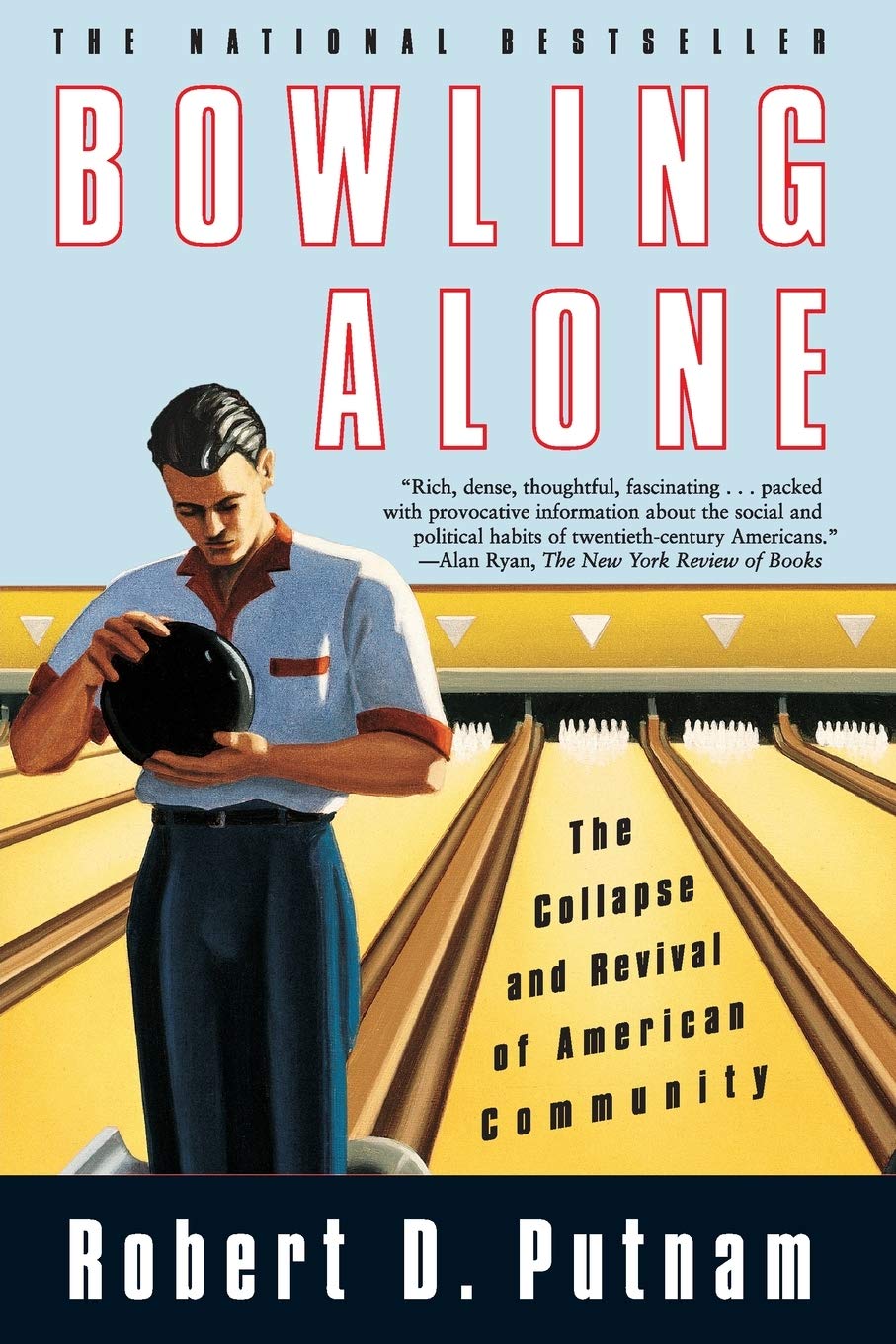
Once we bowled in leagues, usually after workbut no longer. This seemingly small phenomenon symbolizes a significant social change that Robert Putnam has identified in this brilliant volume, which The Economist hailed as a prodigious achievement.Drawing on vast new data that reveal Americans changing behavior, Putnam shows how we have become increasingly disconnected from one another and how social structureswhether they be PTA, church, or political partieshave disintegrated. Until the publication of this groundbreaking work, no one had so deftly diagnosed the harm that these broken bonds have wreaked on our physical and civic health, nor had anyone exalted their fundamental power in creating a society that is happy, healthy, and safe.Like defining works from the past, such as The Lonely Crowd and The Affluent Society, and like the works of C. Wright Mills and Betty Friedan, Putnams Bowling Alone has identified a central crisis at the heart of our society and suggests what we can do.
⚠️ WARNING (California Proposition 65):
This product may contain chemicals known to the State of California to cause cancer, birth defects, or other reproductive harm.
For more information, please visit www.P65Warnings.ca.gov.
- Q: How many pages does 'Bowling Alone' have? A: This book has five hundred forty-four pages. It provides a comprehensive exploration of social connections in America.
- Q: What is the binding type of 'Bowling Alone'? A: The book is available in paperback binding. This makes it more accessible and portable for readers.
- Q: Who is the author of 'Bowling Alone'? A: The author is Robert D. Putnam. He is a recognized scholar in the field of social science.
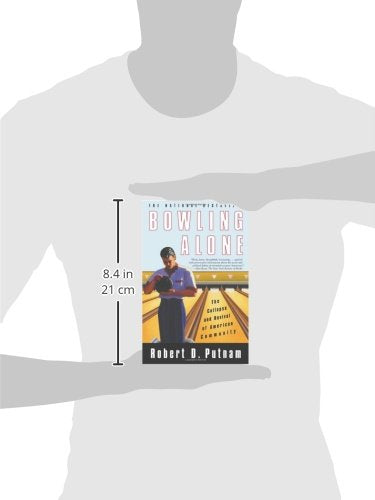
- Q: What are the dimensions of 'Bowling Alone'? A: The book measures five point five one inches in length, one point three inches in width, and eight point four four inches in height. These dimensions make it easy to handle and store.
- Q: What is the main theme of 'Bowling Alone'? A: The main theme is the decline of social capital in America. It examines how community engagement has changed over time.
- Q: Is 'Bowling Alone' suitable for academic study? A: Yes, it is suitable for academic study. The book is well-researched and includes extensive data and analysis.
- Q: How can I apply the insights from 'Bowling Alone'? A: You can apply the insights by engaging more in community activities and fostering connections. The book suggests various ways to revive social ties.
- Q: Is 'Bowling Alone' appropriate for high school students? A: Yes, it is appropriate for high school students. The book's themes of community and social interaction are relevant to all ages.
- Q: What are some recommended ways to engage with the book? A: You can join a book club or discuss its themes with peers. Engaging in community activities mentioned in the book is also beneficial.
- Q: How should I care for my paperback copy of 'Bowling Alone'? A: Store it in a cool, dry place away from direct sunlight. Avoid bending the spine to keep it in good condition.
- Q: Can I return 'Bowling Alone' if I don't like it? A: Yes, you can typically return it within a specified period if purchased from a retailer with a return policy. Always check the policy before buying.
- Q: What should I do if my copy of 'Bowling Alone' arrives damaged? A: You should contact the seller immediately for a replacement or refund. Most sellers have policies in place for damaged items.
- Q: Is there a digital version of 'Bowling Alone' available? A: Yes, there is a digital version available. You can find it on various e-book platforms for convenient reading.
- Q: What distinguishes 'Bowling Alone' from other sociology books? A: It uniquely combines extensive data analysis with personal anecdotes. This approach makes complex social issues more relatable.
- Q: Are there any follow-up works to 'Bowling Alone'? A: Yes, Putnam has written additional works exploring related themes. These include 'Our Kids' and various articles on social capital.