
Title
Brainstorming and Beyond: A UserCentered Design Method,Used
Sold by Ergodebooks, an authorized reseller.
Returns accepted within 30 days | support@ergodebooks.com
Shipping Information
- Free Standard Shipping — United States only
- Processing Time: 3–5 business days
- Estimated Delivery: 6–10 business days after dispatch
- Double-boxed, fully insured & discreetly packaged
- Tracking number sent via email once dispatched
Returns & Refund
Returns accepted within 30 days of delivery.
Damaged or Defective Item
Free return shipping + replacement or full refund
Wrong Item Received
Free return shipping + replacement or full refund
Change of Mind
Return shipping at customer's expense · 25% restocking fee applies
Payment Option

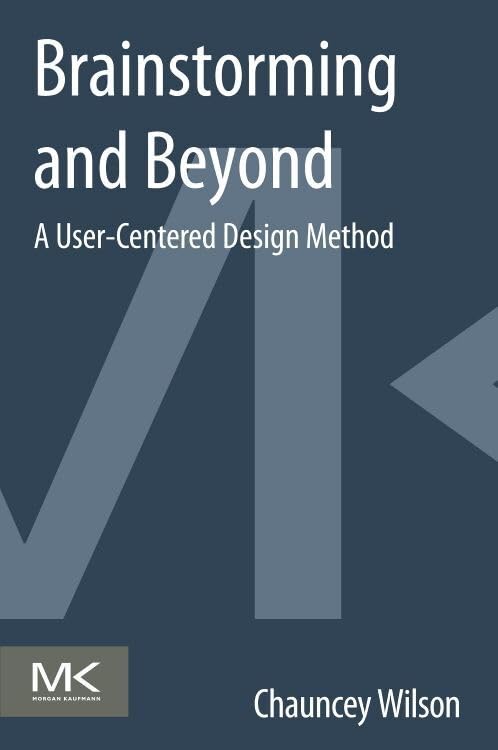
Brainstorming and Beyond describes the techniques for generating ideas verbally, in writing, or through sketches. The first chapter focuses on brainstorming, the foundation method for ideation, which is a complex social process building off of social psychology principles, motivational constructs, and corporate culture. Brainstorming is commonly portrayed as an easy way to generate ideas, but in reality, it is a complex social process that is often flawed in ways that are not selfevident. Chapter 2 discusses Brainwriting, which is a variation on brainstorming in which each person writes ideas down on paper and then passes the paper to a new person who reads the first set of ideas and adds new ones. Since there is no group shouting out of ideas, strong facilitation skills are not required, and more often than not, Brainwriting results greatly exceed those of group brainstorming in a shorter time because ideas are generated in a parallel, rather than serial, fashion. Brainwriting is useful when time is limited, groups are hostile, or you are dealing with a culture where shouting out wild or divergent ideas might be difficult. Finally, in Chapter 3, readers learn about Braindrawing, a method of visual brainstorming that helps practitioners generate ideas for icons, other graphics, user interface layouts, or Web page designs. Each of these methods provides readers with ways to generate, present, and evaluate ideas so they can begin building a strong foundation for product success. Learn the proper techniques for generating ideas with limited time, hostile audiences, and limited facilitation support Explores efficient processes for analyzing the value of ideas Examines ways to generate visual as well as textual ideas
⚠️ WARNING (California Proposition 65):
This product may contain chemicals known to the State of California to cause cancer, birth defects, or other reproductive harm.
For more information, please visit www.P65Warnings.ca.gov.