If you have any questions, you are always welcome to contact us. We'll get back to you as soon as possible, withing 24 hours on weekdays.
Customer service
All questions about your order, return and delivery must be sent to our customer service team by e-mail at yourstore@yourdomain.com
Sale & Press
If you are interested in selling our products, need more information about our brand or wish to make a collaboration, please contact us at press@yourdomain.com
Help
If you have any questions, you are always welcome to contact us. We'll get back to you as soon as possible, withing 24 hours on weekdays.
Customer service
All questions about your order, return and delivery must be sent to our customer service team by e-mail at yourstore@yourdomain.com
Sale & Press
If you are interested in selling our products, need more information about our brand or wish to make a collaboration, please contact us at press@yourdomain.com
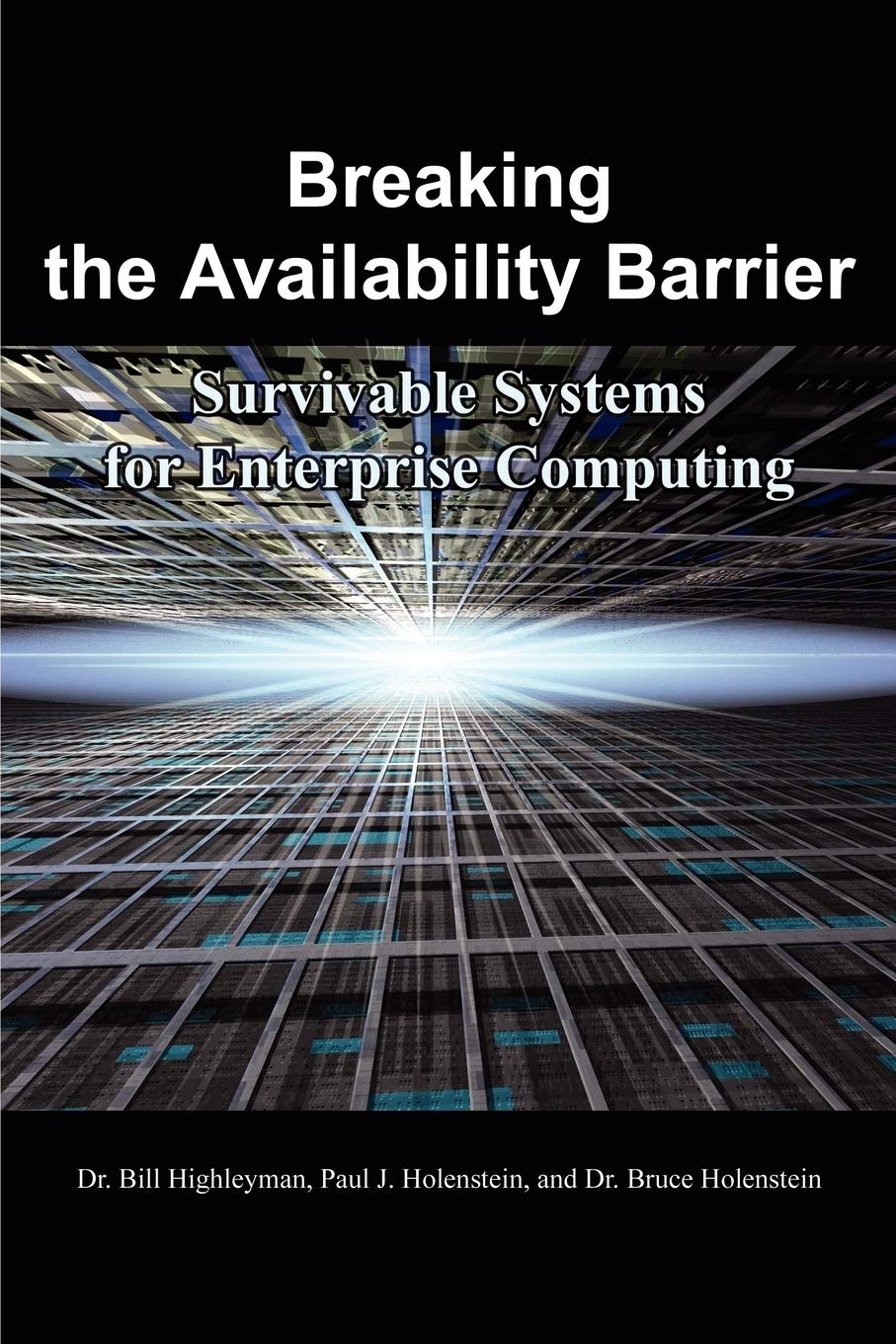
As our daily lives and corporate wellbeing become more dependent upon computers, system reliability grows increasingly important. No longer are frequent system outages acceptable. In many cases, failure intervals must now be measured in centuries. Even current faulttolerant computing systems will fail once every five or ten years. This book is the first in a threepart series on active/active systems. It describes techniques that can be used today for extending system failure times from years to centuries, often at little or no additional cost. The techniques described include splitting a large system into smaller, cooperating independent nodes. Copies of the application's database are distributed across the nodes. It is shown that these techniques significantly reduce the number of system failure modes and increase the level of sparing. As a result, the loss of a single node's capacity occurs far less frequently than the loss of all capacity when the equivalent monolithic system fails. Furthermore, the loss of more than one node's worth of capacity is almost never. Central to these techniques is the requirement that all database copies that are distributed across the network must be kept in synchronism. Several methods available today for maintaining synchronism are described. They include asynchronous data replication, synchronous data replication, and network transactions.
⚠️ WARNING (California Proposition 65):
This product may contain chemicals known to the State of California to cause cancer,
birth defects, or other reproductive harm.
For MAP (Minimum Advertised Price) violations and Intellectual Property (IP) or Trademark concerns, please contact:
support@ergodebooks.com
⚠️ California Proposition 65 Warning: Some products sold on this website may expose you to chemicals known to the State of California to cause cancer, birth defects, or other reproductive harm. For more information, visit www.P65Warnings.ca.gov.