
Title
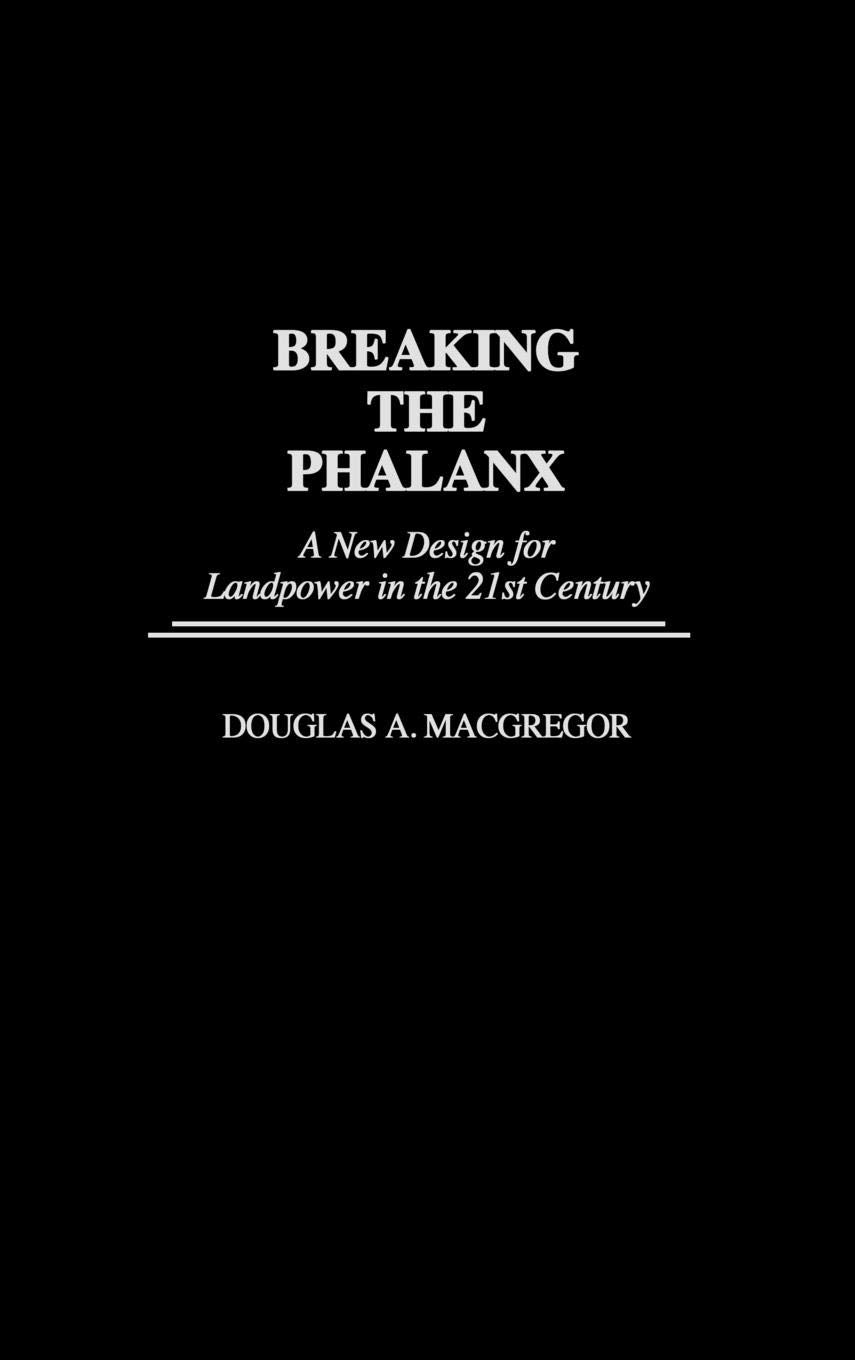
Breaking the Phalanx: A New Design for Landpower in the 21st Century (Bibliographies and Indexes in American),Used
Sold by Ergodebooks, an authorized reseller.
Returns accepted within 30 days | support@ergodebooks.com
Shipping Information
- Free Standard Shipping — United States only
- Processing Time: 3–5 business days
- Estimated Delivery: 6–10 business days after dispatch
- Double-boxed, fully insured & discreetly packaged
- Tracking number sent via email once dispatched
Returns & Refund
Returns accepted within 30 days of delivery.
Damaged or Defective Item
Free return shipping + replacement or full refund
Wrong Item Received
Free return shipping + replacement or full refund
Change of Mind
Return shipping at customer's expense · 25% restocking fee applies
Payment Option

This work proposes the reorganization of America's ground forces on the strategic, operational and tactical levels. Central to the proposal is the simple thesis that the U.S. Army must take control of its future by exploiting the emerging revolution in military affairs. The analysis argues that a new Army warfighting organization will not only be more deployable and effective in Joint operations; reorganized information age ground forces will be significantly less expensive to operate, maintain, and modernize than the Army's current Cold War divisionbased organizations. And while ground forces must be equipped with the newest Institute weapons, new technology will not fulfill its promise of shaping the battlefield to American advantage if new devices are merely grafted on to old organizations that are not specifically designed to exploit them. It is not enough to rely on the infusion of new, expensive technology into the American defense establishment to preserve America's strategic dominance in the next century. The work makes it clear that planes, ships, and missiles cannot do the job of defending America's global security issues alone. The United States must opt for reform and reorganization of the nation's ground forces and avoid repeating Britain's historic mistake of always fielding an effective army just in time to avoid defeat, but too late to deter an aggressor.
⚠️ WARNING (California Proposition 65):
This product may contain chemicals known to the State of California to cause cancer, birth defects, or other reproductive harm.
For more information, please visit www.P65Warnings.ca.gov.
- Q: What is the main thesis of 'Breaking the Phalanx'? A: The main thesis of 'Breaking the Phalanx' is that the U.S. Army must reorganize its ground forces to effectively exploit the emerging revolution in military affairs, ensuring they are more deployable, cost-effective, and capable of modern warfare.
- Q: How does this book propose to improve the effectiveness of the U.S. Army? A: The book proposes a new warfighting organization that focuses on reorganizing ground forces to be better suited for Joint operations, leveraging new technologies designed specifically for modern warfare.
- Q: What are the key themes discussed in the book? A: Key themes include military reform, the need for a modernized Army structure, and the importance of integrating new technologies rather than just adding them to existing outdated organizations.
- Q: Who is the author of 'Breaking the Phalanx'? A: The author of 'Breaking the Phalanx' is Douglas A. Macgregor, a military strategist and author.
- Q: What is the publication date of this book? A: The book was published on January 30, 1997.
- Q: How many pages does 'Breaking the Phalanx' have? A: The book contains 304 pages.
- Q: What type of binding does this book have? A: This edition of 'Breaking the Phalanx' is bound in hardcover.
- Q: Is there any special edition or unique features of this book? A: The book does not specify any special edition or unique features; it is presented as a standard hardcover publication.
- Q: What are the implications of the proposed Army reorganization in the book? A: The implications include a shift towards more effective defense strategies, reduced operational costs, and avoiding historical mistakes of military readiness.
- Q: Can this book be beneficial for military professionals or students? A: Yes, this book offers insights into military strategy and organizational reform, making it valuable for military professionals, strategists, and students of military science.