If you have any questions, you are always welcome to contact us. We'll get back to you as soon as possible, withing 24 hours on weekdays.
Customer service
All questions about your order, return and delivery must be sent to our customer service team by e-mail at yourstore@yourdomain.com
Sale & Press
If you are interested in selling our products, need more information about our brand or wish to make a collaboration, please contact us at press@yourdomain.com
Help
If you have any questions, you are always welcome to contact us. We'll get back to you as soon as possible, withing 24 hours on weekdays.
Customer service
All questions about your order, return and delivery must be sent to our customer service team by e-mail at yourstore@yourdomain.com
Sale & Press
If you are interested in selling our products, need more information about our brand or wish to make a collaboration, please contact us at press@yourdomain.com
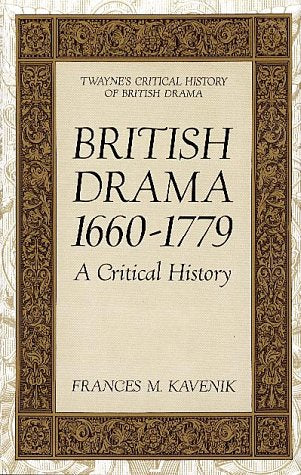
Product Description The development of this drama over 119 years is the subject of Frances M. Kavenik's British Drama, 16601779: A Critical History, a fascinating account of the people and events shaping the genre during the period. Approaching her subject from a popular culture perspective, Kavenik argues that the drama produced in these years was the most innovative since Shakespeare's time, giving rise to such forms as the musical and the situation comedy. A comprehensive first chapter describes the theaters, stage apparatus, playwrights, performers, audiences, and critics of the period, while four chronologically arranged chapters detail key developments during each subperiod. The Lincoln's Inn Fields and Drury Lane theaters, the Licensing Act of 1737, legendary figures like Nell Gwyn and David Garrick, the growth of the periodical press as a medium for dramatic criticism, the popularity of productions like John Gay's The Beggar's Opera and Aphra Behn's The Rover these and much more are brought vividly to life for readers, as is Kavenik's theme that 'late seventeenth and eighteenthcentury comedies, heroic plays, tragicomedies, and tragedies were the genre films and soap operas of their day, enthralling their audiences and speaking to their needs and desires, offering entertainment, excitement, and escape. They also were capable ... of creating or reforming their audiences' needs and desires.' About the Author Frances M. Kavenik is associate professor of English at the University of Wisconsin Parkside.
⚠️ WARNING (California Proposition 65):
This product may contain chemicals known to the State of California to cause cancer,
birth defects, or other reproductive harm.
For MAP (Minimum Advertised Price) violations and Intellectual Property (IP) or Trademark concerns, please contact:
support@ergodebooks.com
⚠️ California Proposition 65 Warning: Some products sold on this website may expose you to chemicals known to the State of California to cause cancer, birth defects, or other reproductive harm. For more information, visit www.P65Warnings.ca.gov.