
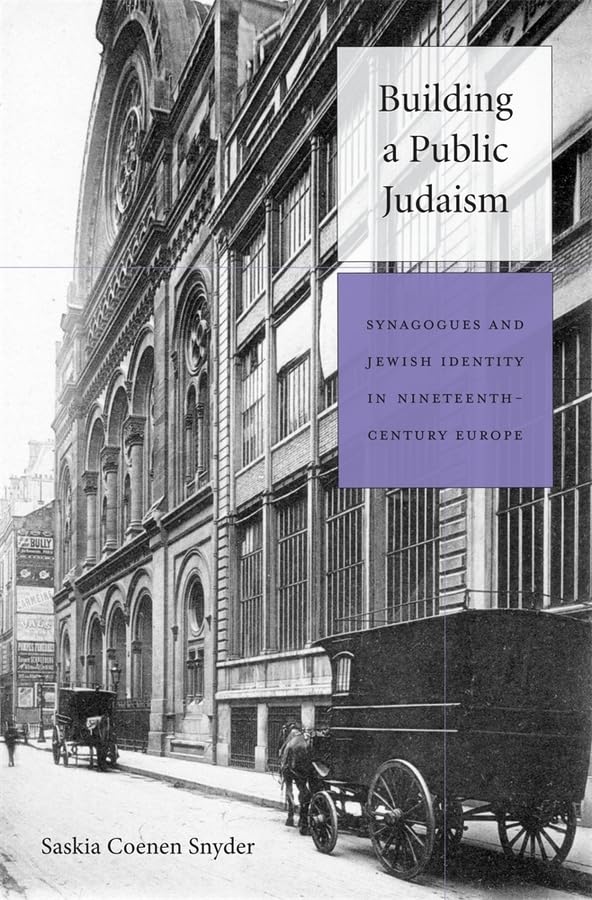
Title
Building a Public Judaism: Synagogues and Jewish Identity in NineteenthCentury Europe,Used
Sold by Ergodebooks, an authorized reseller.
Returns accepted within 30 days | support@ergodebooks.com
Shipping Information
- Free Standard Shipping — United States only
- Processing Time: 3–5 business days
- Estimated Delivery: 6–10 business days after dispatch
- Double-boxed, fully insured & discreetly packaged
- Tracking number sent via email once dispatched
Returns & Refund
Returns accepted within 30 days of delivery.
Damaged or Defective Item
Free return shipping + replacement or full refund
Wrong Item Received
Free return shipping + replacement or full refund
Change of Mind
Return shipping at customer's expense · 25% restocking fee applies
Payment Option

Nineteenthcentury Europe saw an unprecedented rise in the number of synagogues. Building a Public Judaism considers what their architecture and the circumstances surrounding their construction reveal about the social progress of modern European Jews. Looking at synagogues in four important centers of Jewish lifeLondon, Amsterdam, Paris, and BerlinSaskia Coenen Snyder argues that the process of claiming a Jewish space in European cities was a marker of acculturation but not of full acceptance. Whether modest or spectacular, these new edifices most often revealed the limits of European Jewish integration.Debates over building initiatives provide Coenen Snyder with a vehicle for gauging how Jews approached questions of selfrepresentation in predominantly Christian societies and how public manifestations of their identity were received. Synagogues fused the fundamentals of religion with the prevailing cultural codes in particular locales and served as aesthetic barometers for European Jewrys degree of modernization. Coenen Snyder finds that the dialogues surrounding synagogue construction varied significantly according to city. While the larger story is one of increasing selfagency in the public life of European Jews, it also highlights this agencys limitations, precisely in those places where Jews were thought to be most acculturated, namely in France and Germany.Building a Public Judaism grants the peculiarities of place greater authority than they have been given in shaping the European Jewish experience. At the same time, its placespecific description of tensions over religious tolerance continues to echo in debates about the public presence of religious minorities in contemporary Europe.
⚠️ WARNING (California Proposition 65):
This product may contain chemicals known to the State of California to cause cancer, birth defects, or other reproductive harm.
For more information, please visit www.P65Warnings.ca.gov.