
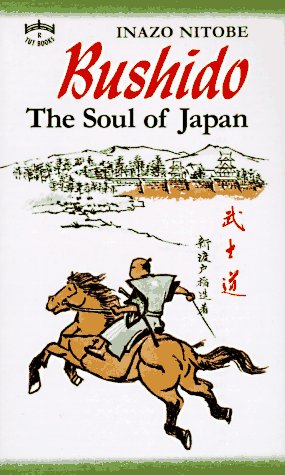
Title
Bushido: The Soul of Japan : An Exposition of Japanese Thought,New
Sold by Ergodebooks, an authorized reseller.
Returns accepted within 30 days | support@ergodebooks.com
Shipping Information
- Free Standard Shipping — United States only
- Processing Time: 3–5 business days
- Estimated Delivery: 6–10 business days after dispatch
- Double-boxed, fully insured & discreetly packaged
- Tracking number sent via email once dispatched
Returns & Refund
Returns accepted within 30 days of delivery.
Damaged or Defective Item
Free return shipping + replacement or full refund
Wrong Item Received
Free return shipping + replacement or full refund
Change of Mind
Return shipping at customer's expense · 25% restocking fee applies
Payment Option

Purchase of this book includes free trial access to www.millionbooks.com where you can read more than a million books for free. This is an OCR edition with typos. Excerpt from CHAPTER III RECTITUDE OR JUSTICE HERE we discern the most cogent precept in the code of the samurai. Nothing is more loathsome to him than underhand dealings and crooked undertakings. The conception of Rectitude may be erroneousit may be narrow. A well known bushi defines it as a power of resolution;'Rectitude is the power of deciding upon a certain course of conduct in accordance with reason, without wavering;to die when it is right to die, to strike when to strike is right.' Another speaks of it in the following ' Rectitude is the bone that gives firmness and stature. As without bones the head cannot rest on the top of the spine, nor hands move nor feet stand, so without rectitude neither talent nor learning can make of a human frame a samurai. With it the lack of accomplishments is as nothing.' Mencius calls Benevolence man's mind, and Rectitude or Righteousness his path. 'How lamentable,' he exclaims, 'is it to neglect the path and not pursue it, to lose the mind and not know to seek it again! When men's fowls and dogs are lost, they know to seek for them again, but they lose their mind and do not know to seek for it.' Have we not here 'as in a glass darkly' a parable propounded three hundred years later in another clime and by a greater Teacher, Who called Himself the Way of righteousness, through whom the lost could be found? But I stray from my point. Righteousness, according to Mencius, is a straight and narrow path which a man ought to take to regain the lost paradise. Even in the latter days of feudalism, when the long continuance of peace brought leisure into the life of the warrior class, and with it dissipations of all kinds and accomplishments of gentle arts, the epithet Gishi (a man of rectitude) was considered superior to anyname that signified ...
⚠️ WARNING (California Proposition 65):
This product may contain chemicals known to the State of California to cause cancer, birth defects, or other reproductive harm.
For more information, please visit www.P65Warnings.ca.gov.
- Q: How many pages does this book have? A: This book has two hundred four pages. It covers various aspects of Japanese thought and philosophy.
- Q: What is the binding type of this book? A: The binding type is paperback. This makes it lightweight and easy to handle.
- Q: What are the dimensions of this book? A: The dimensions are four point twenty-five inches in length, zero point fifty-one inches in width, and seven point twenty-five inches in height. These measurements make it portable and convenient for reading.
- Q: Who is the author of this book? A: The author is Inazo Nitobe. He was a prominent figure in Japanese literature and philosophy.
- Q: What is the genre of this book? A: The genre is philosophy. It delves into the ethical and moral values of the samurai.
- Q: Is this book suitable for beginners in philosophy? A: Yes, this book is suitable for beginners. It provides an accessible introduction to Japanese thought.
- Q: Can I read this book online? A: Yes, you can read this book online. Purchase includes free trial access to www.million-books.com for additional reading.
- Q: What themes are explored in this book? A: The book explores themes of justice, righteousness, and the moral code of the samurai. It reflects on the values and principles guiding Japanese culture.
- Q: Is this book appropriate for children? A: Yes, this book is generally appropriate for older children and teens. However, parental guidance is advisable for younger readers due to complex themes.
- Q: How should I care for this book? A: Keep the book in a dry, cool place. Avoid exposing it to direct sunlight to prevent fading.
- Q: What should I do if my book arrives damaged? A: If your book arrives damaged, contact the seller for a replacement or refund. Make sure to provide photos of the damage.
- Q: Does this book have any typos? A: Yes, this is an OCR edition with typos. Readers may notice some errors in the text.
- Q: Is this book part of a series? A: No, this book is not part of a series. It stands alone as an exposition of Japanese thought.
- Q: Can I find a summary of this book online? A: Yes, summaries and reviews are available online. Many websites provide insights into the book's themes and discussions.
- Q: Is this book available in other formats? A: Yes, this book may be available in other formats like hardcover or digital. Check with the publisher or retailers.