If you have any questions, you are always welcome to contact us. We'll get back to you as soon as possible, withing 24 hours on weekdays.
Customer service
All questions about your order, return and delivery must be sent to our customer service team by e-mail at yourstore@yourdomain.com
Sale & Press
If you are interested in selling our products, need more information about our brand or wish to make a collaboration, please contact us at press@yourdomain.com
Help
If you have any questions, you are always welcome to contact us. We'll get back to you as soon as possible, withing 24 hours on weekdays.
Customer service
All questions about your order, return and delivery must be sent to our customer service team by e-mail at yourstore@yourdomain.com
Sale & Press
If you are interested in selling our products, need more information about our brand or wish to make a collaboration, please contact us at press@yourdomain.com
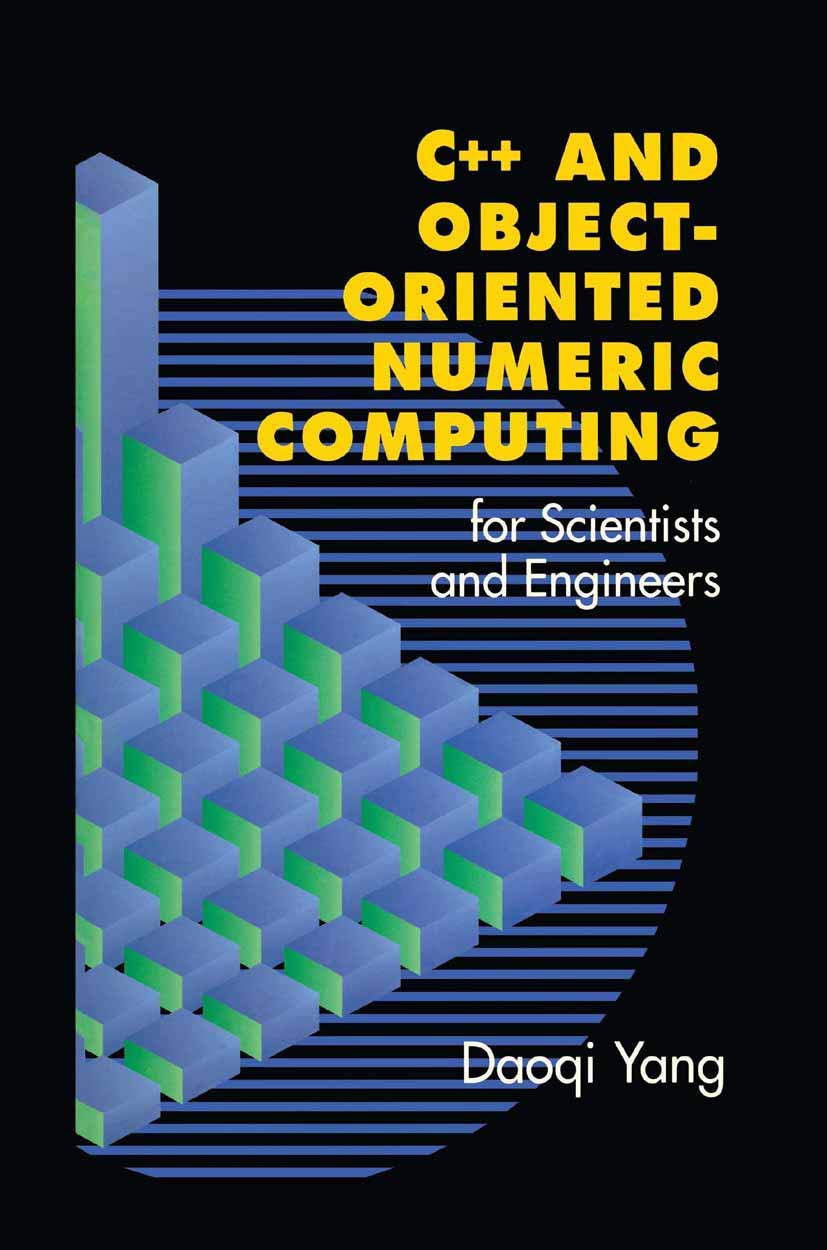
This book is intended to be an easy, concise, but rather complete, introduc the ISO/ANSI C++ programming language with special empha tion to sis on objectoriented numeric computation for students and professionals in science and engineering. The description of the language is platform independent. Thus it applies to different operating systems such as UNIX, Linux, MacOS, Windows, and DOS, as long as a standard C++ compiler is equipped. The prerequisite of this book is elementary knowledge of cal culus and linear algebra. However, this prerequisite is hardly necessary if this book is going to be used as a textbook for teaching C++ and all the sections on numeric methods are skipped. Programming experience in an other language such as FORTRAN, C, Ada, Pascal, Maple, or Matlab will certainly help, but is not presumed. All C++ features are introduced in an easy way through concepts such as functions, complex numbers, vectors, matrices, and integrals, which are familiar to every student and professional in science and engineering. In the final chapter, advanced features that are not found in FORTRAN, C, Ada, or Matlab, are illustrated in the context of iterative algorithms for linear systems such as the preconditioned conjugate gradient (CG) method and generalized minimum residual (GMRES) method. Knowledge of CG, GMRES, and preconditioning techniques is not presumed and they are ex plained in detail at the algorithmic level.
⚠️ WARNING (California Proposition 65):
This product may contain chemicals known to the State of California to cause cancer,
birth defects, or other reproductive harm.
For MAP (Minimum Advertised Price) violations and Intellectual Property (IP) or Trademark concerns, please contact:
support@ergodebooks.com
⚠️ California Proposition 65 Warning: Some products sold on this website may expose you to chemicals known to the State of California to cause cancer, birth defects, or other reproductive harm. For more information, visit www.P65Warnings.ca.gov.