
Title
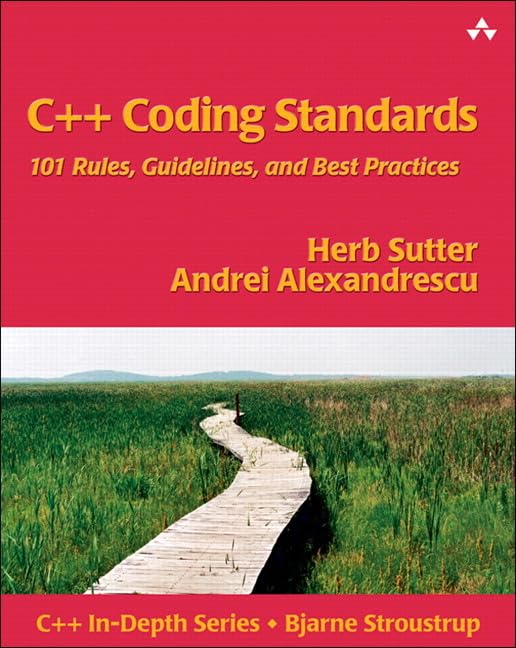
C++ Coding Standards: 101 Rules, Guidelines, and Best Practices,Used
Sold by Ergodebooks, an authorized reseller.
Returns accepted within 30 days | support@ergodebooks.com
Shipping Information
- Free Standard Shipping — United States only
- Processing Time: 3–5 business days
- Estimated Delivery: 6–10 business days after dispatch
- Double-boxed, fully insured & discreetly packaged
- Tracking number sent via email once dispatched
Returns & Refund
Returns accepted within 30 days of delivery.
Damaged or Defective Item
Free return shipping + replacement or full refund
Wrong Item Received
Free return shipping + replacement or full refund
Change of Mind
Return shipping at customer's expense · 25% restocking fee applies
Payment Option

Consistent, highquality coding standards improve software quality, reduce timetomarket, promote teamwork, eliminate time wasted on inconsequential matters, and simplify maintenance. Now, two of the world's most respected C++ experts distill the rich collective experience of the global C++ community into a set of coding standards that every developer and development team can understand and use as a basis for their own coding standards.The authors cover virtually every facet of C++ programming: design and coding style, functions, operators, class design, inheritance, construction/destruction, copying, assignment, namespaces, modules, templates, genericity, exceptions, STL containers and algorithms, and more. Each standard is described concisely, with practical examples. From type definition to error handling, this book presents C++ best practices, including some that have only recently been identified and standardizedtechniques you may not know even if you've used C++ for years. Along the way, you'll find answers to questions like What's worth standardizingand what isn't? What are the best ways to code for scalability? What are the elements of a rational error handling policy? How (and why) do you avoid unnecessary initialization, cyclic, and definitional dependencies? When (and how) should you use static and dynamic polymorphism together? How do you practice 'safe' overriding? When should you provide a nofail swap? Why and how should you prevent exceptions from propagating across module boundaries? Why shouldn't you write namespace declarations or directives in a header file? Why should you use STL vector and string instead of arrays? How do you choose the right STL search or sort algorithm? What rules should you follow to ensure typesafe code?Whether you're working alone or with others, C++ Coding Standards will help you write cleaner codeand write it faster, with fewer hassles and less frustration.
⚠️ WARNING (California Proposition 65):
This product may contain chemicals known to the State of California to cause cancer, birth defects, or other reproductive harm.
For more information, please visit www.P65Warnings.ca.gov.
- Q: What is the page count of the book? A: The book contains two hundred forty pages. This length provides a comprehensive overview of C++ coding standards and best practices.
- Q: What are the dimensions of this book? A: The book measures seven point two inches in length, nine point one inches in height, and zero point six inches in width. These dimensions make it portable and easy to handle.
- Q: What type of binding does this book have? A: The book is available in paperback binding. This makes it flexible and lightweight for readers.
- Q: How can I apply the coding standards in this book? A: You can apply the coding standards by using the guidelines and examples provided as a basis for your own projects. This helps ensure consistency and quality in your C++ coding practices.
- Q: Is this book suitable for beginners in C++? A: Yes, this book is suitable for beginners as well as experienced developers. It offers foundational knowledge while also addressing advanced topics.
- Q: What topics are covered in this book? A: The book covers topics such as design and coding style, class design, templates, and error handling. Each topic is detailed with practical examples.
- Q: How should I care for this book? A: To keep the book in good condition, store it in a dry place and avoid exposure to direct sunlight. Handle it gently to prevent creasing the pages.
- Q: Is there a warranty or return policy for this book? A: Yes, there is a return policy in place. If you're not satisfied with the book, you can return it within a specified period for a refund.
- Q: What if the book arrives damaged? A: If the book arrives damaged, you should contact customer support immediately. They will guide you through the return and replacement process.
- Q: Can I use the coding practices from this book in a team setting? A: Yes, the coding practices are designed to promote teamwork and consistency among development teams. They can be adopted as a standard for group projects.
- Q: Does this book discuss error handling techniques? A: Yes, the book includes sections on rational error handling policies and techniques. This is crucial for writing robust C++ applications.
- Q: Are there practical examples included in the book? A: Yes, the book provides practical examples alongside each coding standard. This helps readers understand how to implement the standards effectively.
- Q: Is there a focus on modern C++ practices? A: Yes, the book includes modern C++ practices and techniques that have been standardized recently. This makes it relevant for current development trends.
- Q: What is the author’s background? A: The author, Herb Sutter, is a well-respected expert in C++ programming. His extensive experience lends credibility to the content of the book.
- Q: Are there any additional resources recommended in the book? A: Yes, the book suggests additional resources for further learning and exploration of C++ standards and best practices.